

Clear Plastic Business Cards: Function, Limits, and Uses
Bold design choices are reshaping how American professionals present themselves, and clear plastic business cards are at the center of this shift. More than 60 percent of creative industry leaders say the look and feel of a business card shapes their first impression. Understanding the real benefits and debunking common myths about these transparent cards can help you decide if they truly reflect your brand’s innovative spirit and elevate your networking strategy.
Table of Contents
- Defining Clear Plastic Business Cards And Common Myths
- Material Properties And Visibility Considerations
- Design Constraints And Printing Limitations Explained
- Strategic Applications: Ideal Use Cases And Industries
- Who Should—And Should Not—Choose Clear Plastic
Key Takeaways
| Point | Details |
| Clear Plastic Cards Enhance Branding | They offer a unique visual and tactile experience, making them ideal for creative and technology-driven professionals. |
| Material Matters | PVC and polycarbonate have different visual and durability characteristics that affect their application. |
| Ideal Industries | Clear plastic business cards thrive in creative and tech fields but may not suit conservative or traditional sectors. |
| Strategic Design is Key | Understanding material properties, printing techniques, and audience expectations is crucial for effective use. |
Defining Clear Plastic Business Cards and Common Myths
Clear plastic business cards represent a sophisticated design approach that transforms traditional networking tools into transparent, visually striking personal branding statements. Unlike standard paper cards, these specialized cards leverage advanced material properties to create unique visual and tactile experiences.
At their core, clear plastic business cards are precision-engineered cards manufactured from polyvinyl chloride (PVC) or polycarbonate materials, engineered to provide exceptional translucency and durability. Transparent plastic business cards represent more than a mere design choice - they signal a deliberate approach to professional presentation that communicates sophistication and innovative thinking.
Common myths about clear plastic business cards often misrepresent their functionality and potential. Many professionals mistakenly believe these cards are fragile, prohibitively expensive, or challenging to design. In reality, high-quality clear plastic cards can withstand significant handling, offer precise printing capabilities, and provide a memorable first impression that standard paper cards cannot match. The material’s inherent properties allow for intricate design details, precise color reproduction, and a distinctive translucent aesthetic that captures attention.
While clear plastic business cards excel in certain professional contexts, they are not universally optimal. Industries emphasizing traditional craftsmanship or those with conservative design expectations might find these cards too avant-garde. Design success depends on understanding your specific professional environment and brand positioning.
Pro Design Tip: Approach clear plastic business card design strategically by considering your industry, target audience, and personal brand narrative. Select materials and design elements that communicate your professional identity authentically and memorably.
Material Properties and Visibility Considerations
Polyvinyl chloride (PVC) and polycarbonate serve as the primary material foundations for clear plastic business cards, each offering distinct performance characteristics that significantly impact visual presentation and durability. Understanding these material properties is crucial for designing effective transparent business communication tools.
The fundamental challenge with clear plastic business cards lies in their complex visibility dynamics. Unlike traditional paper cards, transparent materials interact with light differently, creating unique design constraints and opportunities. Thickness typically ranges between 0.3mm to 0.76mm, with thinner variants offering greater flexibility and translucency, while thicker options provide enhanced structural integrity.

Visibility considerations extend beyond mere transparency. Different printing techniques like silk screen, digital UV printing, and offset printing produce dramatically different visual results on clear plastic. White ink underlays become critical for ensuring legibility, as text and graphics must contrast effectively against the transparent background. Color saturation, opacity, and light refraction play intricate roles in determining how design elements will ultimately appear.
Material performance metrics include critical factors such as scratch resistance, bend tolerance, water resistance, and long-term dimensional stability. Professional-grade clear plastic business cards must withstand repeated handling, maintain crisp printed details, and resist environmental degradation without compromising their sophisticated aesthetic.
Pro Material Selection Tip: Always request material samples and conduct thorough durability testing before finalizing your clear plastic business card design, ensuring the selected material perfectly matches your professional presentation requirements and environmental conditions.
Here’s how the two main clear plastic card materials differ:
| Material | Visual Qualities | Durability Factors | Typical Business Use |
| PVC | Slightly softer translucency | Good scratch and bend resistance | Everyday professional cards |
| Polycarbonate | High clarity, more rigid | Superior impact and heat resistance | Premium or specialty cards |
Design Constraints and Printing Limitations Explained
Designing clear plastic business cards demands an advanced understanding of complex printing challenges that fundamentally differ from traditional paper-based card production. The transparent material introduces unique constraints that require specialized technical expertise and precise design strategies to overcome inherent visibility and printing limitations.
Letterpress business card techniques demonstrate that printing on clear plastic requires meticulously calibrated approaches. Critical design constraints emerge from several key technical factors: material translucency, ink adhesion, color opacity, and light refraction. Standard printing methods like offset or digital printing cannot be directly applied without significant modifications.
Printing limitations manifest through multiple technical challenges. Color reproduction becomes particularly complex, as transparent surfaces interact differently with light compared to opaque materials. White ink underlays become essential for ensuring visual legibility, acting as a critical foundation layer that prevents design elements from appearing washed out or indistinct. Designers must carefully consider color saturation, ink thickness, and precise registration to achieve optimal visual clarity.
Material-specific constraints further complicate the design process. Plastic surfaces require specialized surface treatments to ensure ink adhesion, prevent smudging, and maintain long-term durability. Designers must select printing techniques like silk screen, UV digital printing, or specialized thermal transfer methods that can effectively bond with the plastic substrate while preserving intricate design details.
Pro Design Optimization Tip: Collaborate directly with specialized printing professionals who understand clear plastic card production, and always request comprehensive material and print samples to validate your design’s visual and structural integrity before final production.
Strategic Applications: Ideal Use Cases and Industries
Clear plastic business cards represent a sophisticated branding tool with targeted applications across specific professional domains. Strategic implementation requires a nuanced understanding of how these unique communication instruments can elevate professional positioning and create memorable first impressions.
Creative industries emerge as prime candidates for white printing on transparent materials, particularly for professionals whose work demands visual innovation. Graphic designers, photographers, digital artists, and architectural firms can leverage the transparent medium to showcase their design sensibilities. The card itself becomes a miniature canvas that demonstrates technical skill, material understanding, and creative problem-solving.
Technology, design, and innovation-driven sectors present optimal environments for clear plastic business cards. Startup founders in advanced technology, product design, digital marketing, and user experience fields can utilize these cards as tangible representations of their forward-thinking approaches. The transparent medium subtly communicates technological sophistication, suggesting a professional who understands cutting-edge communication strategies and values precision engineering.
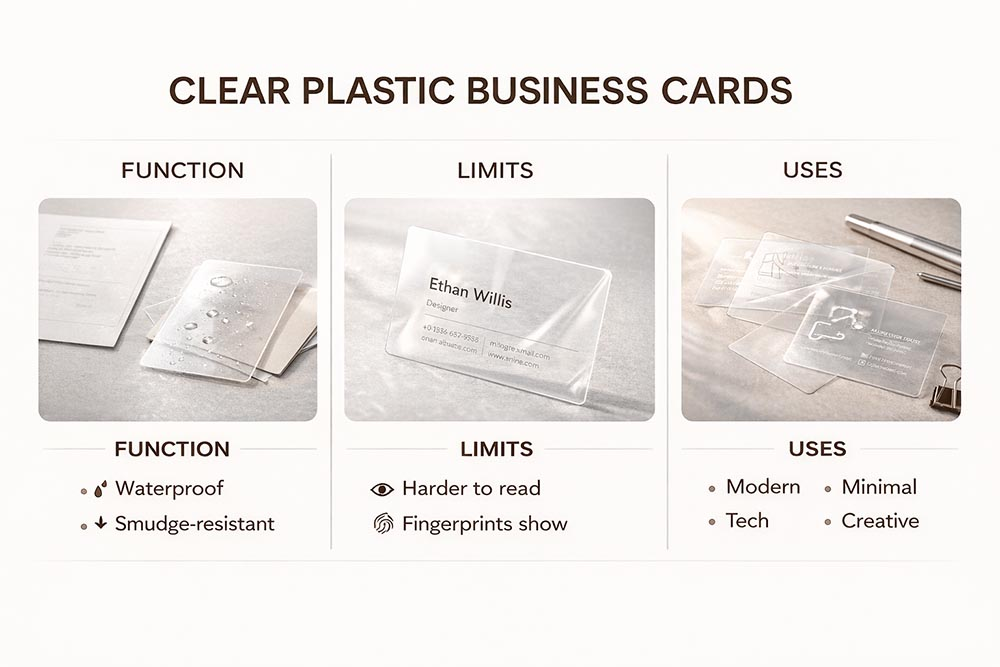
Strategic limitations exist alongside opportunities. Industries emphasizing traditional corporate communication or those with conservative professional cultures may find clear plastic cards too experimental. Financial services, legal practices, and traditional manufacturing sectors typically prefer standard paper-based cards that align with established professional communication norms. Successful implementation depends on carefully reading professional context and audience expectations.
Pro Targeting Tip: Conduct audience research to determine whether your specific professional ecosystem will appreciate and recognize the strategic communication value of a transparent business card before investing in production.
Who Should—and Should Not—Choose Clear Plastic
Professional positioning requires strategic material selection that communicates brand identity effectively. Clear plastic business cards represent a sophisticated communication tool, but they are not universally appropriate for every professional context or industry sector.
Plastic business card durability makes them particularly compelling for professionals in dynamic, innovation-driven fields. Ideal candidates include technology entrepreneurs, creative professionals, design-focused industries, and forward-thinking service providers. Graphic designers, digital artists, architectural firms, user experience specialists, product designers, and startup founders can leverage these cards to demonstrate technical sophistication and creative problem-solving capabilities.
Conversely, certain professional environments demand more conservative communication strategies. Financial services, traditional legal practices, government agencies, and manufacturing sectors typically prioritize conventional communication tools. These industries often interpret experimental design choices as potential indicators of unprofessionalism or lack of established credibility. The transparent medium might be perceived as experimental rather than strategic in these more traditional professional ecosystems.
Beyond industry classification, individual brand positioning plays a critical role in determining clear plastic card suitability. Professionals must conduct thorough audience analysis, considering client expectations, cultural norms, and specific communication objectives. The card should function as an extension of personal or organizational brand narrative, not as a disruptive element that potentially alienates potential connections.
This table highlights professions where clear plastic cards thrive versus where they may backfire:
| Professional Segment | Clear Card Effectiveness | Branding Message Communicated |
| Creative/Design Industries | Highly effective | Innovative, forward-thinking image |
| Technology Startups | Distinct advantage | Tech-savvy, modern branding |
| Legal/Finance Sector | Often ill-advised | May appear unorthodox |
| Traditional Manufacturing | Rarely suitable | Could undermine professionalism |
Pro Selection Tip: Conduct targeted audience research and request prototype samples to validate whether clear plastic business cards will enhance or potentially undermine your professional positioning within your specific industry ecosystem.
Elevate Your Professional Image with Clear Plastic Business Cards
Navigating the challenges of translucency and printing complexity in clear plastic business cards requires expert craftsmanship and design insight. At BcardsCreation, we understand the importance of overcoming visibility limitations and material constraints to create a card that truly reflects your innovative brand identity. Whether you are in a creative field or a forward-thinking technology startup, our Clear Plastic Business Cards deliver unmatched sophistication and durability tailored to your specific needs.
Take the first step toward transforming your networking impact today. Explore our fully custom solutions at BcardsCreation, and experience the difference of personalized consultation combined with expert production. Discover how our Plastic Business Cards and specialized White Plastic Business Cards can help you stand out with a strategic and elegant design. Act now to secure a premium business card that embodies your brand’s vision and creates lasting impressions.
Frequently Asked Questions
What are clear plastic business cards made of?
Clear plastic business cards are primarily made from materials like polyvinyl chloride (PVC) or polycarbonate, providing durability and translucency that differentiates them from standard paper cards.
Are clear plastic business cards durable?
Yes, high-quality clear plastic business cards are designed to withstand significant handling and environmental conditions, making them more durable than traditional paper cards.
What printing techniques are used for clear plastic business cards?
Printing on clear plastic cards often involves specialized techniques such as silk screen, UV digital printing, or thermal transfer, which accommodate the unique visibility and adhesion challenges of transparent materials.
In which industries are clear plastic business cards most effective?
Clear plastic business cards are particularly effective in creative industries, technology startups, and design-focused sectors, where their unique visual qualities can enhance branding and professional presentation.
Recommended
- Acrylic Card Holder | Personalized Business Card Holder for Desk – BcardsCreation
- Diamond Business Cards | Frosted Plastic | Custom shape card – BcardsCreation
- Custom Shape option for ordered Business Cards Add-on listing – BcardsCreation
- Fine Paper Double layered Business Card with Neon and Purple Foils, Th – BcardsCreation


