

What Is the Standard Business Card Size—and Why It Matters
Nearly every American professional knows the impact of a well-designed business card during first impressions, but few realize that over 90 percent of business cards in the USA follow a standard 3.5 by 2 inch size. For luxury brand owners and creative professionals, this small detail separates effective branding from missed opportunities. Understanding the standard American business card size empowers you to craft designs that communicate refinement while ensuring compatibility with client expectations and high-end presentation.
Table of Contents
- Defining Standard Business Card Size In The USA
- Why Standard Card Sizes Became The Norm
- US And EU Standards Versus Custom Dimensions
- When To Choose Standard Or Go Custom
- Practical Impacts: Wallets, Holders, And Brand Experience
Key Takeaways
| Point | Details |
|---|---|
| Standard Size is 3.5 x 2 inches | This size ensures compatibility with wallets and standard cardholders, facilitating easy exchange during networking. |
| Custom Sizes Offer Unique Branding | While custom dimensions can stand out, they may lead to higher costs and storage issues, requiring careful consideration. |
| Standardization Enhances Professionalism | Adhering to standard sizes signals reliability and professionalism in traditional industries. |
| Testing is Crucial for Design | Before deciding on a card design, conduct usability tests to ensure it fits well in common storage systems and resonates with intended recipients. |
Defining Standard Business Card Size in the USA
In the professional world of business communications, understanding the standard business card size is more than a trivial detail - it’s a fundamental aspect of creating effective professional branding. The United States has established a consistent sizing standard that ensures maximum utility and compatibility across various contexts.
According to standard identification card specifications, the typical business card measures 3.5 inches by 2 inches, which closely aligns with credit card dimensions. This precise sizing enables seamless integration into wallets, cardholders, and professional organizational systems. The standard dimensions provide enough space for critical contact information while maintaining a compact, portable format that professionals can easily carry and exchange.
The consistency in business card sizing is not arbitrary. These specific measurements - 3.5 x 2 inches - have been carefully developed to balance visual presentation with practical functionality. Card sizing standards ensure that business cards can be uniformly stored, scanned, and processed across different industries and professional environments. The standardized approach minimizes friction in networking and information exchange, allowing professionals to focus on building connections rather than managing inconsistent card formats.
Professional Pro-Tip: When designing your business card, always design with the standard 3.5 x 2 inch dimension in mind to guarantee maximum compatibility and professional presentation.
Why Standard Card Sizes Became the Norm
The evolution of business cards is a fascinating journey that reflects broader shifts in professional communication and technological innovation. What began as an aristocratic practice in 17th-century Europe transformed into a critical networking tool, with standardization emerging as a key factor in their widespread adoption.
The history of business card sizing reveals a pragmatic approach to professional communication. Initially, visiting cards among European nobility were personalized and varied in size. However, as business networking expanded, the need for consistent, practical dimensions became apparent. The standard size was not just an arbitrary choice, but a deliberate strategy to ensure maximum utility and ease of exchange across different professional contexts.
Printing and design considerations played a significant role in solidifying these standard dimensions. Manufacturers discovered that uniform sizes dramatically reduced production costs, simplified printing processes, and created a predictable template for designers. The 3.5 x 2 inch format became a universal language of professional introduction, allowing cards to seamlessly fit into wallets, cardholders, and digital scanning systems. This standardization eliminated friction in networking, making information exchange more efficient and streamlined.
Professional Pro-Tip: When selecting a business card design, prioritize standard sizing to ensure your professional materials remain universally accessible and functional across different networking environments.
US and EU Standards Versus Custom Dimensions
Understanding the nuanced differences between business card sizing standards reveals the complex interplay between regional practices, functional design, and professional communication protocols. While standardization might seem mundane, it represents a critical aspect of global business interaction that transcends mere paper dimensions.
Business card dimensional variations highlight fascinating regional differences in professional communication standards. In the United States, the standard business card measures 3.5 inches by 2 inches, meticulously designed for seamless wallet integration and universal compatibility. European standards, by contrast, slightly diverge with cards measuring 85 mm by 55 mm - a dimension more closely aligned with European credit card specifications. These subtle variations reflect deeper cultural approaches to professional networking and design philosophy.
Custom business card dimensions present an intriguing alternative to standard sizing, offering brands an opportunity to stand out visually. However, this creative approach comes with significant practical considerations. Non-standard sizes often incur higher printing costs, potentially compromise card storage compatibility, and may create subtle friction during networking exchanges. While unique dimensions can communicate creativity and brand distinctiveness, professionals must carefully weigh aesthetic innovation against functional utility. The potential visual impact must be balanced against potential inconvenience to recipients who expect familiar, easily storable card formats.
Professional Pro-Tip: When considering custom business card dimensions, conduct a practical test by creating a prototype and asking trusted colleagues how it fits into their existing card storage systems.
Here’s how US and EU business card standards compare to custom options:
| Aspect | US Standard (3.5 x 2 in) | EU Standard (85 x 55 mm) | Custom Dimensions |
|---|---|---|---|
| Storage Compatibility | Fits most US wallets | Fits EU wallets, holders | May not fit common holders |
| Printing Costs | Most cost-effective | Slightly higher regionally | Often higher, variable |
| Design Flexibility | Limited by standard | Slight regional flexibility | Highly flexible, unique |
| Professional Perception | Conventional, reliable | Regionally accepted | Creative, memorable |
When to Choose Standard or Go Custom
The decision between standard and custom business card dimensions is more than a simple design choice - it’s a strategic communication decision that reflects a brand’s professional identity and networking approach. Every business must carefully evaluate their specific context, target audience, and communication objectives when selecting a card format.
Business card sizing strategies reveal nuanced considerations that extend beyond mere aesthetic preferences. Standard sizes offer predictable advantages: cost-effectiveness, universal compatibility, and immediate recognition. They seamlessly integrate into professional exchange systems, meeting established client expectations without creating unnecessary friction. Professionals in traditional industries like finance, law, and consulting typically benefit most from adhering to conventional dimensions, where conformity signals reliability and established credibility.
Custom card dimensions become compelling when a brand seeks to make a distinctive visual statement or targets a specific niche market. Creative industries such as design, marketing, and technology often leverage unique card formats to demonstrate innovation and break traditional communication boundaries. However, this creative approach demands careful execution. The custom card must balance visual distinctiveness with practical usability - a challenging design objective that requires sophisticated understanding of both graphic design principles and professional networking dynamics. Unique shapes or sizes can communicate brand personality, but they must not compromise the fundamental purpose of efficient information exchange.
Professional Pro-Tip: Before committing to a custom business card design, create multiple prototypes and conduct an informal focus group with trusted professional contacts to gauge their practical and emotional response.
The following summarizes key business impacts of choosing standard versus custom business card sizes:
| Choice | Networking Ease | Brand Recognition | Risk of Being Overlooked |
|---|---|---|---|
| Standard Size | Instant, seamless | Recognizable presentation | Low |
| Custom Size | May hinder interaction | Stands out visually | Moderate to high |
Practical Impacts: Wallets, Holders, and Brand Experience
Business cards are more than just printed contact information - they are tactile representations of professional identity that must navigate complex physical and psychological spaces of networking interactions. The seemingly mundane dimensions of a business card carry profound implications for brand perception and practical usability.
Business card sizing considerations reveal intricate connections between physical design and brand experience. Standard card sizes like 3.5 x 2 inches are meticulously engineered to provide optimal functionality, ensuring seamless integration into wallets, cardholders, and professional organizational systems. This precision matters more than most professionals realize - a card that fails to fit smoothly into standard storage solutions risks being discarded or forgotten, effectively nullifying its primary networking purpose.
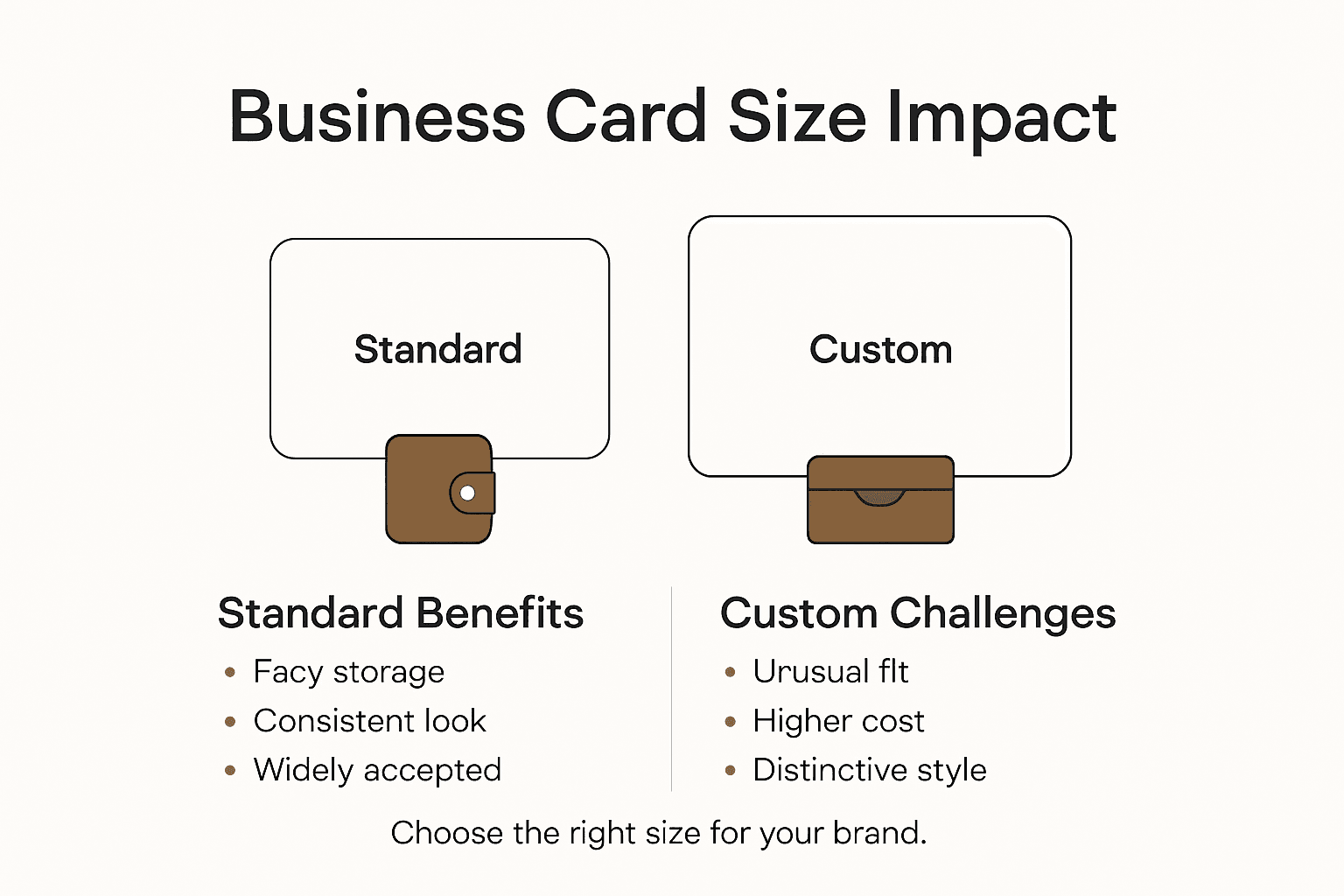
Practical dimensions and user experience demonstrate how seemingly minor design choices dramatically impact brand retention. A well-designed business card that slides effortlessly into a wallet communicates professionalism through its very physicality. Conversely, an oddly sized card creates subtle friction, forcing recipients to make inconvenient decisions about storage and preservation. The card’s dimensions become a silent communicator of a brand’s understanding of professional convenience and thoughtful design.
Professional Pro-Tip: Test your business card design by asking several professionals to physically interact with it, observing how naturally it fits into their existing card storage systems.
Elevate Your Professional Image with the Perfect Business Card Size
Understanding the importance of the standard business card size is crucial to making a lasting impression without sacrificing practicality. As the article highlights, the perfect dimensions ensure your card fits easily into wallets and cardholders while delivering your contact details clearly and professionally. But what if you could combine this essential sizing wisdom with bespoke design and premium materials to truly set your brand apart?
Discover how Business Cards – BcardsCreation help you balance standard dimensions with high-impact personalization. Whether you want traditional elegance or innovative flair, our expert team crafts each card without templates or automated shortcuts. For those eager to make a bolder statement, explore our Custom Shaped Business Cards – BcardsCreation option that blends creativity with thoughtful usability.
Don’t let your business card be just another standard piece of paper. Visit BcardsCreation now to experience premium design-driven solutions tailored to your professional needs. Act today to secure a uniquely memorable card that fits perfectly in every wallet and every opportunity.
Frequently Asked Questions
What is the standard size of a business card?
The standard size of a business card is 3.5 inches by 2 inches, closely resembling credit card dimensions. This size is designed for easy storage in wallets and cardholders.
Why is the standard business card size important?
The standard size ensures compatibility across various professional contexts, allowing for seamless storage, scanning, and exchange, which minimizes friction in networking.
What are the implications of using custom business card dimensions?
While custom dimensions allow for creativity and brand distinctiveness, they may incur higher printing costs and can cause compatibility issues with common card storage systems, potentially hindering networking effectiveness.
How does the size of a business card affect professional perception?
A standard size business card conveys professionalism and reliability, while custom designs can make a memorable impression; however, unconventional sizes may increase the risk of being overlooked during networking exchanges.
Recommended
- Acrylic Card Holder | Personalized Business Card Holder for Desk – BcardsCreation
- Diamond Business Cards | Frosted Plastic | Custom shape card – BcardsCreation
- Letterpress Business Card with full color print and real foil Rose Gol – BcardsCreation
- Thick WHITE VELVET Multilayer Business cards Blind Debossing – BcardsCreation


