

Recycled Business Card Paper: What It Is and Why It Matters
TL;DR:
- Recycled business card paper is made from recovered fibers, primarily post-consumer waste, and is essential for sustainability claims. The actual environmental value depends on the percentage of post-consumer recycled content, which must be verified through documentation and certifications. Designing on uncoated recycled stock requires careful consideration of colors, typography, and proofing to achieve high-quality results.
Recycled business card paper is paper stock made from recovered fibers, primarily post-consumer waste, processed and formed into card-weight sheets suitable for professional printing. Understanding what is recycled business card paper means knowing the difference between post-consumer recycled (PCR) content and pre-consumer recycled content. That distinction determines both the environmental impact and the credibility of your sustainability claims. Brands like VistaPrint offer recycled matte card options, and studios like Bcardscreation work with verified recycled stocks for custom small-batch production. Choosing the right material starts with understanding what “recycled” actually means on the spec sheet.

What is recycled business card paper and how is it made?
Recycled business card paper is defined as card stock manufactured from paper fibers recovered after consumer or industrial use, rather than from virgin wood pulp. The industry term for the highest-quality version is 100% post-consumer recycled (PCR) paper. Post-consumer recycled content represents fiber diverted directly from consumer waste streams, such as office paper, newspapers, and cardboard collected through municipal recycling programs. Pre-consumer content, by contrast, comes from manufacturing scraps and trim waste that never reached a consumer. The environmental value of PCR content is significantly higher because it diverts material that would otherwise enter a landfill.
The manufacturing process follows a defined sequence. Paper recycling involves collection, sorting, repulping, cleaning, deinking, and sheet formation to produce new paper. Here is how each step works in practice:
- Collection and sorting. Recovered paper is gathered and sorted by grade. Contaminated or non-paper materials are removed at this stage.
- Repulping. Sorted paper is mixed with water in a pulper, breaking it down into a slurry of individual fibers.
- Cleaning and screening. The slurry passes through screens and centrifugal cleaners to remove staples, adhesives, and other contaminants.
- Deinking. Inks and coatings are stripped from the fiber using flotation or washing processes. This step directly affects the brightness and cleanliness of the final sheet.
- Sheet formation. The cleaned fiber slurry is spread onto a moving wire mesh, drained, pressed, and dried into paper rolls or sheets.
Fiber length degrades with each recycling cycle. Fiber degradation limits set practical ceilings on brightness, opacity, and strength for recycled paper stocks. This is why most recycled business card paper blends recovered fiber with a small percentage of virgin or long-fiber pulp to maintain structural integrity.
Pro Tip: Ask your printer or studio for the exact PCR percentage on the spec sheet, not just a general “recycled” label. A card described as “recycled” may contain as little as 10% post-consumer fiber.
How does recycled content percentage affect quality and sustainability?
Not all recycled paper carries the same environmental weight. The percentage and type of recycled content determine both the sustainability credentials and the physical characteristics of the finished card stock.
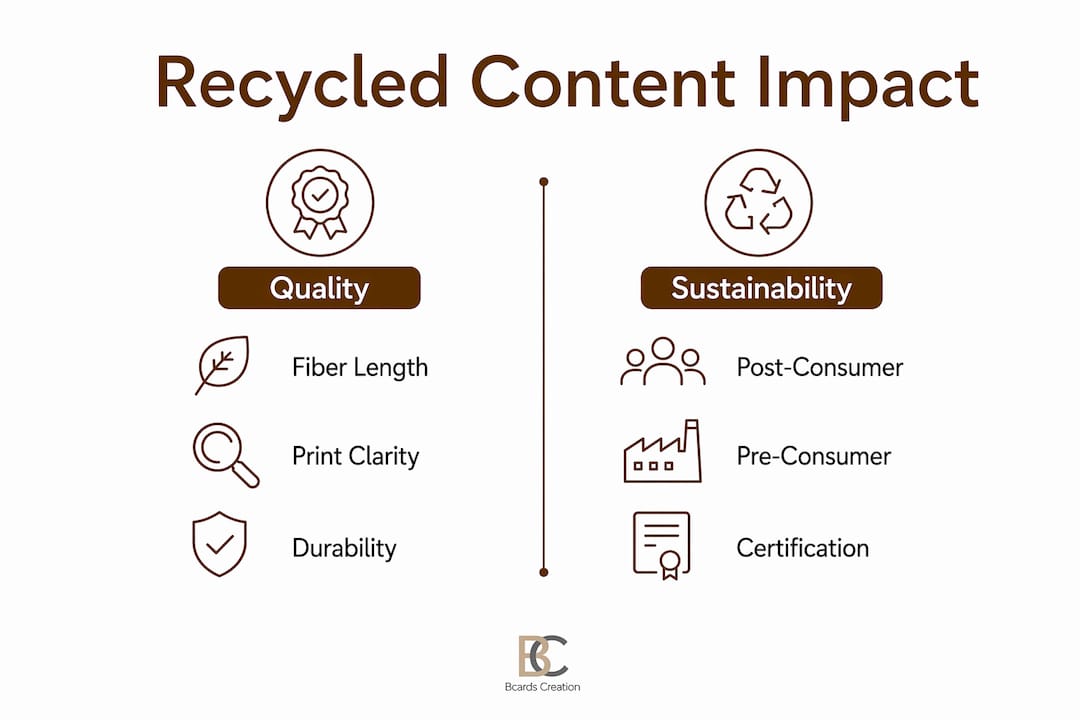
| Content Type | Environmental Impact | Print Quality Implications |
|---|---|---|
| 100% Post-Consumer Recycled | Highest: diverts consumer waste directly | Softer texture, slight color variation, matte-friendly |
| Mixed Recycled (PCR + Pre-Consumer) | Moderate: partial waste diversion | More consistent brightness, better opacity |
| Pre-Consumer Only | Lower: manufacturing scraps, not landfill diversion | Closer to virgin paper in appearance |
| Virgin Paper with FSC Certification | Responsible sourcing, no waste diversion | Highest brightness and consistency |
100% PCR paper is the strongest recycled-content claim available. Any paper that blends pre-consumer fiber cannot be labeled 100% recycled without specifying the post-consumer share. That distinction matters for corporate social responsibility reporting and for avoiding greenwashing.
Vague recycled claims create real risk. Transparency in recycled claims is critical to maintaining brand reputation among eco-conscious consumers. If your business card vendor cannot tell you the exact PCR percentage, that is a red flag. Sustainability auditors and procurement teams increasingly require documented fiber sourcing, not marketing language.
FSC certification adds a complementary layer of assurance. FSC-certified recycled paper ensures responsible forest management practices in the supply chain, even when the paper itself contains recycled fiber. FSC and PCR content are separate credentials. A card can carry both, and for brands with formal ESG commitments, both matter.
Pro Tip: When reviewing supplier specs, look for ISO 14021 compliance. That standard governs environmental labeling claims, including recycled content, and gives you a defensible basis for your sustainability communications.
What design and print choices work best on recycled paper?
Recycled paper stock behaves differently from coated or virgin card stock. Knowing those differences before you finalize artwork saves time and prevents disappointing results.
Uncoated, matte recycled business card paper is the preferred surface for eco-friendly cards because it is writeable, absorbs ink well, and aligns with recycling expectations. The shine-free surface supports muted, earthy design palettes and gives the card a tactile quality that feels intentional rather than budget-driven. That texture is a feature, not a limitation.
Key design considerations for recycled card stock:
- Color palette. Saturated neons and ultra-bright whites rarely perform well on recycled stock. Earthy tones, deep neutrals, and muted palettes print more accurately and complement the natural fiber appearance.
- Typography. Use clean, bold typefaces at readable sizes. Fine serif details and hairline strokes can lose definition on softer, more absorbent surfaces.
- Image use. Avoid photographic images with subtle gradients or fine shadow detail. Flat graphics, icons, and solid color blocks reproduce with far more reliability.
- Ink coverage. Heavy solid ink coverage on both sides can cause warping on lighter recycled stocks. Balance coverage across the card or choose a heavier card weight to compensate.
- Proofing. Always proof on the exact recycled stock you plan to use. Fiber variability in recycled paper affects opacity and print sharpness in ways that a standard digital proof will not reveal.
For guidance on achieving strong results with uncoated stocks, the Bcardscreation article on digital printing for business cards covers ink behavior and color management in practical detail.
The organic variation in recycled paper is also a design asset. Slight mottling, natural off-white tones, and visible fiber texture communicate authenticity. Brands in wellness, architecture, consulting, and sustainability-focused sectors often find that recycled card stock reinforces their positioning more effectively than a glossy coated alternative ever could.
What are the real benefits of recycled business cards?
The benefits of recycled business cards extend beyond the environmental. They function as a tangible signal of brand values at the moment of introduction.
Environmental advantages are concrete and documentable:
- Recycled paper production uses less water and energy than virgin paper manufacturing.
- Recycling keeps carbon locked within paper products rather than releasing it into the atmosphere through decomposition or incineration.
- Choosing recycled card stock diverts paper from landfill and supports circular economy infrastructure.
Brand perception advantages are equally significant. Eco-conscious consumers and business partners notice material choices. A card printed on verified 100% PCR stock, with clear sourcing credentials, communicates that your sustainability commitments are operational, not decorative. That specificity matters. Vague claims like “eco-friendly” without supporting detail are increasingly dismissed by informed audiences.
Recycled business cards also fit naturally into broader ESG frameworks. If your organization tracks Scope 3 emissions or reports on sustainable procurement, documented use of PCR paper stock contributes to those metrics. The card becomes part of the evidence base, not just a marketing gesture.
For a broader view of what makes a business card genuinely sustainable versus what is simply marketed as such, the Bcardscreation guide on sustainable business cards is worth reading before you finalize your material choice.
Pro Tip: Request a material data sheet from your printer that documents the PCR percentage, FSC certification status, and any relevant ISO compliance. Keep it on file for sustainability reporting.
Key takeaways
Recycled business card paper delivers genuine environmental value only when the post-consumer recycled content percentage is verified, documented, and reflected in your design choices.
| Point | Details |
|---|---|
| PCR content is the key metric | Post-consumer recycled fiber diverts consumer waste; pre-consumer fiber does not carry the same environmental weight. |
| Verify exact percentages | Ask suppliers for documented PCR percentages and ISO 14021 compliance, not just a “recycled” label. |
| Design for the material | Use muted palettes, bold type, and flat graphics; proof on the actual stock before full production. |
| FSC and PCR are separate credentials | A card can carry both; for ESG reporting, both matter and should be documented. |
| Recycled cards signal brand values | Verified recycled stock communicates operational sustainability at the moment of introduction. |
What i’ve learned working with recycled paper stocks
Working with recycled business card paper long enough teaches you one thing fast: the word “recycled” on a spec sheet means almost nothing without the percentage behind it. I have seen clients come in proud of their “eco-friendly” cards only to discover the stock was 20% post-consumer fiber blended with pre-consumer scraps. Technically recycled. Practically, not much of a sustainability story.
The other mistake I see regularly is treating recycled paper as a compromise. It is not. The texture, the warmth, the way a well-designed card feels in your hand on a quality recycled stock is genuinely distinctive. But you have to design for it. Artwork built for coated gloss stock will look flat and muddy on uncoated recycled paper. The material has its own logic, and the best results come from working with that logic rather than against it.
My honest recommendation: before you commit to a recycled stock for a full print run, request a physical sample printed on that exact paper. Not a generic sample pack. Your artwork, your colors, on the stock you plan to use. That one step eliminates most of the disappointment I have seen from clients who assumed recycled paper would behave like everything else. It will not. And once you understand that, it becomes one of the most rewarding materials to work with.
— Kostiantyn
Custom recycled business cards from Bcardscreation
Bcardscreation works with verified recycled paper stocks for fully custom, small-batch business card production. Every project starts with a material consultation, so you know exactly what PCR percentage you are working with and how to design for it.
If you want cards that carry real sustainability credentials and look the part, Bcardscreation handles the full process: stock selection, design development, and production oversight. No templates, no automated editors. You can start with custom business card design and specify recycled paper as part of your brief. For brands that want to explore the full range of luxury business card materials, including recycled options alongside specialty papers and finishes, that resource covers the decision logic in full.
FAQ
What does “post-consumer recycled” mean on a business card?
Post-consumer recycled (PCR) content means the paper fiber was recovered from materials consumers already used and discarded, such as office paper or cardboard collected through recycling programs. It is the strongest recycled-content claim because it directly diverts waste from landfill.
Is 100% recycled paper good enough for professional business cards?
Yes, provided you design for the material. Uncoated, matte recycled stocks print well with bold type, flat graphics, and muted color palettes. Fine detail and photographic images require careful proofing to achieve acceptable results.
How do i verify that my business card paper is genuinely recycled?
Request a material data sheet from your printer showing the exact PCR percentage, FSC certification status, and ISO 14021 compliance documentation. A supplier who cannot provide this information cannot support a credible sustainability claim.
Does recycled business card paper cost more than standard stock?
Recycled card stock typically carries a modest price premium over standard coated stocks, reflecting the processing costs involved in fiber recovery and deinking. The gap narrows significantly for matte uncoated options, which are the most common recycled business card format.
Can recycled paper business cards include specialty finishes like foil or embossing?
Some specialty finishes are compatible with recycled stocks, though the uncoated surface limits options compared to coated paper. Consult your printer before specifying foil stamping or embossing on recycled card stock to confirm adhesion and registration results.


