

What Is a Sustainable Business Card? A Clear Guide
TL;DR:
- A sustainable business card minimizes environmental impact through materials, design, and lifecycle choices that reduce waste. Durable, well-designed cards and digital options extend reprint cycles and lower overall environmental footprints. Verification through documentation ensures credible sustainability claims aligned with responsible sourcing and lifespan strategies.
Most people assume a “sustainable business card” just means recycled paper. That assumption misses most of what actually determines environmental impact. A sustainable business card is designed to minimize harm across its full lifecycle. That includes materials, production methods, durability, and how often it gets reprinted. This guide breaks down what sustainable business card materials actually look like, how certifications work, where digital alternatives fit in, and how to align all of it with your brand without greenwashing.
Table of Contents
- Key takeaways
- What is a sustainable business card, really
- Comparing sustainable business card materials
- Design and brand alignment in eco cards
- Digital and hybrid options in the mix
- My take on what actually moves the needle
- Sustainable cards, designed with intention at Bcardscreation
- FAQ
Key takeaways
| Point | Details |
|---|---|
| Sustainability is more than material | True impact depends on materials, durability, print frequency, and end-of-life behavior together. |
| Certifications differ from recycled content | FSC certification and recycled fiber content are independent claims. Ask for both when sourcing. |
| Durability reduces total waste | Cards that last years generate less cumulative waste than frequently reprinted paper cards. |
| Design shapes sustainability | Multi-functional, well-designed cards get kept longer, which reduces reprint cycles and waste. |
| Digital and physical can coexist | NFC cards and digital alternatives reduce reprints without eliminating the tactile brand experience. |
What is a sustainable business card, really
A sustainable business card uses lower-impact materials and/or delivery methods to reduce its environmental footprint compared to a conventional card. That definition covers a wide spectrum.
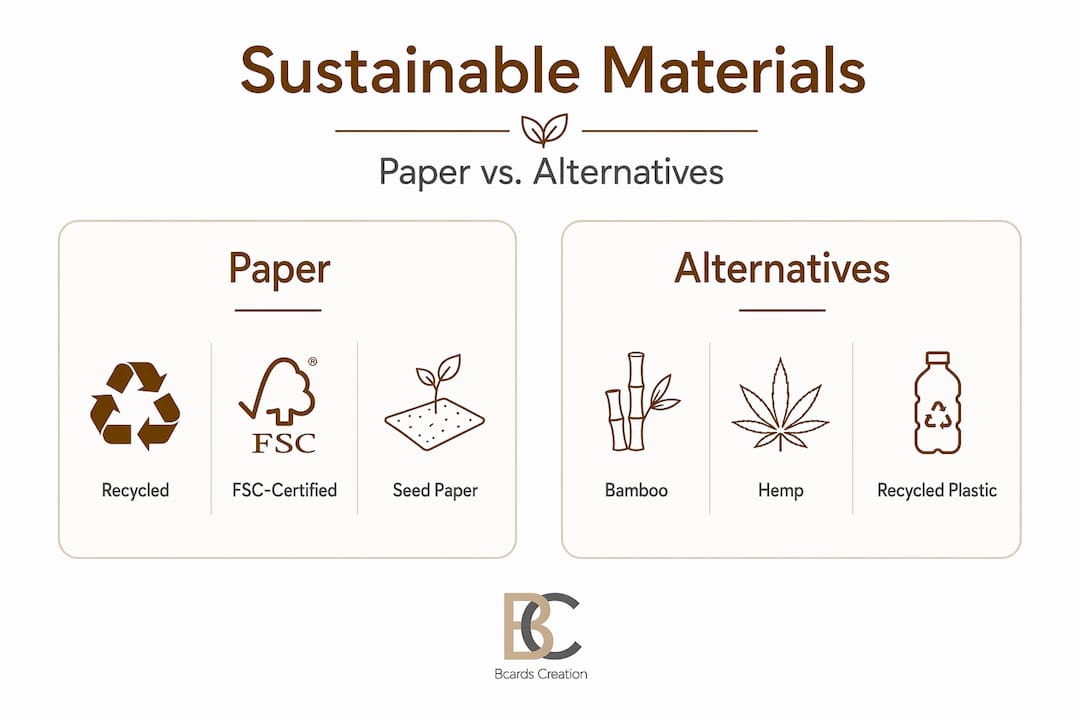
On the material side, options include FSC-certified paper, recycled fiber, bamboo, hemp, and plantable seed paper. Each has a different sourcing story, production footprint, and end-of-life outcome.
But material is only one variable. The lifecycle perspective matters just as much. A card printed on premium recycled stock and reprinted every six months because your title changed is not particularly sustainable. A durable card that stays in circulation for two or three years, even if it costs more upfront, often generates less total waste.
Certifications are not interchangeable. FSC certification confirms that the paper fiber was sourced from responsibly managed forests. Recycled content tells you what percentage of the fiber came from recovered material. A sheet can be FSC-certified without any recycled content, and vice versa. If your sustainability claims need to hold up to scrutiny, ask your printer for documentation on both.
- Recycled paper: Uses post-consumer or pre-consumer recovered fiber. Post-consumer content is generally the stronger claim.
- FSC-certified paper: Sourced from forests managed to environmental and social standards. Chain-of-custody documentation is required.
- Seed paper: Contains embedded wildflower seeds. Recipients plant it instead of discarding it.
- Bamboo fiber: Fast-growing, low-pesticide source material with a shorter regrowth cycle than timber.
- Hemp or cotton blends: Durable, natural fiber options with minimal processing requirements.
- Recycled plastic: Extends the lifespan of recovered plastic and reduces reprint frequency through durability.
Pro Tip: When sourcing paper, ask for both recycled percentage broken out by post-consumer versus pre-consumer fiber and the chain-of-custody documentation. Generic “eco-friendly” claims without numbers are not procurement-grade evidence.
Comparing sustainable business card materials
Choosing a sustainable business card material means trading off environmental impact, cost, tactile experience, and print quality. No single option wins across all four.
| Material | Environmental profile | Durability | Print quality | Relative cost |
|---|---|---|---|---|
| Recycled cardstock | Good: diverts waste fiber | Moderate | Good on coated; softer on uncoated | Low to moderate |
| FSC-certified paper | Good: responsible sourcing | Moderate | Excellent | Moderate |
| Seed paper | Variable: depends on planting | Low | Limited | High |
| Bamboo fiber | Good: fast-growing source | Moderate to high | Good | Moderate to high |
| Recycled plastic | Strong: durable and long-lasting | Very high | Excellent | Moderate to high |
| Wood veneer | Moderate: depends on sourcing | High | Specialty print only | High |
A few things worth unpacking from that table.
Recycled paper is the most accessible green option. Coated recycled stocks offer better color vibrancy and print sharpness, while uncoated provide a softer tactile feel and better writability. The choice between them is a brand decision as much as an environmental one.

Seed paper has genuine appeal as a concept. Seed paper cards contain wildflower seeds that recipients plant by soaking the card and placing it under soil. The environmental benefit depends entirely on whether the recipient actually does that. Most do not. Without planting, the sustainability benefit is largely a marketing story.
Recycled plastic is often overlooked in green business card conversations, but it deserves attention. The cards are extremely durable, resist moisture and wear, and reduce the frequency of reprints significantly. Extending a card’s lifespan from days to years reduces repeated manufacturing, printing, and transport, which cuts long-term carbon output in ways that material sourcing alone cannot.
Sustainable paper materials typically cost 15 to 40% more than conventional stocks, depending on material and quantity. Seed paper and specialty eco-textures sit at the higher end. The cost premium is real, but for brands where sustainability is part of their positioning, the signal that premium materials send to clients and contacts is often worth the difference.
Pro Tip: If you are weighing recycled paper versus recycled plastic for sustainability, factor in how often your contact information changes. Brands that reprint frequently due to title or address changes will achieve more total impact from a durable card that extends reprint cycles than from choosing one paper type over another.
Design and brand alignment in eco cards
Sustainable business card printing is not just a materials decision. It is a design decision too. The way a card is designed directly affects how long it stays in use, and that lifespan has environmental consequences.
Cards that serve a function beyond basic contact exchange get kept longer. That could mean a card with a QR code linking to a portfolio, a useful conversion chart on the back, or a format that doubles as a bookmark or a note card. These environmentally friendly card design choices increase perceived value and reduce the chance the card ends up in a trash can within 48 hours.
Finishes also matter here. Soft-touch lamination, UV spot coating, and foil application all add physical resilience. A card that resists moisture, creasing, and edge wear stays presentable longer. That is a sustainability argument, not just an aesthetic one.
The greenwashing risk is real and worth taking seriously. Printing on recycled stock while using six-color printing, heavy lamination, and metallic foil in a way that makes the card non-recyclable sends a mixed signal. More importantly, it means the sustainability claim does not actually hold up at the end of the card’s life. Genuine environmentally friendly card design thinks through the whole process, not just the paper choice.
Some specific design moves that strengthen both sustainability and brand impact:
- Use your brand color palette selectively rather than flooding both sides with heavy ink coverage, which affects both recyclability and print quality on uncoated stocks.
- Treat the back of the card as functional space rather than a repeat of the front, giving recipients a reason to hold onto it.
- Build your card’s information to stay current longer by using a QR code for details that change frequently, such as job titles, phone numbers, and social handles.
- Choose finishes that protect the card surface without rendering the base material non-recyclable when a paper-based option is selected.
Digital and hybrid options in the mix
Fully digital business cards sit at one end of the sustainability spectrum. No production, no shipping, no physical waste. Digital cards can offer the lowest environmental impact by eliminating physical production and waste, though their footprint is not zero. Server infrastructure, device energy use, and app ecosystem overhead all exist as background costs.
For brands that want to reduce physical card volume without abandoning the tactile exchange altogether, a hybrid approach makes sense. Here is how that typically works:
- Use a durable NFC card as your primary card. One card, reused across every interaction. Contact details update digitally without reprinting. This is the strongest argument against frequent reprinting.
- Reserve physical cards for high-value contacts. A premium physical card with intentional material and finish choices carries more weight when it is given selectively rather than distributed in bulk at every event.
- Reduce batch size and update strategy together. Ordering smaller quantities of well-designed cards and committing to a stable contact format reduces waste from obsolete stock significantly.
- Track what actually drives reprints. In most cases, changing phone numbers or job titles offsets paper sustainability gains faster than material choice can compensate. Stability in your contact information is a sustainability strategy.
The premium physical card does not compete with digital. It plays a different role. A well-made card with strong material and finish choices communicates things that a shared contact file cannot. Used strategically alongside digital tools, it maintains that function while minimizing environmental overhead.
My take on what actually moves the needle
I’ve spent a lot of time reviewing sustainable card projects, and the honest observation is this: most of the environmental conversation focuses on the paper, when the bigger variable is how often the card gets reprinted.
I’ve seen brands order FSC-certified recycled stock with genuine care, then reprint the entire run six months later because someone got promoted. That cycle negates the sustainability benefit of the material choice within one year. Reducing reprint frequency through durable materials and stable update strategies does more for total environmental impact than optimizing paper certification alone.
My other observation is on credibility. Vague eco claims get noticed and questioned by exactly the kind of clients a premium brand wants to attract. The buyers who care about sustainability enough to ask about it are the same ones who will ask for documentation. Insisting on documented FSC certification and recycled content percentages is not just good procurement practice. It is what makes a sustainability claim credible rather than decorative.
If I were advising a brand on where to focus, it would be this: choose a durable material, design the card to stay current and useful for at least two years, and get the documentation that backs up whatever claim you are making. That combination holds up. The rest is mostly aesthetics.
— Kostiantyn
Sustainable cards, designed with intention at Bcardscreation
Choosing a sustainable business card is not a checkbox. It involves material knowledge, design thinking, and an honest look at how your cards actually get used and replaced over time.
Bcardscreation works with professionals and brands who treat their business card as a branding tool, not a commodity. Every project starts with a material and design consultation, covers custom eco business card printing in small batches, and is developed individually without templates. Whether you are exploring recycled paper, durable plastic alternatives, or specialty finishes that extend card life, the team at Bcardscreation can help you make choices that serve both your brand and your environmental goals. Explore your options and start a conversation about your next project.
FAQ
What is a sustainable business card?
A sustainable business card minimizes environmental impact through lower-impact materials such as recycled paper, FSC-certified fiber, seed paper, or durable recycled plastic, combined with production and design choices that reduce waste over the card’s full lifecycle.
What materials make a business card sustainable?
Common sustainable business card materials include post-consumer recycled paper, FSC-certified paper, bamboo fiber, hemp or cotton blends, seed paper, and recycled plastic. Each material has different durability, print quality, and end-of-life characteristics.
Is FSC-certified paper the same as recycled paper?
No. FSC certification confirms responsible forest sourcing. Recycled content measures how much fiber came from recovered material. A paper can carry one claim, both, or neither, so you should verify both when evaluating a supplier’s sustainability documentation.
Does seed paper actually help the environment?
Only when recipients plant it. Seed paper cards embedded with wildflower seeds offer a genuine environmental benefit if the card is planted correctly, but most cards are not. Without planting, the sustainability case for seed paper is weak.
Are durable plastic cards a green option?
Yes, in specific circumstances. Recycled plastic business cards last significantly longer than paper alternatives, which reduces reprint frequency. When contact information stays stable, a durable card used over several years often generates less total waste than paper cards reprinted multiple times.
Recommended
- Why choose clear business cards for brand impact – BcardsCreation
- Unique Business Card Ideas Guide for Strategic Branding – BcardsCreation
- 7 Insights on Sustainable Business Cards: What Matters vs. Marketing – BcardsCreation
- Top sustainable business card options for small USA brands – BcardsCreation


