

How to make clear plastic cards for luxury branding
You hand someone your card at a networking event. They glance at it, pocket it, and move on. That’s the reality with most paper business cards. They blend in. They get lost in a stack. For luxury brand owners and creative entrepreneurs, that’s a missed opportunity. Clear plastic cards work differently. They stop people. They get held up to the light. They get commented on. This guide walks you through exactly how clear plastic cards are made, what materials you need, and how to get a finished product that reflects the quality of your brand.
Table of Contents
- What makes clear plastic cards unique?
- Essential materials and tools for making clear plastic cards
- Step-by-step process: How clear plastic cards are made
- Key challenges and expert solutions
- Verifying quality and maximizing brand impact
- Premium clear plastic cards: Transform your brand’s first impression
- Frequently asked questions
Key Takeaways
| Point | Details |
|---|---|
| Clear cards signal luxury | Clear plastic cards create a high-end, memorable impression that strengthens premium branding. |
| Specialized production matters | Working with experienced clear card printers ensures the best print quality and durability. |
| Design for clarity and impact | Use strong contrast, white ink, and well-planned layouts to maximize your card’s visual effect. |
| Attention to detail | Check for edge smoothness, color consistency, and gloss to make your card feel truly luxurious. |
What makes clear plastic cards unique?
Clear plastic cards are not just a visual upgrade. They signal something about your brand before you say a word. The material itself communicates quality, modernity, and intention.
The benefits of clear plastic cards go beyond looks. They are durable, water resistant, and tactilely distinct from anything printed on paper. When someone holds one, it feels different. That feeling is part of your brand experience.
Most clear cards are made from one of three materials:
- PVC (polyvinyl chloride): The most common option. Flexible, cost effective, and widely available for custom printing.
- PET (polyethylene terephthalate): More rigid and environmentally friendlier than PVC. Good for brands with sustainability values.
- Polycarbonate: The most premium option. Extremely durable and used for high-security applications like ID cards.
As noted by Vents Magazine, clear plastic cards are produced via extrusion into sheets, then printed using offset, UV inkjet, dye-sublimation, or silkscreen methods, followed by die-cutting and lamination.
The standard size is CR80, which matches a credit card at 3.375 x 2.125 inches. You can go fully transparent, frosted, or layered with opaque sections. Each option creates a different visual effect and brand feel. The impact on luxury branding depends heavily on which combination you choose.
Stat: Thermoplastics account for 92% of professional card applications across industries.
Now that you understand why clear plastic cards stand apart, let’s cover what you’ll need to make them.
Essential materials and tools for making clear plastic cards
Getting a clear plastic card right requires specific materials and equipment. Here’s what goes into a professional production run.
Core materials:
- Clear PVC, PET, or polycarbonate sheets
- White ink (critical for color opacity on transparent stock)
- UV-curable or solvent-based inks
- Lamination film (gloss or matte)
- Die-cutting tools or custom cutting dies
Printing methods available:
- UV inkjet: Best for short runs and vibrant color
- Offset: Ideal for large volumes with consistent color
- Silkscreen: Great for bold, simple designs
- Dye-sublimation: Used for photographic quality output
The plastic business card process requires equipment that most small studios and home setups simply don’t have. That’s the core challenge with DIY production.
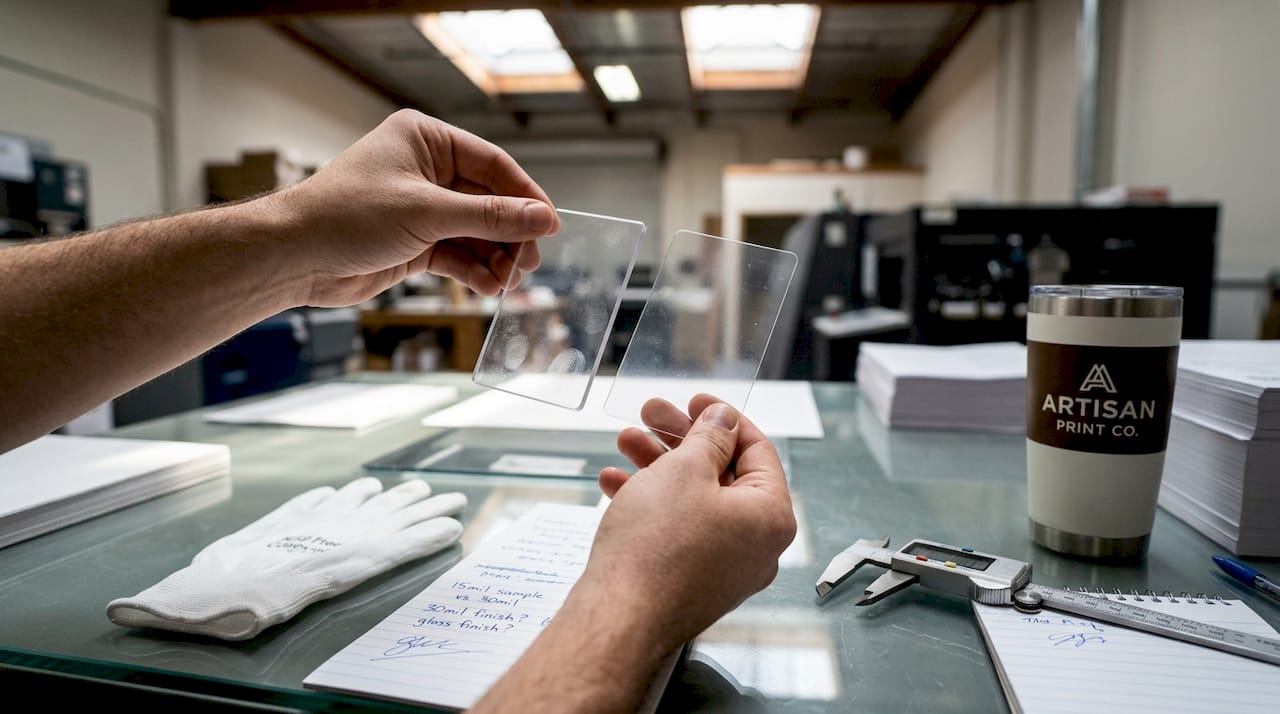
Standard thickness runs 20 to 30 mil (approximately 0.76mm), which is the same feel as a credit card. Thinner cards feel cheap. Thicker cards feel premium.
DIY vs. specialist printing: A quick comparison
| Factor | DIY printing | Specialist printer |
|---|---|---|
| Equipment cost | Very high | Included in order |
| Print quality | Inconsistent | Controlled and verified |
| White ink capability | Rarely available | Standard offering |
| Minimum order | Any quantity | Usually 50 to 500+ |
| Turnaround | Variable | 8 to 12 business days |
| Lamination options | Limited | Full range available |
For a deeper look at what specialist printers offer, Plastic Printers is a good reference point for USA-based production capabilities.
Pro Tip: For luxury results, outsourcing to a specialist is almost always the right call. The equipment required for clean white ink layering and precise die-cutting is expensive and highly technical. One bad run costs more than the savings.
Armed with your toolkit and material options, it’s time to walk through the step-by-step process.
Step-by-step process: How clear plastic cards are made
Understanding the production workflow helps you ask better questions, set realistic timelines, and catch problems before they become expensive.
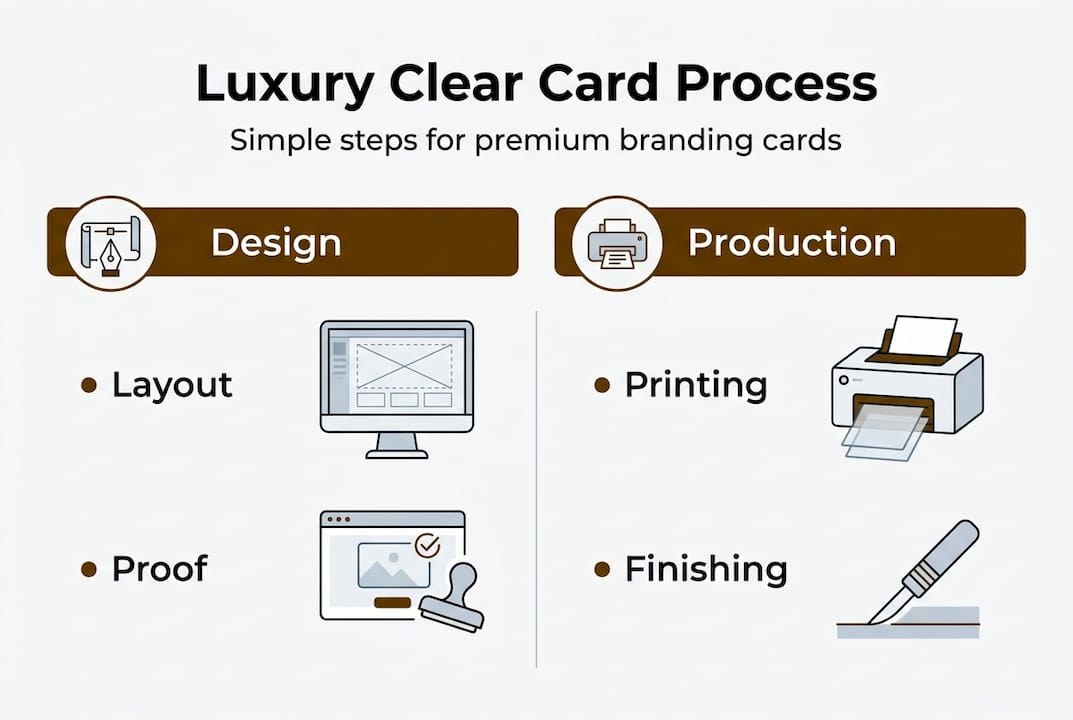
The standard production sequence:
- Material selection: Choose your base sheet (PVC, PET, or polycarbonate) based on brand needs and budget.
- Design preparation: Set up files with proper bleeds, safe zones, and color profiles suited for transparent stock.
- Printing: Apply inks using UV inkjet or offset. For full-color designs on clear stock, a white ink underbase is applied first to create opacity behind colors.
- Die-cutting: Cards are cut to shape. Custom shapes require a one-time die fee.
- Lamination or coating: Gloss, matte, or soft-touch finishes are applied to protect the surface and enhance feel.
- Quality checks: Each batch is reviewed for sharpness, edge consistency, and color accuracy.
As outlined by Plastic Printers, this six-step sequence is standard for professional clear card production in the USA.
The design process for luxury cards is where most brands either win or lose. A design that works on paper often fails on clear stock. Contrast, spacing, and color choices all behave differently on a transparent background.
Production timeline overview:
| Stage | Estimated time |
|---|---|
| Design approval | 1 to 3 business days |
| Printing and lamination | 3 to 5 business days |
| Die-cutting and QC | 1 to 2 business days |
| Shipping (USA) | 2 to 3 business days |
| Total | 8 to 12 business days |
The printing process for luxury branding also involves layering decisions. Printing on one side is recommended when you want maximum transparency on the reverse. Two-sided printing reduces the see-through effect but adds design real estate.
“Use white ink underbase for opacity on transparent backgrounds, layering effects for depth.” — BcardsCreation
Pro Tip: Always request a physical proof before approving a full run. Colors shift on clear stock. What looks right on screen may look washed out without a proper white underbase.
With the production method clear, let’s troubleshoot common challenges and set realistic expectations.
Key challenges and expert solutions
Clear plastic cards come with specific production challenges. Knowing them in advance saves time, money, and frustration.
Common issues and how to handle them:
- Scratches: Clear PVC scratches more visibly than paper. Gloss lamination adds a protective layer and reduces this risk significantly.
- Color bleeding: Inks can spread slightly on plastic. Use high-resolution files and work with printers experienced in plastic substrates.
- Transparency issues: Too much ink coverage reduces the clear effect. Keep designs minimal and strategic.
- Die-cutting precision: Custom shapes require exact cutting dies. Misaligned cuts ruin the card. Always verify die specs before production.
- Lighting variation: Cards look different under warm, cool, and natural light. Test samples in multiple environments before approving.
For elevating beauty branding and similar luxury sectors, the frosted finish is often a better choice than fully clear. It softens the look, hides minor scratches better, and photographs more cleanly.
As PlasticPrinters notes, aligning your material choice with your brand identity is critical. Transparent cards signal openness and modernity. Frosted cards feel more refined and understated.
For a broader view of how materials perform across different use cases, this materials overview covers the practical differences well.
Pro Tip: Minimize detail, maximize contrast. On clear stock, fine lines and small text disappear. Bold typography and high-contrast color blocks perform best for luxury card designs.
Finally, let’s review the finished product and how to ensure it meets luxury branding standards.
Verifying quality and maximizing brand impact
A finished card that looks great in photos but feels inconsistent in hand is not a luxury product. Quality verification is the final step that separates good from great.
Your quality checklist:
- Edges: Clean, smooth, and consistent across the entire batch. Rough edges signal poor die-cutting.
- Color accuracy: Compare printed cards to your approved proof. Colors should match within acceptable tolerance.
- Thickness: Every card in the batch should feel identical. Variation signals inconsistent lamination.
- Surface finish: Gloss should be even. No bubbles, streaks, or dull patches.
- Transparency: If you ordered a clear design, check that the see-through effect is consistent across all cards.
- Text sharpness: Fine print should be crisp. Blurry text means the white underbase or ink layering was off.
As Plastic Printers confirms, USA-based specialist printers like Plastic Printers (MN) and Plastek Cards run full in-house quality control processes to catch these issues before shipping.
Ask your printer these questions before placing a full order:
- Do you offer physical proofs before production?
- What is your policy on reprints for quality defects?
- Can I see samples of previous clear card runs?
For creating memorable business cards that hold up over time, the card’s feel in hand matters as much as its look. Luxury is in the details. Consistent edges, even gloss, and precise color are what separate a premium card from a novelty one.
“Luxury is not about doing more. It’s about doing less, better.”
Gather feedback from two or three trusted clients or partners before committing to a large run. Their reaction tells you more than any screen preview.
Premium clear plastic cards: Transform your brand’s first impression
If you’re ready to move from concept to finished card, working with a specialist makes the difference between a card that impresses and one that just exists. At BcardsCreation, every project is handled individually. No templates. No automated editors. Just expert design guidance, material consultation, and controlled production built for luxury brands.
You can explore our high-end clear business cards to see current options and finishes. If you want a card built around your specific brand identity, our custom business card design service starts with a consultation to align material, finish, and design before anything goes to print. We work with small-batch orders across the USA, so you get a premium result without committing to thousands of units.
Frequently asked questions
What’s the typical turnaround for custom clear plastic cards in the USA?
Production and delivery take about 8 to 12 business days with specialist printers in the USA, depending on design complexity and order size.
Are clear plastic cards more durable than paper cards?
Yes. Thermoplastic cards resist moisture and tearing, making them far more durable than standard paper business cards in everyday use.
Should I attempt to print clear cards on my own printer?
DIY printing is not recommended. The equipment required for white ink layering and precise die-cutting is highly specialized. Outsourcing to a specialist consistently delivers better results for luxury applications.
What’s the standard thickness and size for clear plastic business cards?
Standard size is CR80 at 3.375 x 2.125 inches, with a typical thickness of 20 to 30 mil, which is similar to a credit card.
Are clear cards suitable for any type of brand?
They work best for modern, premium, or innovative brands. As PlasticPrinters notes, transparent cards signal openness and modernity, making them a strong fit for luxury, tech, and creative industries.


