

Business Card Networking for Photographers: 2026 Guide
TL;DR:
- Business card networking enables photographers to showcase their work, build relationships, and attract clients effectively.
- Combining physical, digital, or hybrid cards enhances tactile impact and digital connectivity during professional interactions.
Business card networking for photographers is the practice of using carefully designed physical and digital cards to build professional relationships, showcase your portfolio, and convert contacts into clients. The U.S. photography industry has grown to over 150,000 related occupations, which means standing out at every touchpoint matters more than ever. Your card is often the first tangible piece of your brand someone holds. Done right, it works long after the conversation ends. This guide covers what to put on your card, which formats to use, how to design for retention, and how to deploy cards strategically at events and beyond.
What should a photographer’s business card include?
The most effective photographer business cards carry both contact information and a clear signal of your visual style. Think of the card as a compressed portfolio sample, not just a contact vehicle. Every element should earn its place.
Contact and identity essentials:
- Full name and business name (keep them consistent with your online presence)
- Phone number and professional email address
- Website URL, ideally pointing to your portfolio landing page
- Social media handles, limited to one or two where your work is most active
- Photography specialty or niche (wedding, commercial, real estate, editorial)
Portfolio and digital access:
- A QR code linking directly to your online portfolio or booking page
- NFC chip integration for tap-to-share functionality at events
- A short tagline that reflects your photographic style or client promise
Design as a signal:
Business card design should convey brand quality instantly. The card is a tactile portfolio sample, not just a contact vehicle, and it influences client perceptions before they ever contact you. A wedding photographer using soft cream stock with letterpress text signals something very different from a commercial photographer using a bold black card with spot UV. Both are correct choices. The key is alignment between the card’s feel and the work it represents.

Pro Tip: Add a brief stylistic statement to the back of your card. One sentence describing your approach, such as “Natural light portraiture for families and brands,” tells a potential client exactly what to expect before they visit your site.
Physical, digital, or hybrid: which card type works best?
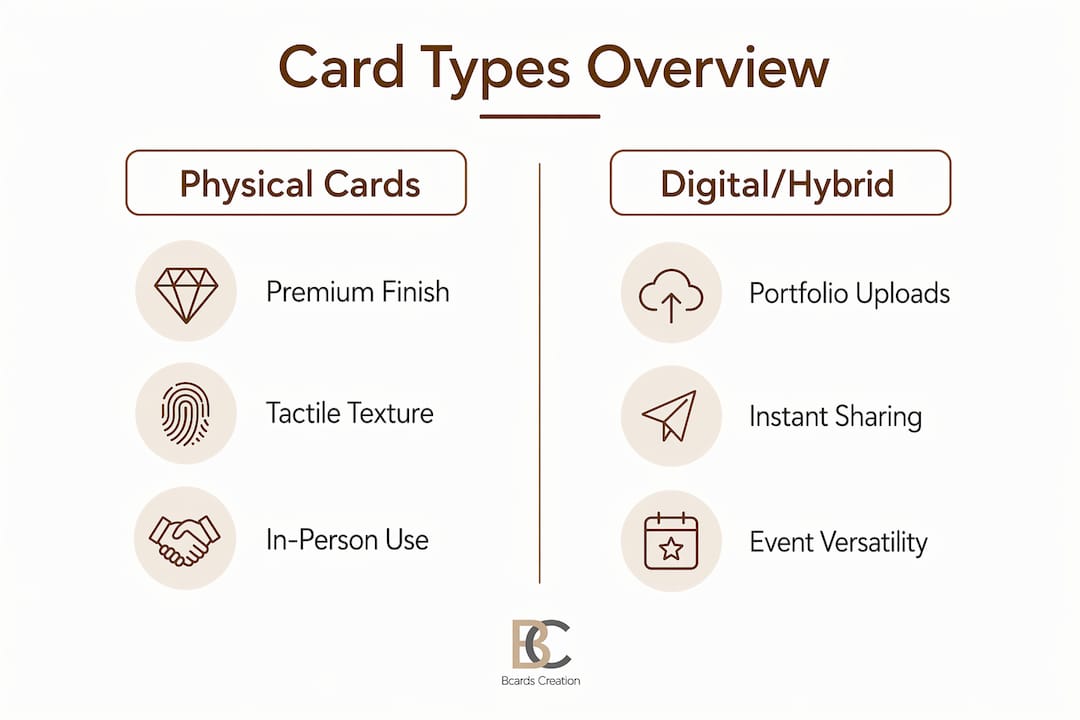
Photographers have three main card formats to choose from. Each serves a different networking context. Many working photographers use more than one.
| Card Type | Best Use Case | Key Advantage | Limitation |
|---|---|---|---|
| Premium physical card | In-person events, weddings, markets | Tactile impact, brand signal, memorability | No real-time portfolio access |
| Digital card (app-based) | Online networking, follow-ups, email | Instant portfolio sharing, lead capture forms | No physical presence or tactile quality |
| Hybrid (physical + QR/NFC) | All contexts | Combines tactile trust with digital depth | Requires QR/NFC setup and maintenance |
Physical cards remain the standard for face-to-face networking. Card texture, weight, and finish are critical to perceived professional quality. The tangible product acts as a trust and quality proxy during networking. A thick matte card with soft-touch lamination communicates craft. A flimsy card communicates the opposite, regardless of the photography behind it.
Digital cards from platforms like Wave Connect, HiHello, and Blinq offer features like unlimited portfolio image uploads, client inquiry forms, and NFC hardware compatibility. Premium digital plans for creatives range from $7 to $14.99 per month depending on features. Digital cards with unlimited portfolio images and immediate client inquiry forms create more qualified leads compared to basic contact cards.
Hybrid cards are the most practical solution for photographers who shoot 20 or more events per year. A balanced workflow uses premium physical cards for tactile impact in face-to-face networking and NFC or QR-linked digital cards for fast portfolio sharing and data capture. Most photographers start with about 100 cards for several months of networking, particularly for weddings and events. Ordering 250 cards at $119.99 provides better per-unit value for high-volume professionals compared to 100 cards at $55.99.
How do you design a photography business card that gets kept?
Most business cards get discarded within 48 hours. The ones that survive do so because they offer something worth keeping. Design is the primary reason a card stays in a wallet or gets pinned to a board.
Use your work as the design:
- Place one strong portfolio image on the back of the card. Choose a shot that represents your best and most bookable work.
- For portrait photographers, a single well-lit face image communicates style immediately.
- For real estate or architectural photographers, a clean interior or exterior shot signals technical precision.
Format and finish choices:
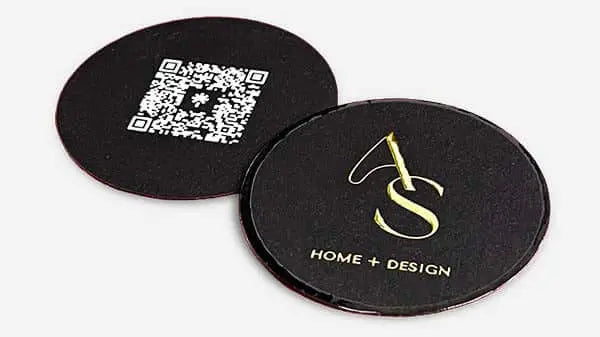
Creative professionals’ business cards serve as portfolio pieces themselves. Texture, finish, and unique formats impact perceived service quality significantly more than standard layouts. Square cards, die-cut shapes, and foldable formats all create a physical experience that a standard rectangle cannot. Spot UV coating on a dark card creates a tactile contrast that is hard to ignore. Foil stamping on a name or logo adds a level of perceived value that reads as premium without requiring explanation.
For photographers who want to explore unique card formats that reinforce brand differentiation, the format itself becomes part of the message.
Add functional value:
Successful business cards offer clear added value like appointment cards, mini price lists, or direct booking links to encourage card retention and client engagement. A card with a QR code linking to a booking calendar is more likely to be kept than one with only a phone number. A mini session price list printed on the back gives the recipient a reason to hold onto the card until they are ready to book.
Color and typography:
Your color palette should match your website and social media presence. Consistency across touchpoints builds recognition. Typography should be legible at small sizes. Avoid script fonts for contact details. Reserve decorative type for your name or tagline only.
Pro Tip: If you shoot in a specific niche like real estate photography, tailor your card’s back image and tagline to that niche. A generalist card works everywhere but converts nowhere.
How to use business cards effectively at photography events
Handing out cards without a strategy produces a pile of forgotten paper. Effective deployment requires knowing when, where, and to whom you give a card.
-
Prioritize client-adjacent professionals over direct clients. In-person networking is most effective when building relationships with client-adjacent professionals like spa managers or gym owners who can act as referral partners. A florist, venue coordinator, or makeup artist at a wedding will refer photographers to dozens of future clients. One relationship with a venue coordinator can outperform 50 cards handed to guests.
-
Give cards with context. Hand your card after a genuine conversation, not before. Mention what you specialize in as you hand it over. “I focus on editorial portraits for small brands” gives the recipient a reason to remember you and a reason to refer you.
-
Use digital sharing for immediate follow-up. After meeting someone at a conference or event, send a digital card follow-up within 24 hours. Include a link to a relevant portfolio gallery that matches their industry or interest.
-
Avoid common mistakes. Do not hand out cards to everyone in a room. Do not give cards without receiving one in return. Do not use a card as a substitute for a real conversation. Cards reinforce connections. They do not create them.
-
Build a referral system. Leave a small stack of cards with venue coordinators, bridal boutiques, and event planners you work with regularly. These professionals become passive distributors of your brand.
Pro Tip: Write a short note on the back of your card before handing it to someone. “Great meeting you at [event name]” takes five seconds and dramatically increases the chance your card gets kept and acted on.
Key takeaways
Effective business card networking for photographers requires cards that function as both a brand signal and a portfolio tool, deployed with intention at every professional touchpoint.
| Point | Details |
|---|---|
| Card as brand signal | Design, finish, and format communicate your quality before a client visits your site. |
| Hybrid format wins | Combine premium physical cards with QR or NFC links for both tactile impact and digital depth. |
| Functional value drives retention | Cards with booking links, mini price lists, or appointment slots get kept longer than contact-only cards. |
| Target referral partners | Client-adjacent professionals like venue coordinators generate more sustained referrals than direct client outreach. |
| Niche-specific design converts | Cards tailored to your specialty outperform generic designs in both recall and booking conversion. |
What i’ve learned about cards that actually work
I have seen photographers invest heavily in their camera gear and almost nothing in their printed materials. The logic is understandable. The work speaks for itself, right? Not at a networking event where 20 photographers are in the same room.
The photographers who get remembered are the ones whose cards feel like an extension of their work. A fine art photographer I know uses a thick cotton stock with letterpress printing and no image at all. The card is so tactile and unusual that people ask about it. That question starts a conversation. The card does the networking before the photographer says a word.
The mistake I see most often is treating the card as an afterthought. Photographers spend hours editing a single image and then order the cheapest card available. That disconnect is visible. Clients notice it, even if they cannot articulate why.
The other insight worth sharing: stop trying to hand cards to potential clients at events. Focus on the professionals around those clients. A gym owner who books headshots for their trainers every quarter is worth more than 50 wedding guests who may or may not book in the next two years. Shift your networking mindset from client acquisition to relationship building, and your cards will find their way to the right people through the right hands.
The design tips for creatives that hold up over time are always about alignment. The card should look like it came from the same person who shot the portfolio. When that alignment exists, the card does real work.
— Kostiantyn
Get a card that represents your work
Your photography deserves a card that matches its quality. Bcardscreation designs and produces fully custom, small-batch business cards for photographers who treat their brand as seriously as their craft.
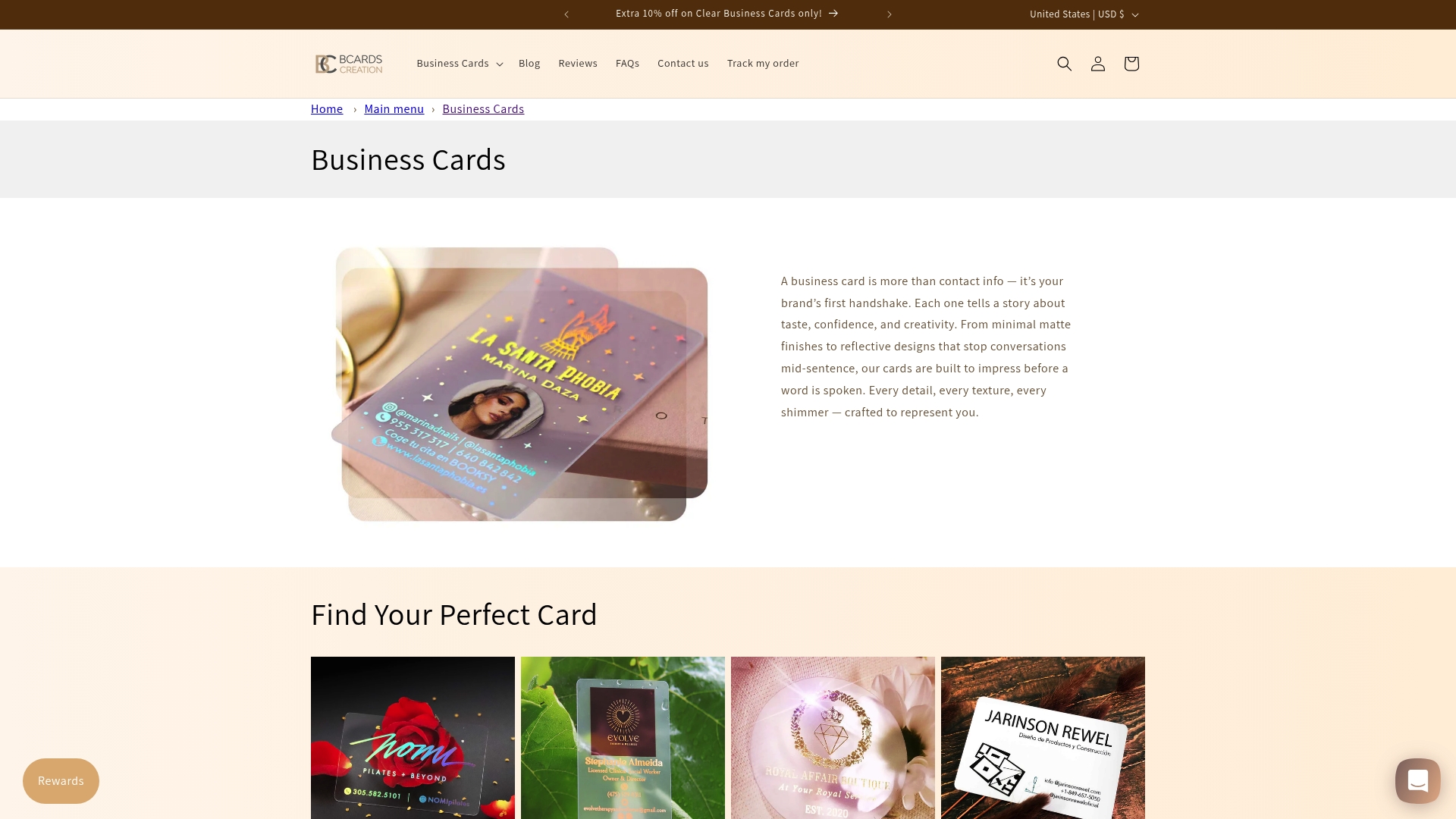
Every project at Bcardscreation starts with a design consultation, not a template. You choose the material, finish, and format that fits your brand. Options include specialty papers, soft-touch lamination, real foil, and clear plastic cards. Production is controlled and small-batch, so every card meets the same standard. If you are ready to order a card that works as hard as you do, explore custom business card design or browse luxury finishing options to find the right fit.
FAQ
What information should a photographer put on a business card?
A photographer’s business card should include your name, business name, phone, email, website, and photography specialty. Add a QR code linking to your portfolio or booking page for immediate digital access.
How many business cards should a photographer order?
Most photographers start with 100 cards at around $55.99, which covers several months of events. Ordering 250 cards at $119.99 offers better per-unit value for photographers shooting 20 or more events per year.
Are digital business cards worth it for photographers?
Digital cards from platforms like Wave Connect or HiHello are worth the $7–$14.99 monthly cost if you network frequently online or need portfolio sharing and lead capture features beyond basic contact info.
What card format stands out most for photographers?
Square cards, die-cut formats, and cards with tactile finishes like spot UV or foil stamping stand out more than standard rectangles. Texture and format signal service quality before the recipient reads a single word.
How do photographers use business cards to build referral networks?
Leave cards with client-adjacent professionals like venue coordinators, florists, and makeup artists rather than only handing them to direct clients. These professionals refer photographers to multiple future clients and generate sustained booking volume.


