

Business Card Thickness Selection Guide for Professionals
TL;DR:
- Choosing the right card thickness is crucial for conveying durability and brand perception, with 14 to 16 pt being ideal for most professional cards. Physical measurements (points) and weight (GSM) both influence the card’s feel and performance, but samples are essential for accurate assessment. Selecting thickness should align with intended use, storage, and brand positioning to ensure lasting quality and impactful impression.
Choosing the right card thickness is one of the most overlooked decisions in business card production. Most professionals focus on design and overlook the physical weight and feel of the card itself. But a card that bends on first contact or feels flimsy in someone’s hand sends a message before a single word is read. This card thickness selection guide covers everything you need to make an informed decision: how thickness is measured, which specifications match your use case, and how to avoid the most common ordering mistakes that result in cards that underperform in real-world conditions.
Key takeaways
| Point | Details |
|---|---|
| Learn both measurements | Points (pt) measure thickness; GSM and lb measure weight. You need both to order correctly. |
| 14 to 16 pt covers most needs | Standard business cards fall in this range, with 16 pt offering better durability and a premium feel. |
| Finish changes the experience | Coating and texture affect how thick a card feels, not just its measured thickness. |
| Always request physical samples | Density varies between manufacturers, so the same GSM can feel very different in hand. |
| Match thickness to brand position | High-end brands benefit from 16 pt and above; lighter stocks work for volume distribution. |
Understanding card thickness measurements and standards
The terminology around card stock can be genuinely confusing. Two separate measurement systems exist, and vendors often list only one of them. Knowing both is the first step in this card thickness selection guide.
Points (pt) measure physical thickness. One point equals 0.001 inches. So a 16 pt card is 0.016 inches thick. This is the most direct way to understand how rigid or substantial a card will feel. Pt measures thickness, not weight, and the two are not interchangeable without a conversion chart or full material specification.
GSM (grams per square meter) and lb cover measure weight, not thickness. A 300 gsm card from one manufacturer may feel noticeably thicker or thinner than a 300 gsm card from another, because paper density and coating affect the result. Requesting physical samples before placing a large order is the only reliable way to verify how a specific stock actually feels.
Common business card thickness ranges
| Thickness (pt) | Approx. GSM | Typical use |
|---|---|---|
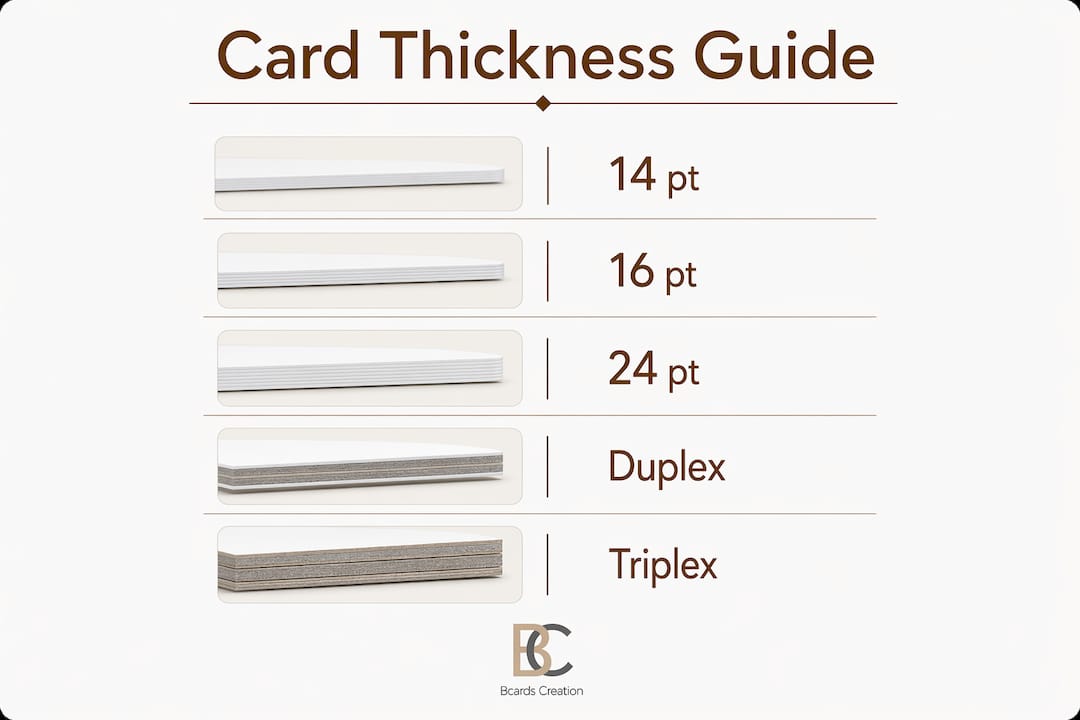
| 14 pt | 216–240 gsm | Standard professional cards |
| 16 pt | 270–300 gsm | Premium, durable cards |
| 24 pt+ | 350+ gsm | Luxury, duplex or specialty cards |
Business cards at 216–300+ gsm cover the practical range for most professional applications, with heavier stocks offering better resistance to bending and a stronger tactile impression. Cards at 300 gsm and above increase premium perception noticeably.
For reference, the ISO/IEC 7810 ID-1 standard defines card thickness at 0.76 mm for credit card-sized formats. Standard business cards run thinner, around 0.3 to 0.4 mm (14 to 16 pt), which keeps them comfortable in wallets and cardholders. Going significantly thicker than 16 pt can create fit problems in standard card cases.
Pro Tip: Always ask your printer to confirm both the pt thickness and the GSM of the stock they use. If they can only provide one metric, ask for a sample before committing.
How to choose card thickness based on usage
Thickness is not purely a premium signal. It is a functional decision tied to how your cards will be used, stored, and received.

Durability and handling frequency are the primary factors. If your cards will be distributed at high-traffic trade shows, tucked into wallets, or passed between multiple people, cards that carry frequently need sturdier stock to survive. A 16 pt card holds its shape and edges far longer than a 14 pt card under those conditions.
Brand positioning matters just as much. A 14 pt card in matte finish suits a straightforward, functional professional context. A 16 pt card with soft-touch lamination or spot UV communicates deliberate investment in presentation. For clients and companies building a premium brand impression, the tactile weight of the card is part of the message.
Here are the key factors to evaluate when selecting card thickness:
- Distribution volume. Large distribution events favor 16 pt because durable stock reduces replacement frequency despite slightly higher material costs per card.
- Writing on the card. If recipients write notes on cards, an uncoated or lightly coated stock works best. Thick gloss-coated cards repel most pens.
- Finish type. Soft-touch lamination, for example, adds a tactile layer that changes the feel without altering the base thickness measurement.
- Industry context. Legal, finance, and creative industries often expect a more substantial card. A flimsy card in those settings actively damages credibility.
- Wallet and cardholder compatibility. Cards above 18 pt may not fit standard cardholders without feeling forced.
Pro Tip: If you work across multiple client types, consider printing two versions: a 16 pt version for key relationships and a 14 pt version for high-volume networking events.
Thickness combined with finish creates the total tactile impression. A well-finished 14 pt card can feel more premium than a plain 16 pt card. The two decisions work together, and premium card materials should always be chosen in relation to each other.
Step-by-step guide to selecting card thickness
Use this process to move from concept to final specification without guesswork.
- Define your use case. Will these cards be distributed broadly or shared selectively? Will they live in wallets, binders, or premium card cases? Write this down before you contact a printer.
- Identify your brand tier. Entry-level professional, mid-market, or premium? Each tier has a corresponding thickness expectation. Matching your card to your positioning prevents mixed signals.
- Request sample packs. Most quality printers offer physical samples across stock options. Handle them. Bend them. Put them in your wallet for a day and check the condition afterward.
- Check printer specifications. Some printers have upper limits on thickness, especially for offset printing with specialty finishes. Ignoring printer limitations leads to production failures or forced substitutions.
- Evaluate finish alongside thickness. Decide on lamination, coating, or raw stock at the same time you choose pt weight. These decisions affect each other.
- Order a short run first. Before committing to a large batch, order a small quantity. Live with the cards for a week and assess durability in real conditions.
- Finalize and document your specs. Record both the pt measurement and the GSM, along with the finish type. This protects you when reordering from the same or a different printer.
| Thickness | Finish pairing | Best for |
|---|---|---|
| 14 pt | Matte or gloss laminate | Standard professional distribution |
| 16 pt | Soft-touch or spot UV | Premium client-facing cards |
| 24 pt+ | Raw or specialty | Luxury and ultra-premium brands |
Premium options at 24 pt and above typically involve duplexing (bonding two sheets), triplexing, or specialty substrates like PVC or metal. These are not commodity products. They are custom productions that require individual consultation.
Common mistakes when choosing card thickness
Getting this decision wrong costs money and time. These are the most frequent problems professionals run into.
- Confusing GSM with pt. These measure different things. A card listed as 350 gsm sounds substantial, but without the pt measurement, you cannot confirm its actual physical thickness. Always confirm both numbers.
- Ignoring grain direction. Grain direction affects how a card bends and how it holds up over time. Cards that score or fold against the grain may crack. This matters especially for folded or scored card formats.
- Choosing thickness without testing fit. Cards over 18 pt may not slide smoothly into standard business card cases or wallet slots. ISO/IEC 7810 compatibility is worth checking if wallet fit is a priority.
- Assuming coatings are purely cosmetic. Coatings change perceived flexibility and thickness. A soft-touch laminate, for example, adds a slight cushioning feel that makes a 14 pt card register as more premium in the hand.
- Skipping the sample stage. Card stocks with similar GSM from different manufacturers can feel completely different due to density and coating variations. There is no substitute for a physical sample.
- Overlooking durability under load. A card in a wallet experiences compression and friction daily. Cards below 14 pt show visible wear within weeks. Factor in the full lifecycle of the card, not just first impressions.
Watch for printer limitations on maximum thickness as well. Some digital presses cannot handle stock above 16 pt without risking feed errors or print quality issues. This is a practical constraint that affects your options before design even begins.
Final considerations for professional card thickness
Selecting card material thoughtfully produces cards that hold up. That durability is not just physical. A card that looks as good after a week in a wallet as it did on day one reinforces your brand every time it is seen.
For most business professionals, 16 pt is the practical standard. It handles daily use without visible wear, fits standard cardholders, and conveys a level of substance that 14 pt simply does not. The card thickness comparison between these two options is most obvious when cards are side by side in hand.
If you are selecting card material for a luxury or ultra-premium brand, move to duplex or triplex constructions. The added thickness and the visible layered edge create a card that functions as a physical artifact of your brand, not just a contact detail delivery system.
Balance cost against longevity. A slightly more expensive 16 pt stock that survives three months of daily wallet use is more cost-effective than a cheaper 14 pt card that looks worn after two weeks. Pairing your thickness choice with the right finish and thoughtful design produces a card that earns its place in someone’s collection rather than the recycling bin.
My take on card thickness decisions
I have seen clients spend considerable time on typography and logo placement, then select card thickness almost by default based on what seems standard. That approach always costs them something.
Thickness carries meaning before the design is even noticed. When someone picks up your card, the first signal is physical. Weight and rigidity communicate confidence or hesitation before a word is read. I have seen well-designed cards undercut by stock that felt hollow. And I have seen simple, text-only cards that commanded real attention purely because the material felt deliberate.
The most common misconception I encounter is that thicker automatically means better. That is not accurate. The right thickness depends on the relationship between your brand, your audience, and how the card will actually be used. A 16 pt card with a matte laminate can outperform a 24 pt card with a poorly matched finish. Thickness is part of a system, not a standalone variable.
My approach is always to start with samples and a real conversation about how the cards will be distributed and stored. That context shapes every material decision that follows.
— Kostiantyn
Get the right thickness with Bcardscreation
Bcardscreation works with each client individually to match card thickness and finish to their brand requirements. There are no templates or preset packages. Every project starts with a material consultation that covers stock weight, pt thickness, coating options, and production method.
Whether you are looking for custom business card design across standard to luxury specs, or exploring luxury foil cards with premium finish pairings, Bcardscreation handles each order with direct attention to material detail. Small-batch production means your specifications are followed precisely, not approximated to fit a production line. Explore the full range and request a consultation to find the thickness and finish combination that fits your brand.
FAQ
What thickness is standard for business cards?
Most professional business cards use 14 pt to 16 pt stock, which corresponds to approximately 216 to 300 gsm. A 16 pt card is considered the premium standard for durability and tactile quality.
Are GSM and pt the same measurement?
No. GSM measures paper weight per square meter, while pt (points) measures physical thickness. A card at 300 gsm from one manufacturer may be thinner or thicker than 300 gsm from another due to density differences.
How thick can a business card be before it stops fitting in wallets?
Standard business card slots and wallets typically accommodate cards up to about 16 to 18 pt comfortably. Cards above that range, such as duplex or triplex constructions at 24 pt or more, may not fit standard cardholders.
Does card finish affect perceived thickness?
Yes. Coatings like soft-touch lamination add a cushioning layer that changes how a card feels in hand, even without changing the base pt measurement. Finish and thickness work together to shape the overall tactile impression.
When should I choose a thicker card stock?
Choose thicker stock (16 pt and above) when cards will be handled frequently, distributed at high-stakes meetings, or used to represent a premium or luxury brand. Durability under real-world conditions is the primary driver, not aesthetics alone.


