

What Is Card Stock? a Guide for Design Professionals
TL;DR:
- Card stock is thicker and more durable than standard paper, measuring thickness in points for accuracy. Its finish, fiber type, and thickness influence print quality, tactile feel, and brand perception. Selecting the right material depends on brand positioning, print method, and desired audience experience.
Card stock is one of those materials that most people think they understand until they try to order it. The term gets used loosely, and the options can multiply fast: points, pounds, GSM, coated, uncoated, C1S, C2S. If you’re sourcing material for business cards or branded print projects, knowing what is card stock at a technical level makes a real difference. This guide breaks down how card stock is measured, what the finish types mean, and how to match material decisions to your brand goals.
Table of Contents
- Key takeaways
- What card stock is: definitions and measurements
- Types of card stock finishes and surfaces
- Thickness, durability, and what it signals
- How to choose the right card stock
- My perspective on card stock selection
- Explore custom card stock options with Bcardscreation
- FAQ
Key takeaways
| Point | Details |
|---|---|
| Card stock vs. paper | Card stock sits between regular paper and cardboard, offering rigidity without bulk. |
| Measure by points, not pounds | Points (pt) give you true thickness; pound weight alone does not. |
| Finish drives perception | Surface coating affects print quality, tactile feel, and how your brand registers with a recipient. |
| Fiber type has trade-offs | Virgin fiber delivers whiteness and strength; recycled fiber supports sustainability messaging. |
| Match material to brand | Thickness and finish should reflect your brand’s positioning, not just your budget. |
What card stock is: definitions and measurements
Card stock is heavier and more durable than standard writing or printing paper, but thinner and more flexible than paperboard. That distinction matters when you’re choosing material for something that needs to feel substantial without being stiff or difficult to handle. Card stock ranges from 8pt to 24pt in thickness, while a typical sheet of printer paper measures around 4pt. That gap explains the difference in feel immediately.

How thickness is actually measured
Thickness of card stock is measured in points, where 1 point equals 0.001 inches. A 14pt card stock is 0.014 inches thick. Higher point values mean more rigidity and a more substantial feel in hand. For most professional business cards, 14pt to 16pt is the standard range. Premium applications often go up to 18pt or beyond.
The pound weight system causes more confusion than it solves. Weight in pounds measures the mass of 500 sheets at a specific base size, and that base size changes depending on the paper category. An 80lb cover stock and an 80lb text stock are not the same thickness. They are measured from entirely different base sheet dimensions. This is why comparing pound weights across paper types is misleading. Points give you a direct, comparable measurement of actual thickness.
GSM, or grams per square meter, is the international standard. It measures paper density uniformly across all types. Standard paper runs 80 to 100 GSM, while card stocks used for luxury applications typically exceed 300 GSM. A 100lb card stock, for reference, sits around 270 GSM.
Here’s a quick reference for common card stock specs:
| Thickness (pt) | Approximate GSM | Typical use |
|---|---|---|
| 8pt | 200 GSM | Light card, postcards |
| 12pt | 250 GSM | Standard business cards |
| 14pt | 300 GSM | Premium business cards |
| 16pt | 350 GSM | Heavyweight business cards |
| 18pt+ | 400+ GSM | Ultra-premium, specialty cards |
Pro Tip: Always confirm thickness in points with your printer, not just pound weight. Two suppliers saying “80lb cover” may deliver noticeably different results depending on their base sheet standards.
Types of card stock finishes and surfaces
Understanding card stock types goes beyond thickness. The surface finish determines how your card prints, how it feels when someone picks it up, and what category of brand it signals.
Coated vs. uncoated
Coated stocks have a clay-based layer applied to the surface. This layer improves print sharpness and color vibrancy by reducing ink absorption into the paper fibers. Coated stocks produce crisper print results and are better suited for designs with photography, fine gradients, or dense color fields.
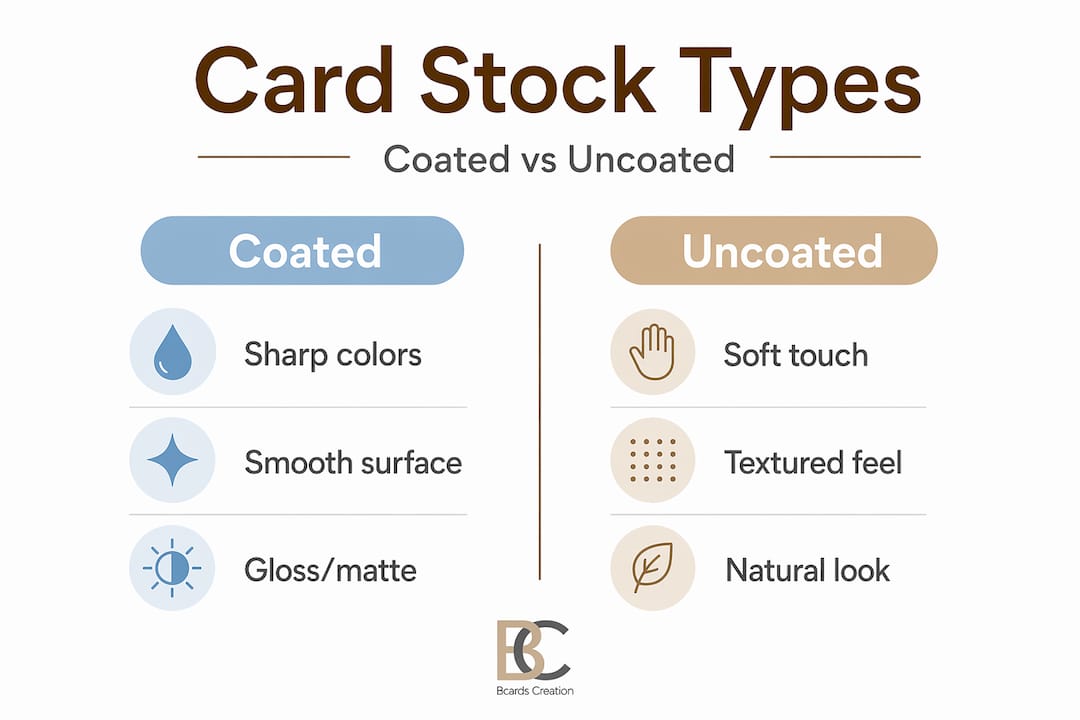
Uncoated stocks absorb ink into the fiber, which gives them a softer, more tactile surface. The texture reads as natural and approachable. Ink colors appear slightly less saturated, but the feel is warmer and more distinctive in hand.
C1S and C2S
Coated One Side (C1S) means the coating is applied to one face only. The reverse stays uncoated, which works well when one printed face is the focus and the back needs to accept writing or a different finish. C1S is used where one premium face is sufficient; C2S coats both sides, making it the right choice for double-sided designs where both faces carry print-intensive content.
Surface textures and specialty options
Beyond coated or uncoated, there are surface textures worth understanding:
- Wove: Smooth, even surface. The most common base for business cards.
- Laid: Features fine parallel lines across the surface, giving an elegant, traditional character.
- Embossed: A pattern pressed into the fiber, creating texture without printing.
- Metallic: Reflective surface finish that reads as high-end immediately.
- Glossy: High-shine coating that intensifies color depth and creates visual impact.
Glossy and textured finishes create measurably different sensory impressions, which matters when your business card is a branding touchpoint rather than a formality.
Virgin vs. recycled fiber
Virgin fiber card stock offers superior whiteness and strength. Colors print with higher fidelity, and the surface holds finishes more cleanly. Recycled fiber stock carries a different value: it supports your sustainability messaging and appeals to audiences who factor environmental responsibility into how they perceive a brand.
Virgin fiber provides better print quality; recycled fiber offers eco-branding advantages. Neither is objectively better. The right choice depends on what your brand stands for and who receives the card.
Pro Tip: If you’re targeting an audience that values sustainability, the material itself becomes part of the message. A recycled fiber card with intentional design can communicate more than a glossy sheet with premium print.
Thickness, durability, and what it signals
Thickness is not just a structural choice. It is a perception choice. When someone picks up a card and feels its weight, they form an impression before reading a single word. That impression is either aligned with your brand or it is not.
Lightweight to heavyweight: practical range
Lighter card stocks in the 8pt to 10pt range are functional but feel closer to heavy paper than to a proper card. They work for high-volume print runs where cost is the primary constraint, but they do not signal quality. A 12pt stock is the minimum for most professional business cards. At 14pt and above, the card holds its shape, resists bending, and feels solid in hand.
Heavyweight stocks at 16pt to 18pt require suitable equipment for cutting and finishing. Not every print shop can handle ultra-thick stocks without damaging edges or misaligning cuts. This is worth confirming before specifying a weight.
Aligning thickness with brand positioning
Here is how thickness decisions map to real-world brand contexts:
- A founder in finance or law handing out cards at a client meeting benefits from 16pt or heavier. The card signals stability and attention to detail.
- A creative professional or designer might choose a thinner specialty stock with a unique texture, trading thickness for tactile distinctiveness.
- A brand prioritizing sustainability may choose a recycled 14pt uncoated stock, where the material tells part of the story.
- A luxury brand or high-end service provider may go to 18pt or beyond with spot UV or foil finishing, where every material detail reinforces exclusivity.
Choosing card stock for premium business card materials is ultimately a positioning decision. Thickness is one variable; finish, color, and design are the others.
Pro Tip: Avoid the trap of ordering the thickest stock available and assuming the card will feel premium. A poorly finished 18pt card feels worse than a well-finished 14pt card. Stock selection and finishing must work together.
How to choose the right card stock
Making a good material choice requires thinking about several factors together, not in isolation. Here is a practical framework for working through the decision.
-
Define your brand position. Ask what category of brand you are. Premium, approachable, creative, corporate, sustainable? The material needs to reinforce that identity without contradiction.
-
Know your print method. Digital printing and offset printing handle coated and uncoated stocks differently. Some finishes, like foil stamping or letterpress, require specific stock types. Confirm compatibility with your printer before selecting.
-
Check your printer’s capabilities. Thicker stocks and specialty surfaces need equipment that can handle them cleanly. A printer that cannot cut 16pt accurately will undermine an otherwise strong material choice.
-
Consider what the card needs to do. Double-sided designs with full-bleed photography need C2S coated stock. A minimal typographic card might perform better on an uncoated textured sheet. Function and aesthetics should align.
-
Factor in sustainability goals. If environmental positioning matters to your brand or audience, recycled fiber stock with FSC certification signals that commitment clearly.
-
Test before you commit. Order samples or request a proof run before going to full production. What looks right on screen and reads right in a spec sheet may feel different in hand.
Working through this list before engaging a supplier saves time, avoids expensive reprints, and produces a card that actually represents the brand. For guidance on how card design and material integrate, the thinking applies the same way to every format.
My perspective on card stock selection
I’ve seen the same mistake repeated more than any other: a client specifies an 18pt card and assumes the work is done. The weight is right. The card will feel heavy. But they haven’t thought about the surface at all.
Weight without finish is like choosing a suit based on fabric weight and ignoring the cut. A matte laminated 14pt card from a quality paper house will outperform a raw 18pt sheet with a mediocre coating every time. The tactile experience shapes perception in ways that specs on a page cannot fully predict.
What surprises most people is how well-executed recycled fiber cards can feel. There’s an assumption that sustainable means lower quality. In practice, a textured recycled uncoated stock can feel more distinctive and premium than a standard coated sheet, especially when the design is built around the material rather than layered on top of it. The material is part of the design, not just a substrate for it.
My advice: focus on the combination of thickness, surface, and finish as a single system. Think about who picks up the card and what you want them to feel before they read it. Brand storytelling through material starts the moment someone touches the card.
— Kostiantyn
Explore custom card stock options with Bcardscreation
If you’ve worked through the considerations in this guide, you already know that card stock selection is not a simple checkbox. It’s a material decision that shapes how your brand registers with every person who receives your card.
Bcardscreation works with professionals and brands who treat this decision seriously. Every project includes individual material consultation, covering thickness, surface finish, fiber type, and finishing techniques. There are no templates and no automated editors. You can explore custom business card design options built around your brand, or browse luxury foil card options for designs that incorporate real foil finishes. For something outside traditional paper entirely, clear business cards offer a completely different material direction.
FAQ
What is card stock used for?
Card stock is used for business cards, postcards, invitations, packaging inserts, and other print applications where durability and a quality feel matter. Its thickness and rigidity make it more suitable than standard paper for items that need to hold their shape.
What is the standard thickness of card stock for business cards?
Most professional business cards use 14pt card stock, which equals approximately 0.014 inches or 300 GSM. Premium cards often go to 16pt or 18pt for a heavier, more substantial feel.
What is the difference between card stock vs paper?
Card stock is thicker and more rigid than standard paper. Regular printer paper runs around 4pt and 80 GSM; card stock starts at 8pt and typically exceeds 200 GSM, making it far more durable and suitable for handled print materials.
Does GSM or points better measure card stock thickness?
Points (pt) measure actual physical thickness and are the most reliable way to compare card stocks. GSM measures density, which correlates with thickness but varies by fiber type. For direct thickness comparison, use points.
How does finish affect card stock quality?
Surface finish affects both print quality and tactile feel. Coated stocks deliver sharper color reproduction; uncoated stocks offer a softer, more natural texture. The right finish depends on your design content and the brand impression you want to create.


