

Business Card Trends 2025: What Professionals Need to Know
TL;DR:
- Business cards in 2025 emphasize intentionality through luxury materials, eco-friendly options, and digital integration to communicate brand value.
- Design trends focus on tactile finishes, minimalist layouts, and functional features like QR codes, highlighting strategic brand positioning over mere contact sharing.
Physical business cards are not fading out. With 27 million cards still printed every day, demand has not dropped. What has changed is what people expect from a card. Business card trends 2025 reflect a sharp shift toward intentionality: professionals want cards that communicate brand positioning through material, finish, and function. This guide breaks down the key business card design trends 2025 is producing, from luxury tactile finishes to eco-conscious materials and digital integrations, so you can make design decisions that actually serve your brand.
Table of Contents
- Key takeaways
- Luxury and premium card trends
- Eco-friendly and minimalist design
- Innovative materials and tactile features
- Digital and interactive elements
- My take on 2025 card design
- Custom cards built for 2025 standards
- FAQ
Key takeaways
| Point | Details |
|---|---|
| Luxury demand is rising | Search interest in luxury cards peaked in late 2025, signaling growing appetite for premium materials and finishes. |
| Sustainability is gaining traction | Recycled, kraft, and plantable card options are building steady interest among brand-conscious professionals. |
| Tactile design drives recall | Embossing, silk lamination, and die-cut shapes make cards more memorable and harder to discard. |
| Digital integration adds function | QR codes and NFC chips connect physical cards to digital portfolios without replacing the card itself. |
| Cards are strategic brand assets | A well-designed card communicates positioning before a word is spoken. |
Luxury and premium card trends
Search data tells a clear story. Google Trends recorded a peak interest score of 100 for “luxury business cards” in December 2025. That is not a coincidence. Professionals across finance, real estate, law, and consulting have recognized that a card is often the first physical brand touchpoint. How it feels in someone’s hand shapes their perception immediately.
What makes a card feel luxury
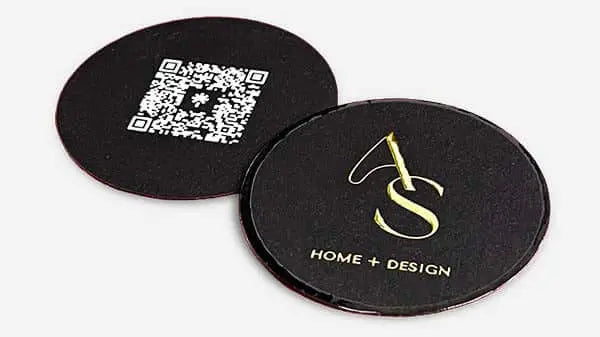
The materials do most of the work. Premium finishes like metal, silk lamination, embossing, and real foil have moved from novelty to expectation in high-end professional contexts. The design language that accompanies them matters equally. Dark palettes, refined typography, and metallic color combinations create a visual weight that feels deliberate.
Here is a comparison of the most popular luxury materials and what they communicate:
| Material or finish | Key characteristic | Brand impression |
|---|---|---|
| Metal (stainless steel or brass) | Heavy, durable, visually striking | Authority, exclusivity |
| Silk lamination | Soft matte texture, smooth to touch | Sophistication, restraint |
| Real gold or silver foil | Reflective, eye-catching detail | Premium positioning |
| Embossed lettering | Raised tactile elements | Craftsmanship, attention to detail |
| Dark matte cardstock | Deep base color, no glare | Confidence, editorial style |
The logic behind investing in luxury finishes is straightforward. In a competitive market, a card that feels different gets kept. One that feels generic gets forgotten or discarded within hours. For founders, executives, or creative directors who meet clients regularly, that distinction is worth the investment.
- Real foil stamping works best when used selectively on a logo or name, not across the entire card surface
- Embossing pairs well with dark backgrounds where the raised texture catches light
- Silk lamination protects ink quality over time, making it practical as well as tactile
- Metal cards work best for industries where longevity and perceived value are part of the brand promise
You can explore the strategic reasoning behind luxury card positioning in more depth if you are still deciding whether premium materials fit your brand context.
Eco-friendly and minimalist design
Not every business card trend in 2025 is about adding more. Some of the strongest design directions this year are about removing what is unnecessary.
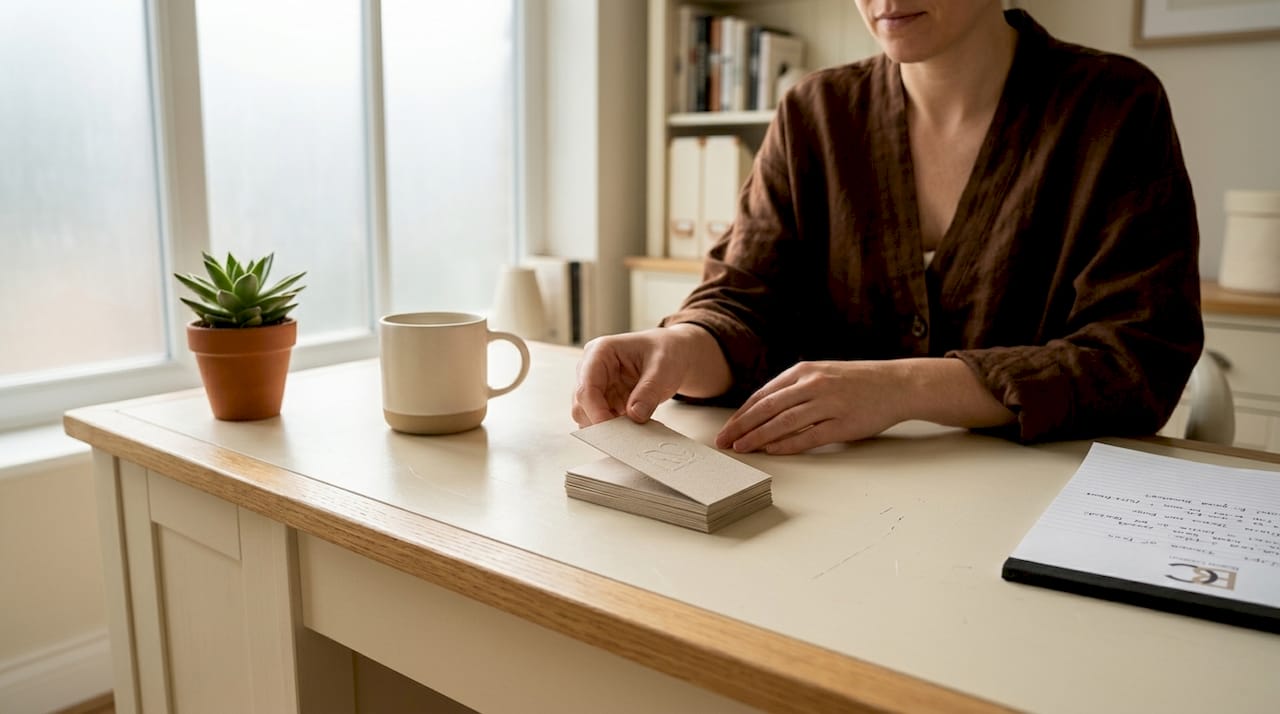
Sustainable materials have moved from a niche choice to a credible brand statement. Recycled paper, kraft stock, and plantable seed cards are appearing across industries where environmental alignment is part of the brand identity. These options are not compromises. Kraft paper in particular carries a textural quality that feels tactile and distinctive in a way that standard cardstock does not.
The minimalist aesthetic often accompanies these material choices. Clean lines, limited text, and deliberate white space are defining features of the minimalist approach. The goal is not to look bare. It is to make every element count. When a card contains only what is truly needed, each detail carries more weight.
Benefits of taking an eco-friendly and minimalist direction include:
- Alignment with corporate sustainability commitments, which matters to an increasingly large client base
- A cleaner visual presentation that photographs well and reads clearly at small sizes
- Reduced production cost on ink and finishing, which can offset the cost of premium sustainable stock
- A distinct aesthetic that stands apart from the overly busy designs still common in many industries
The growing interest in sustainable card designs is not just a consumer preference shift. It reflects a broader move toward brand authenticity. Professionals who genuinely operate with sustainability values benefit from having those values visible in every branded touchpoint, including the cards they hand out.
For a practical overview of what sustainable card materials actually deliver versus what is just marketing language, the 7 insights on sustainable cards article covers the real distinctions clearly.
Pro Tip: If minimalism feels too sparse for your brand, try this: keep the layout clean but choose one material or finish that adds sensory interest. A soft kraft stock with a single spot UV element gives you restraint in layout with richness in touch. You do not have to choose between personality and simplicity.
Innovative materials and tactile features
Material choice is where 2025 business card designs are making the boldest statements. Tactile cards are not just visually interesting. They activate a different kind of attention. Touch is a more direct sense than sight, and a card that feels unexpected gets noticed in a way that print alone cannot achieve.
The range of substrates in use has expanded considerably. Custom die-cut and non-standard shapes are increasingly common for creative professionals and consumer-facing brands. Transparent plastic cards are a strong choice for brands with a modern, technical aesthetic. Wood and fabric-based cards are less common but create a distinctly memorable impression when the brand context supports them.
Tactile effects worth knowing:
- Embossing: Raises selected design elements above the card surface. Works especially well for logos and monograms.
- Debossing: Presses elements into the card surface for a recessed effect. Often paired with foil fill.
- Raised UV lettering: Adds a gloss-raised texture to specific text or graphics. Visible and touchable simultaneously.
- Soft-touch lamination: Coats the card in a velvety matte layer. Changes the entire feel of the card without affecting the visual design.
- Spot UV: Applies high-gloss coating selectively over matte surfaces for contrast effects.
These are not decorative choices. They are communication tools. A raised logo on a soft-touch card tells the person holding it that this brand pays attention to details. That perception transfers directly to how they think about your services.
If you want to see how innovation in tactile finishes translates into real branding outcomes, the examples there are worth reviewing.
Pro Tip: Choose materials and finishes that match what your brand actually promises. A law firm should not be handing out seed paper cards any more than an environmental nonprofit should be using brushed steel. The material choice is part of the message. Get that alignment right first, then optimize for finish.
Digital and interactive elements
Physical and digital are not competing. The strongest 2025 business card designs treat the card as a bridge between a handshake and an online connection. QR codes and NFC chips have become genuinely practical tools for this. A QR code that opens directly to a portfolio, LinkedIn profile, or booking page adds real function without adding visual clutter if it is placed thoughtfully.
Here is a practical order of operations for integrating digital elements:
- Decide what the digital destination is. A card that links to a cluttered or outdated website defeats the purpose. Update the landing page before you print.
- Choose QR or NFC based on your audience. QR codes work universally. NFC requires a compatible phone and a tap, which some recipients may not expect. For most professionals, QR remains more reliable.
- Size and place the QR code intentionally. A code that is too small will not scan reliably. A minimum of 2.5 cm square is the practical floor. Place it where it does not compete with the primary information.
- Test before you print. Scan the final QR code from a printed proof, not just a screen. Finishes like silk lamination or spot UV can affect scanability if applied directly over the code.
- Consider augmented reality selectively. AR layers on cards are emerging in creative industries. They add immersive brand storytelling potential but require the recipient to download an app or follow specific steps. Use only when your audience will genuinely engage with the added step.
Cards with secondary physical functions such as integrated rulers, rounded bottle opener edges, or seed-packet formats add retention value. Functional card add-ons give recipients a reason to keep the card on a desk rather than file it away. That extended visibility compounds the branding impact over time.
Pro Tip: Do not add a QR code just because it is expected. If your card’s primary purpose is a high-touch luxury context such as a formal dinner or premium client event, a QR code may lower the perceived value of the card. Read the room. The best design decision is the one that fits the specific situation.
My take on 2025 card design
I have worked with enough professionals on card projects to notice a pattern. The clients who get the most value from their cards are not the ones who chase every new trend. They are the ones who understand their own brand first and then select one or two trends that genuinely reinforce it.
What I have found is that the luxury and sustainability directions are not as contradictory as they seem. A card printed on premium recycled stock with real foil detail is both. The tension between them dissolves when you stop thinking about trends as categories and start thinking about what your card needs to communicate to a specific person in a specific moment.
The interactive features are real and worth using, but only when the context supports them. I have seen cards with NFC chips handed to people who did not know what to do with them. The technology became a liability instead of an asset. QR codes, placed well and linked to something worth seeing, are still the most reliable digital integration available.
My prediction for where things are heading: physical cards as strategic assets will become even more differentiated from commodity printing. The gap between a card that communicates brand value and one that just conveys contact information will widen. Professionals who treat their cards as part of a broader brand system will have a visible advantage in high-stakes networking situations.
The material is not the trend. The thinking behind the material is.
— Kostiantyn
Custom cards built for 2025 standards
If the trends covered in this article describe where you want your brand to be positioned, Bcardscreation works with professionals to get there without templates or automated editors.
Every project at Bcardscreation starts with a consultation on brand positioning and material fit. You get access to specialty finishes, premium substrates, and expert design guidance developed around your specific brand context. For professionals looking to produce luxury foil business cards with real impact, or for those who need custom card design built from scratch, both options are available with full production oversight. Bcardscreation also offers transparent card options for brands that want a modern, distinctive presentation. Small-batch production. No minimum order pressure. Just cards designed to do a specific job well.
FAQ
What are the biggest business card trends in 2025?
The leading trends are luxury materials with tactile finishes, eco-friendly substrates like recycled and kraft paper, minimalist layouts, and digital integrations such as QR codes and NFC chips. Each reflects a shift toward cards that communicate brand positioning rather than just contact details.
Are physical business cards still worth using in 2025?
Yes. With 27 million cards printed daily, physical cards remain a high-value networking tool, especially when they are designed with intention and quality materials that reinforce brand perception.
What materials are trending for business cards in 2025?
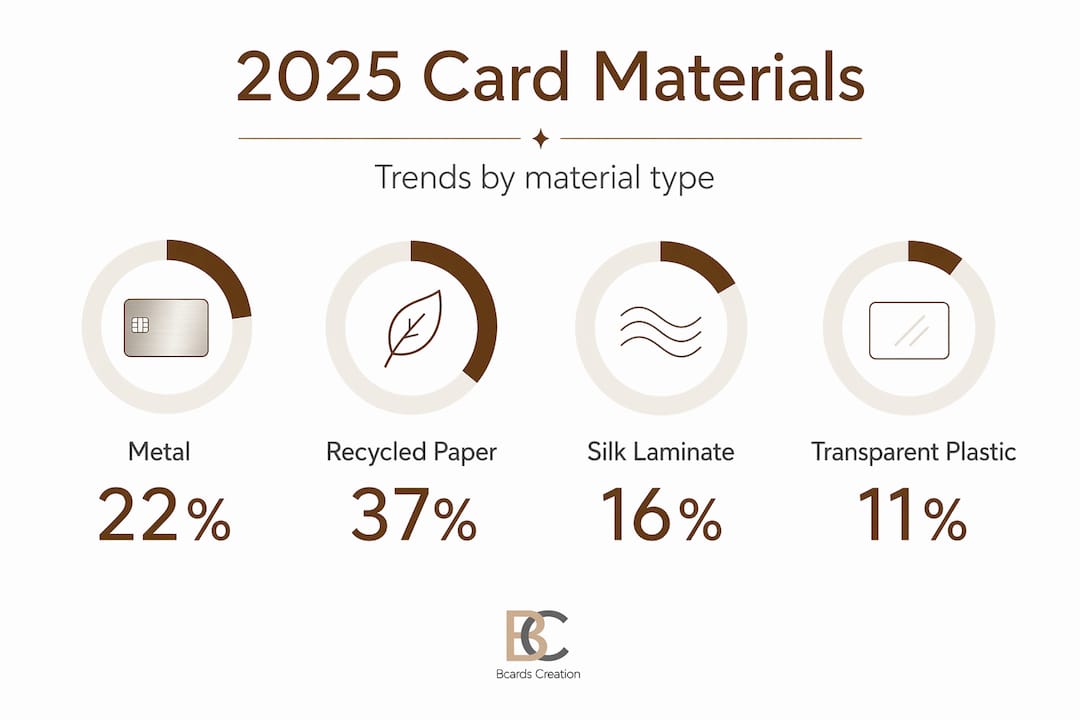
Trending business card materials include metal, silk-laminated cardstock, recycled and kraft paper, transparent plastic, and specialty finishes like real foil and soft-touch lamination. The right choice depends on your brand identity and the context in which you use your cards.
Should I add a QR code to my business card?
A QR code is worth adding if it links to something genuinely useful, such as a portfolio, booking page, or LinkedIn profile, and if the card’s visual design accommodates it cleanly. Avoid adding one just for convention. In luxury or formal contexts, it may reduce the card’s perceived value.
What is the difference between embossing and debossing?
Embossing raises selected design elements above the card surface. Debossing presses them into the surface for a recessed effect. Both are tactile techniques that add dimension and reinforce the impression of quality craftsmanship.
Recommended
- 7 Essentials for Luxury Business Cards in 2025: Materials, Finishes, a – BcardsCreation
- Business Card Marketing Step by Step for Entrepreneurs – BcardsCreation
- Must-have details on business cards for brand impact – BcardsCreation
- Master the creative business card design process in 2026 – BcardsCreation


