

How mirror finish is produced: the technology behind it
How mirror finish is produced: the technology behind it
Most people assume a mirror finish comes from one quick polish, but the reality involves precise multi-stage processes with specialized abrasives, compounds, and skilled craftsmanship. Understanding the layered construction, progressive polishing, and material selection behind mirror finish business cards helps designers specify better finishes and create premium branding tools. This guide explores the detailed technology, methods, and considerations that produce the flawless reflective surfaces defining luxury business cards in 2026.
Table of Contents
- Understanding Mirror Finish And Surface Smoothness
- Polishing Techniques And Abrasive Progression
- Material Considerations For Mirror Finishing
- Common Misconceptions About Mirror Finishes
- Application In Premium Business Card Production
- Frequently Asked Questions About Mirror Finish Business Cards
Key takeaways
| Point | Details |
|---|---|
| Surface smoothness | Mirror finishes require ultra-smooth surfaces with Ra values around 0.02 micrometers for optical clarity and distortion-free reflection. |
| Progressive polishing | The process involves sequential polishing from coarse to ultra-fine grit (40 to 2000+) and multi-stage buffing with specialized compounds. |
| Material selection | Stainless steel, carbon steel, plastics, and coated papers each require tailored polishing methods affecting durability and finish quality. |
| Common myths | Mirror finishes cannot be achieved by single-step polishing or chemical coating alone; multiple mechanical stages are essential. |
| Design impact | Understanding the technology enables designers to make informed material and finishing choices for premium brand positioning. |
Understanding mirror finish and surface smoothness
A mirror finish creates an ultra-smooth, highly reflective surface with minimal distortion. Achieving this requires removing microscopic imperfections to reach surface roughness around 0.02 micrometers, the standard for true mirror-like clarity. Surface roughness average (Ra) measures the vertical deviations of a surface profile, and lower Ra values indicate smoother surfaces that reflect light uniformly rather than scattering it.
Surface roughness directly impacts visual performance. Rougher surfaces cause diffuse reflections, creating hazy or clouded images instead of sharp, clear reflections. When Ra values exceed 0.02 micrometers, even slightly, the finish loses optical clarity and appears less premium. Quality control in mirror finish production relies on precise Ra measurements to ensure consistent reflectivity across every business card.
Producing mirror finishes is labor-intensive and requires skilled craftsmanship to systematically remove machining marks and surface flaws. Skilled technicians must judge when each polishing stage is complete and transition to finer abrasives without introducing new scratches. This manual expertise cannot be fully automated, making mirror finishes a premium offering.
Key benchmarks for mirror finish quality:
- Ra value of 0.02 micrometers or lower for optical clarity
- No visible machining marks or directional grain lines
- Uniform reflectivity across the entire surface
- Distortion-free reflection of objects and light sources
“Surface roughness is the critical factor separating a true mirror finish from merely shiny surfaces. Controlling Ra to sub-micrometer levels requires both advanced equipment and human skill to interpret surface conditions and adjust techniques accordingly.”
Understanding these technical standards helps designers appreciate the luxury mirror business cards impact and specify appropriate finishes that deliver the intended brand impression. The effort invested in achieving these ultra-smooth surfaces translates directly into perceived quality and sophistication.
Polishing techniques and abrasive progression
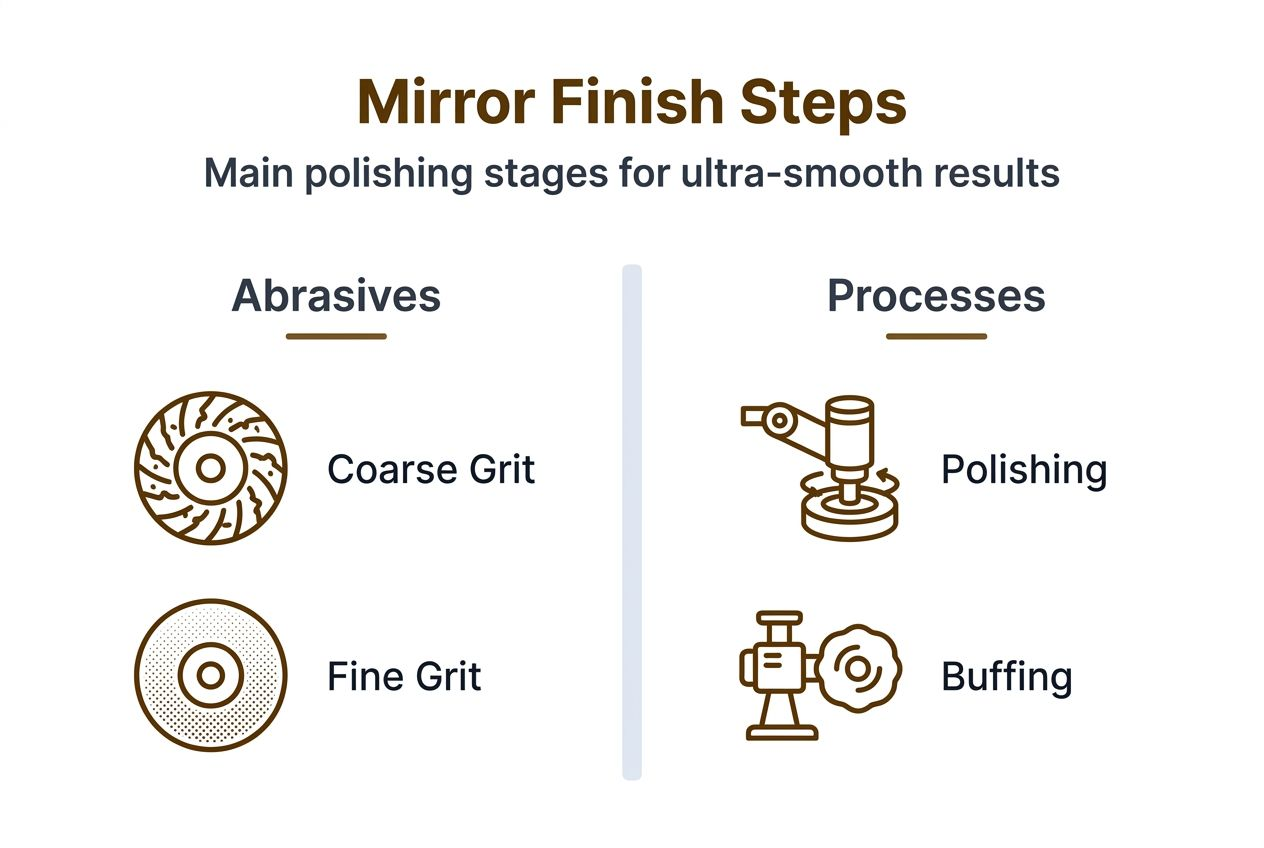
Creating a mirror finish involves systematic mechanical polishing using progressive grit from coarse to ultra-fine abrasives. This sequential approach removes larger imperfections first, then progressively finer scratches until the surface reaches optical smoothness. Skipping grit levels causes inefficiency and poor results because coarse scratches remain visible under finer polishing stages, requiring rework.
The polishing process for #8 mirror finish typically starts with 320 grit abrasives and progresses through 400, 600, 1000, 1500, and 2000+ grit stages. Each stage removes the scratches from the previous grit while introducing finer scratches that the next stage will eliminate. This gradual refinement is essential for achieving non-directional, highly reflective surfaces.
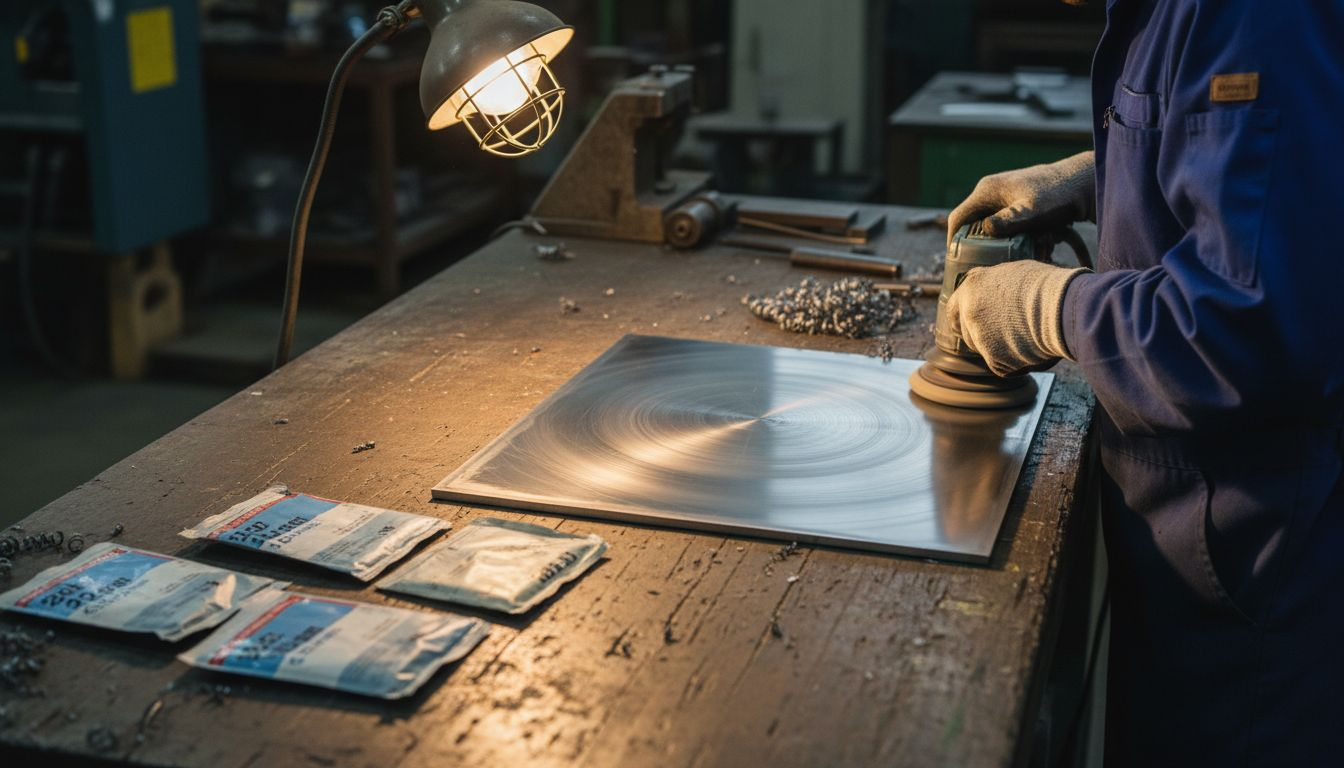
Buffing follows polishing and uses color-coded compounds matched to specific buffing wheel materials. Coarse compounds (brown or black) provide initial cutting action, intermediate compounds (white or green) refine the surface further, and jeweler’s rouge (red) delivers the final mirror shine. Matching compound abrasiveness to wheel firmness optimizes material removal rates and surface quality.
Sequential polishing and buffing workflow:
- Start with 40-400 grit abrasives to remove heavy machining marks and level the surface.
- Progress through 600-1000 grit to eliminate coarse scratches and begin surface refinement.
- Advance to 1500-2000+ grit for ultra-fine smoothing and pre-buffing preparation.
- Apply coarse buffing compound with firm wheels to remove residual fine scratches.
- Use intermediate compound with medium wheels to enhance reflectivity and smoothness.
- Finish with jeweler’s rouge and soft wheels for final mirror shine and optical clarity.
| Grit Range | Purpose | Surface Outcome |
|---|---|---|
| 40-400 | Remove machining marks, heavy leveling | Visible scratch pattern, matte appearance |
| 600-1000 | Eliminate coarse scratches, refine surface | Finer scratch pattern, semi-gloss |
| 1500-2000+ | Ultra-fine smoothing, pre-buffing | Minimal visible scratches, high gloss |
| Buffing (coarse) | Initial polishing compound cutting | Reflective but not optical clarity |
| Buffing (intermediate) | Enhanced shine and smoothness | Near-mirror reflectivity |
| Buffing (jeweler’s rouge) | Final mirror finish | Optical clarity, distortion-free |
Pro Tip: Allow sufficient time for each polishing stage and avoid rushing the process. Insufficient time at any stage leaves residual scratches that appear as swirl marks or haze in the final finish, which is especially noticeable on business cards under direct light.
Understanding this progression helps designers avoid design mistakes mirror cards suffer from when finishing shortcuts are taken. The disciplined application of each grit level and buffing compound ensures consistent, premium results that enhance brand perception.
Material considerations for mirror finishing
Material choice profoundly affects polishing methods, finish quality, and durability. Different substrates respond uniquely to abrasives and compounds, requiring tailored approaches to achieve optimal mirror finishes. Stainless steel, carbon steel, plastics, and specialty coated materials each present distinct advantages and challenges for mirror finishing in business card production.
Stainless steel offers corrosion resistance and durability with a highly reflective finish, but requires specialized polishing stages due to its hardness and tendency to work-harden under abrasion. The chromium content that provides corrosion resistance also makes polishing more labor-intensive. However, once achieved, stainless steel mirror finishes maintain their appearance with minimal maintenance, making them ideal for business cards that must withstand frequent handling.
Carbon steel is easier to polish than stainless steel due to its softer composition, but it needs protective coatings to prevent rust and oxidation. Without proper sealing, carbon steel mirror finishes tarnish quickly, diminishing their visual impact. Tool steel provides excellent wear resistance but presents polishing challenges similar to stainless steel, requiring patience and skill.
Chemical vapor polishing for plastics like polycarbonate offers an alternative to mechanical methods. This process melts the surface layer microscopically, instantly creating a water-clear, mirror-like finish ideal for precision parts and complex geometries. Vapor polishing suits business cards with intricate cutouts or embossed features where mechanical buffing wheels cannot reach effectively.
Material comparison for mirror finish business cards:
- Stainless Steel: Requires multi-stage polishing (320-2000+ grit) and specialized buffing. Offers superior durability and corrosion resistance. Maintains finish with minimal care. Higher labor cost but longest-lasting results.
- Carbon Steel: Easier to polish with standard abrasives. Needs protective clear coating to prevent oxidation. More affordable but requires maintenance. Suitable for short-term promotional cards.
- Polycarbonate Plastic: Can use chemical vapor polishing for complex shapes. Lightweight and impact-resistant. Finish may scratch more easily than metal. Good for innovative card designs with cutouts.
- Coated Paper/Cardstock: Mirror effect achieved through metallic lamination layers rather than polishing. Lower cost and faster production. Limited durability compared to polished metal or plastic. Best for budget-conscious projects.
Material selection impacts production timelines, cost structures, and the final tactile experience. Designers must balance aesthetic goals with practical considerations like mirror business cards durability requirements and client budgets. Understanding these material properties enables informed specifications that align with brand positioning strategies.
Common misconceptions about mirror finishes
Several myths surround mirror finish production, leading to unrealistic expectations and specification errors. The most persistent misconception is that mirror finishes can be achieved through a single polishing step or by applying a chemical coating alone. In reality, true mirror finishes require multiple stages of abrasive sanding, buffing, and compound application to systematically remove microscopic scratches and build reflectivity.
Chemical coatings like clear lacquers or protective films enhance protection and can add aesthetic effects, but they cannot replace the mechanical smoothing necessary for genuine reflectivity. Coatings applied over rough surfaces simply replicate the underlying texture, resulting in glossy but not mirror-like finishes. The substrate must first achieve optical smoothness through progressive polishing before any protective coating is applied.
Another common assumption is that automated machines alone produce mirror finishes without skilled manual labor. While CNC polishing equipment provides consistency for initial stages, achieving flawless optical clarity requires human judgment and hand finishing. Experienced technicians detect subtle surface flaws, adjust pressure and motion, and determine when to transition between abrasive stages. This craftsmanship is irreplaceable for premium results.
Debunking mirror finish myths:
- Myth: One-step polishing produces mirror finishes. Reality: Multiple grit stages (40 to 2000+) plus buffing compounds are essential.
- Myth: Chemical coatings alone create mirror surfaces. Reality: Coatings protect finishes but cannot generate smoothness or reflectivity on rough substrates.
- Myth: Machines handle everything automatically. Reality: Skilled manual finishing is critical for flaw detection and achieving optical clarity.
- Myth: All shiny surfaces are mirror finishes. Reality: True mirror finishes have Ra values around 0.02 micrometers; many glossy surfaces are much rougher.
- Myth: Mirror finishes are fragile and impractical. Reality: Properly executed on durable materials like stainless steel, they withstand normal handling well.
Pro Tip: Collaborate closely with your finishing provider to understand the labor intensity and quality standards they apply. Request Ra measurements or surface roughness data to verify that finishes meet mirror specifications rather than just appearing shiny.
Recognizing these misconceptions helps designers set accurate expectations and communicate effectively with production partners. Understanding the difference between mirror vs foil business cards also clarifies that foil stamping creates metallic accents through heat transfer, while mirror finishes involve surface polishing to optical smoothness. Both enhance business cards but through entirely different technologies.
Application in premium business card production
Mirror finishes elevate perceived brand quality and sophistication on business cards, creating memorable first impressions that distinguish premium brands from competitors. The ultra-smooth reflective surface signals attention to detail and investment in quality, traits that clients associate with the brand itself. For designers and branding professionals, leveraging mirror finish technology transforms business cards from simple contact information into strategic positioning tools.
Understanding the finishing technology enables precise material and polishing technique specifications. Designers can choose between polished metal substrates for maximum durability, vapor-polished plastics for innovative shapes, or laminated mirror-effect papers for cost-effective premium appearance. Each option suits different brand identities and budget constraints while maintaining a luxury aesthetic.
Finish choice directly impacts production cost, durability, and the ultimate visual and tactile impression. Polished stainless steel cards cost more due to labor intensity but offer unmatched longevity and prestige. Laminated mirror-effect options provide similar visual impact at lower cost but with reduced durability. Designers must balance these tradeoffs based on client goals, distribution plans, and brand positioning strategies.
Recommendations for specifying mirror finishes on business cards:
- Evaluate material durability needs based on card distribution context (handed out frequently vs kept as keepsakes).
- Consider cost-quality tradeoffs between polished metal, vapor-polished plastic, and laminated mirror-effect finishes.
- Work closely with print studios to understand their polishing capabilities and quality control standards.
- Request sample cards or Ra measurements to verify that finishes meet optical clarity expectations.
- Design with the reflective surface in mind, using contrast and negative space to enhance the mirror effect.
- Plan for longer lead times compared to standard printing, as mirror finishes require multi-stage production.
- Specify protective packaging to prevent scratches during shipping and storage before distribution.
Mirror finish effects create distinctive premium branding opportunities that resonate with high-value clients and partners. The reflective surface catches light dynamically, making cards stand out in wallets and on desks. This constant visual presence reinforces brand recall and positions the business as detail-oriented and quality-focused. Explore mirror effect business cards collections to see design possibilities that leverage advanced finishing technology. Understanding the complete luxury business card workflow from concept to delivery ensures that mirror finish specifications align with broader branding strategies and client expectations.
Discover premium mirror finish business cards
Ready to translate technical finishing knowledge into stunning physical cards that elevate your brand presence? BcardsCreation offers expertly crafted mirror finish business cards tailored to your unique design vision and brand positioning goals. Every project receives personalized attention with professional design support, material consultation, and precision finishing using advanced printing and polishing technologies.
Customize your designs with specialized mirror effects, integrating reflective surfaces with other premium techniques like spot UV, embossing, or custom die-cutting. Our team helps you navigate material choices and finishing options to achieve the exact visual and tactile impression you envision. Whether you need polished metal cards for maximum impact or laminated mirror-effect options for broader distribution, we deliver quality that reflects your brand standards.
Explore our custom business card design services to collaborate on creating cards that capture attention and communicate sophistication. Browse creative business cards printing and foiling options to combine mirror finishes with other advanced techniques. Discover the full business cards collection to find inspiration and see how premium finishes transform ordinary cards into powerful branding tools that position your business for success.
Frequently asked questions about mirror finish business cards
How durable are mirror finish business cards?
Mirror finish cards using polished stainless steel or protected metal substrates offer excellent durability, withstanding frequent handling without losing reflectivity. Proper protective coatings and careful material selection ensure mirror business cards durability meets professional standards. Laminated mirror-effect options provide good durability for typical distribution scenarios but may show wear faster than solid polished metal cards.
What is the typical production timeline for mirror finish cards?
Production timelines for mirror finish business cards range from 2 to 4 weeks depending on material choice and finishing complexity. Polished metal cards require more time due to multi-stage polishing and quality control, while laminated mirror-effect options can be produced faster. Rush services may be available but could compromise finish quality, so planning ahead ensures optimal results.
How should I care for mirror finish business cards?
Store mirror finish cards in protective sleeves or cases to prevent scratches from contact with other objects. Clean gently with a soft, lint-free microfiber cloth and avoid abrasive cleaners that could damage the finish. For polished metal cards, occasional cleaning maintains reflectivity, while laminated options generally need no special maintenance beyond avoiding sharp objects.
How do mirror finishes differ from foil stamping?
Mirror finishes create reflective surfaces through mechanical polishing or lamination across the entire card or large areas, achieving optical smoothness and uniform reflectivity. Foil stamping applies metallic foil to specific design elements using heat and pressure, creating accents rather than full-surface reflectivity. Mirror finishes offer broader visual impact, while foil adds targeted metallic highlights.
What factors influence the cost of mirror finish business cards?
Cost factors include material choice (polished metal vs laminated), finishing complexity (number of polishing stages), card quantity, design intricacy, and additional techniques like embossing or die-cutting. Polished stainless steel cards cost more due to labor-intensive finishing, while laminated mirror-effect options offer premium appearance at lower cost. Production volume also affects per-card pricing, with larger orders typically reducing unit costs.


