

Mirror Business Cards 2026: 35% Higher Luxury Brand Impact
Mirror business cards increase brand memorability by up to 35% among luxury consumers, making them a powerful tool for executives and brand owners who need to stand out. These reflective cards combine advanced materials with strategic design to deliver measurable brand impact. This guide covers the materials, production techniques, design principles, and strategic positioning that make mirror business cards effective for luxury branding.
Table of Contents
- Introduction To Mirror Business Cards In Luxury Branding
- Materials And Technologies Behind Mirror Business Cards
- Design Principles For Effective Mirror Business Cards
- Production Process And Quality Assurance
- Durability, Maintenance, And Common Misconceptions
- Comparing Mirror Business Cards To Other Luxury Card Options
- Integrating Mirror Business Cards Into Brand Identity Systems
- Practical Application And Strategic Positioning
- Explore Premium Mirror Business Card Solutions
- Frequently Asked Questions
Key Takeaways
| Point | Details |
|---|---|
| Brand Impact | Mirror business cards enhance brand prestige and client recall significantly through reflective surfaces. |
| Durability Advantage | Advanced UV coatings improve scratch resistance by up to 70%, ensuring long-term performance. |
| Design Adaptation | Typography and color must be adjusted for reflective surfaces to maintain clarity and readability. |
| Investment Justification | Higher costs deliver measurable returns through enhanced brand memorability and strategic positioning. |
| Production Quality | Proper workflow and quality controls are critical for consistent mirror finish integrity. |
Introduction to Mirror Business Cards in Luxury Branding
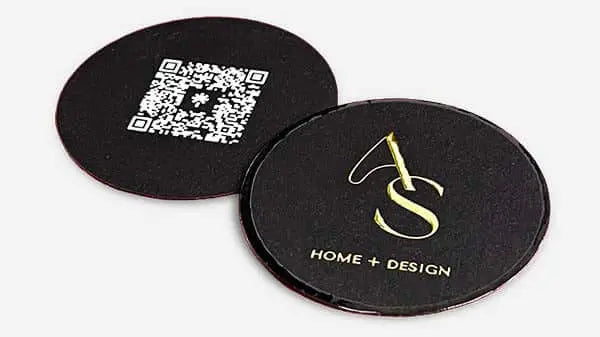
Mirror business cards represent a premium category of business cards featuring high-reflectivity surfaces that create a polished, metallic appearance. These cards use specialized metalized films and coatings to achieve their distinctive mirror effect, setting them apart from standard matte or glossy finishes.
The psychological impact is measurable. Luxury consumers perceive mirror-finished business cards as 25-35% more memorable and 20% more reflective of brand prestige compared to conventional cards. This enhanced perception translates directly into stronger brand recognition and recall during networking interactions.
Several luxury sectors and executive roles regularly use mirror cards:
- High-end beauty and cosmetics professionals
- Boutique creative agencies and design consultants
- Luxury real estate and property developers
- Executive coaches and strategic consultants
- Premium jewelry and fashion brands
Mirror cards elevate brand identity by signaling attention to detail and willingness to invest in quality. They communicate that your brand values excellence and differentiation. Unlike common foil stamping or standard glossy finishes, mirror surfaces provide full-coverage reflectivity that creates a distinctive tactile and visual experience.
Explore our mirror business cards collection to see how reflective surfaces transform brand perception. Understanding the strategic value of luxury business card investment helps you position these cards effectively within your broader brand strategy.
Materials and Technologies Behind Mirror Business Cards
The mirror effect requires specialized materials and production technologies that go beyond standard printing processes. Metalized films and foil layers form the foundation, creating the reflective surface through vacuum deposition or lamination processes. These metallic layers bond to specialty substrates engineered to support the mirror finish without warping or degrading.
Substrates for mirror cards typically include rigid plastic cores or heavy cardstock with smooth surfaces. The substrate must remain dimensionally stable during coating and finishing to prevent distortion. Plastic substrates offer superior durability and moisture resistance, while premium cardstock provides a more traditional feel with modern reflectivity.
UV coating processes protect the mirror surface and enhance performance. UV coatings increase scratch resistance by up to 70%, significantly improving durability for regular handling. The coating application involves precise layering followed by UV curing, which instantly hardens the protective layer through ultraviolet light exposure.
Production workflow follows these key steps:
- Substrate preparation and surface treatment for optimal adhesion
- Application of metalized film or foil layer through lamination or deposition
- Printing of design elements using specialty inks compatible with reflective surfaces
- UV coating application in controlled environment
- Curing process using calibrated UV lamps
- Final cutting and quality inspection
Curing techniques lock in finish quality by ensuring complete polymerization of the coating. Temperature and exposure time must be precisely controlled to prevent under-curing or over-curing, both of which compromise durability and appearance.
Pro Tip: Request material samples before committing to full production. Physical samples reveal how your design interacts with the mirror surface under different lighting conditions, helping you make informed adjustments.
Sustainable options exist for premium cards. Some manufacturers now offer recycled plastic substrates and water-based UV coatings that reduce environmental impact without sacrificing quality. Learn more about luxury business card materials and explore mirror effect business card materials to understand your options. Our production technology expert partner provides additional technical insights.
Design Principles for Effective Mirror Business Cards
Reflective surfaces change how design elements appear, requiring deliberate adjustments to maintain clarity and impact. Typography demands special attention. Reflective surfaces require font sizes of at least 10pt and simpler graphics for legibility. Smaller fonts become difficult to read when light reflects off the surface, creating visual noise that obscures letterforms.
Color selection must optimize contrast without creating glare. Dark text on light mirror backgrounds works well, as does reverse contrast with light text on darker metallic tones. Avoid mid-tone colors that blend into the reflective surface. High contrast ensures your message remains readable across different viewing angles and lighting conditions.
Intricate details and fine lines pose challenges on mirror surfaces. Complex patterns or delicate flourishes can distort in reflections or appear inconsistent across the card. Simplify your design elements. Use bold, clean shapes and generous spacing to let the mirror effect enhance rather than compete with your brand message.
Integrating mirror cards with existing brand visuals requires careful coordination. Your color palette may need adjustment to account for the metallic undertone of the mirror surface. Typography choices should maintain brand consistency while adapting to the reflective medium. Test how your logo and brand marks translate to the mirror finish before finalizing the design.
Common pitfalls to avoid:
- Using fonts smaller than 10pt that become illegible
- Choosing colors with insufficient contrast against metallic backgrounds
- Overloading the design with too many visual elements
- Ignoring how different lighting conditions affect readability
- Failing to account for fingerprint visibility on high-gloss surfaces
Pro Tip: Create design mockups using metallic or reflective papers to simulate how your layout will appear on actual mirror cards. This physical preview reveals issues that digital mockups miss.
Apply luxury design principles to ensure your mirror cards align with strategic brand positioning. Understanding brand engineering design helps you make design decisions that support business objectives.
Production Process and Quality Assurance
Manufacturing mirror business cards requires precision at every stage to preserve the reflective finish and ensure flawless results. The production workflow begins with substrate preparation, where surfaces undergo cleaning and treatment to promote adhesion. Any contamination or surface irregularity will telegraph through the mirror finish, creating visible defects.
Printing on mirror surfaces uses specialty inks formulated for metallic substrates. Standard offset or digital inks often fail to adhere properly or create uneven coverage. UV-curable inks work best, bonding directly to the metalized surface through instant curing. Color accuracy requires careful calibration because the reflective background alters how ink colors appear.
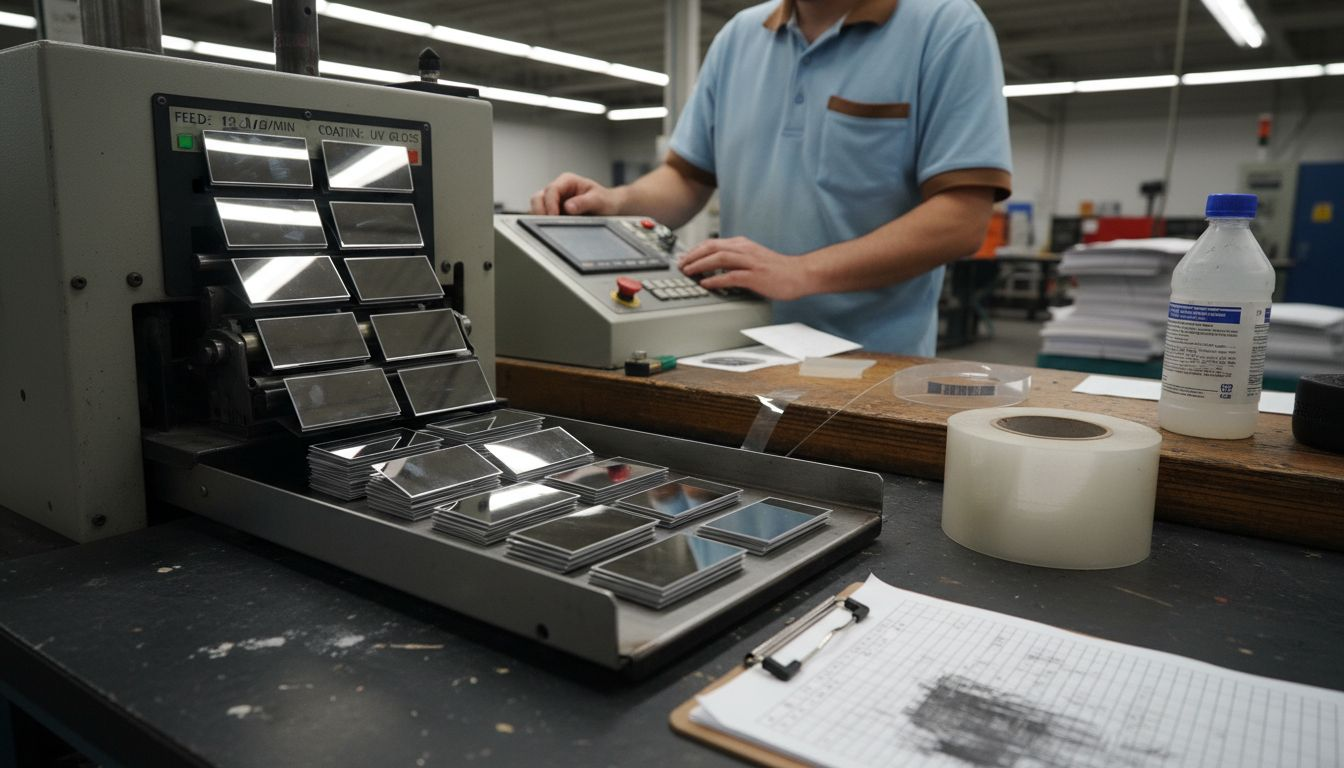
Finishing steps protect the mirror surface and add dimension. Foil stamping can layer additional metallic accents over the base mirror finish. Embossing and debossing create tactile variation that complements the visual reflectivity. Each finishing technique requires specialized dies and precise pressure control to avoid damaging the mirror layer.
UV curing happens at multiple points in the workflow:
- After ink application to bond printed elements
- Following protective coating application
- After any additional finish layers
- Before final cutting and handling
Common production challenges include air bubbles under laminated films, uneven coating application, and scratches during handling. Solutions involve controlled environment production, automated coating systems, and protective interleaving between finished cards. Quality checkpoints and finishing techniques preserve mirror effect integrity throughout the process.
Consistency demands rigorous inspection protocols. Each production run should include sample checks for coating uniformity, color accuracy, and surface quality. Visual inspection under controlled lighting reveals defects that might escape notice in ambient conditions. Dimensional accuracy matters too since mirror cards often stack or fit into specific holders.
Finishing steps that protect mirror surfaces include edge sealing to prevent delamination, protective film application during shipping, and careful packaging to avoid contact damage. Individual sleeves or rigid boxes prevent scratching during transit and storage.
Review the business card production workflow to understand quality standards. Our production process expert offers detailed technical specifications.
Durability, Maintenance, and Common Misconceptions
Mirror business cards withstand regular use when properly manufactured, but they require realistic expectations about care and handling. UV coatings improve scratch resistance by up to 70%, making modern mirror cards far more durable than earlier versions. However, no coating is truly scratch-proof, and the reflective surface shows marks more readily than matte finishes.
Practical durability depends on coating quality and substrate choice. Plastic substrates resist bending and moisture better than paper-based cards. Multi-layer constructions with protective topcoats maintain their appearance longer than single-layer designs. Regular handling during networking events causes minimal wear on well-coated cards, though keys or abrasive surfaces can still scratch them.
Best practices for storage and handling:
- Keep cards in individual sleeves or card cases to prevent contact scratching
- Store in cool, dry environments away from direct sunlight
- Handle by edges when possible to minimize fingerprints
- Clean gently with microfiber cloth, avoiding harsh chemicals
- Avoid stacking unprotected cards directly on top of each other
Common misconceptions deserve correction. Many assume mirror cards are too fragile for everyday use, but quality construction delivers reliable performance. The cost concern is valid since mirror cards do cost more, but the investment delivers measurable brand impact. Some believe all reflective finishes are the same, but mirror surfaces differ significantly from standard foil or glossy coatings in both appearance and production method.
| Feature | Mirror Cards | Matte Luxury | Foil Accent |
|---|---|---|---|
| Scratch Resistance | High with UV coating | Very High | Moderate |
| Fingerprint Visibility | Moderate to High | Low | Low to Moderate |
| Cost Premium vs Standard | 2.5-4x | 1.5-2x | 2-3x |
| Visual Impact | Maximum reflectivity | Subtle sophistication | Strategic highlights |
| Maintenance Needs | Regular cleaning | Minimal | Minimal |
Pro Tip: Order extra cards for your initial run. Having backup cards means you can replace any that show wear without waiting for a new production cycle.
Long-term appearance maintenance involves occasional cleaning and careful storage. Fingerprints accumulate on mirror surfaces, but they wipe away easily with proper materials. Avoid paper towels or rough cloths that can scratch the coating. Microfiber cleaning cloths designed for electronics work perfectly.
Find business card durability tips to extend the life of your mirror cards.
Comparing Mirror Business Cards to Other Luxury Card Options
Luxury business cards come in several premium formats, each offering distinct advantages for strategic brand positioning. Understanding the differences helps you select the option that best matches your brand personality and target audience expectations.
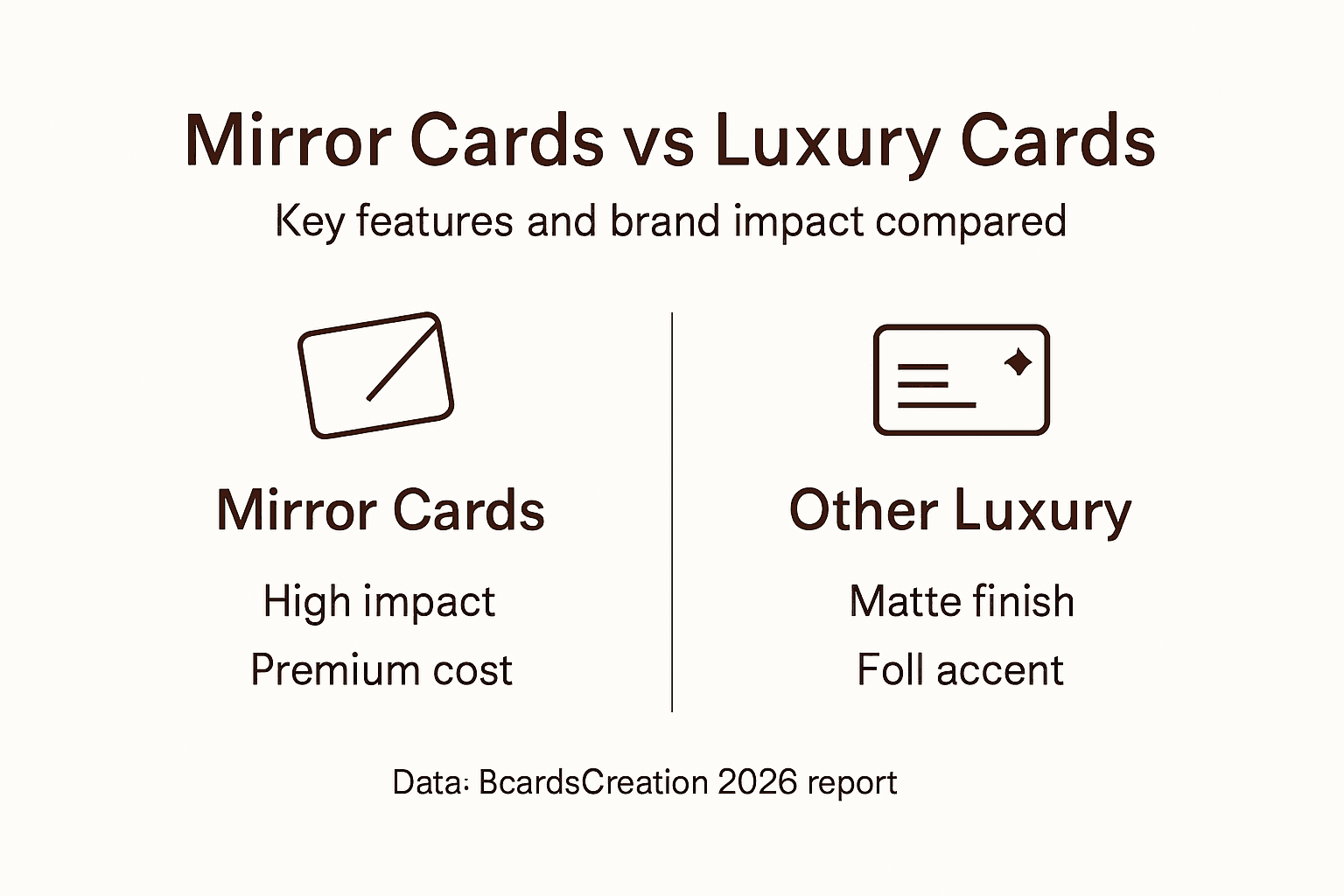
Mirror business cards cost 2.5-4x more but yield stronger brand prestige and memorability compared to standard cards. This premium positions them for brands where differentiation and perceived quality drive business success.
| Card Type | Cost Factor | Visual Character | Tactile Quality | Best For |
|---|---|---|---|---|
| Mirror Surface | 2.5-4x | High reflectivity, metallic sheen | Smooth, cool to touch | Beauty, luxury retail, creative agencies |
| Matte Luxury | 1.5-2x | Subtle elegance, no glare | Soft, velvety texture | Professional services, consultants |
| Raised Foil | 2-3x | Selective metallic accents | Dimensional contrast | Corporate executives, financial services |
| Textured Premium | 2-2.5x | Organic, natural appearance | Varied surface feel | Sustainable brands, boutique firms |
Strategic brand impact differences emerge from how each finish communicates values. Mirror surfaces signal modernity, precision, and bold confidence. Matte finishes convey understated sophistication and timeless quality. Raised foil combines traditional elegance with contemporary refinement. Textured options emphasize authenticity and craftsmanship.
Suited use cases vary by industry and positioning:
- Mirror cards excel for brands emphasizing innovation, style, and distinctive visual identity
- Matte luxury works for established professionals seeking quiet authority
- Raised foil serves corporate environments where tradition meets modernity
- Textured premium appeals to environmentally conscious brands with artisanal positioning
Pros and cons for each type:
Mirror Cards:
- Pros: Maximum visual impact, strong memorability, distinctive appearance
- Cons: Show fingerprints, require more careful handling, higher cost
Matte Luxury:
- Pros: Timeless elegance, excellent durability, fingerprint resistant
- Cons: Less dramatic visual impact, may not stand out in competitive contexts
Raised Foil:
- Pros: Combines visual and tactile elements, versatile styling, wide acceptance
- Cons: Foil can wear over time, design must accommodate raised elements
Match your choice to brand personality and audience expectations. A beauty brand benefits from mirror cards that reflect its focus on appearance and style. A law firm might choose matte luxury that communicates stability and competence. A tech startup could use mirror surfaces to emphasize innovation and forward thinking.
Explore luxury business card options to compare formats in detail.
Integrating Mirror Business Cards into Brand Identity Systems
Mirror business cards achieve maximum impact when they align seamlessly with your broader brand identity system. Consistency across touchpoints reinforces brand recognition and strengthens the perception of professionalism and attention to detail.
Color and typography consistency requires adapting your brand guidelines for the reflective medium. Your standard color palette may need adjustment to account for how metallic surfaces alter color perception. Test your brand colors on mirror substrates to ensure they maintain the intended appearance and contrast. Typography should remain consistent in style and hierarchy while adapting size and weight for reflectivity.
Coordinating physical cards with digital brand assets creates a cohesive experience. Your website, social media, and digital communications should echo the premium positioning your mirror cards establish. Use similar color treatments and design elements across platforms. Consider how your mirror card design translates to digital business card formats and email signatures.
Selecting complementary materials and finishes for other brand collateral ensures cohesion:
- Use similar metallic accents in brochures and packaging
- Match color schemes across all printed materials
- Coordinate paper weights and textures with card substrate quality
- Apply consistent design principles to letterhead and presentations
Aligning card design with strategic market positioning means your mirror cards should reflect how you want the market to perceive your brand. If you position as cutting edge and innovative, embrace bold design choices that push boundaries. If your strategy emphasizes timeless luxury, use restrained layouts with classic typography. The physical card becomes a tangible expression of your strategic positioning.
Mirror cards reinforce brand values and exclusivity through their inherent premium nature. The investment signals that your brand values quality and differentiation. The distinctive appearance communicates confidence and willingness to stand apart from competitors. Limited distribution of premium cards can enhance their perceived value and exclusivity.
Learn how business card design alignment supports cohesive brand identity systems.
Practical Application and Strategic Positioning
Real-world implementation demonstrates the measurable benefits mirror business cards deliver to luxury brands and executives. Case studies show up to 40% increased client recall and 15% higher networking conversion with mirror cards compared to standard business cards. These metrics translate directly into business value through stronger relationships and more effective networking.
Successful corporate applications span multiple sectors. A luxury skincare brand reported that their mirror business cards became conversation starters at trade shows, with prospects specifically commenting on the cards during follow-up meetings. A boutique consulting firm found that their mirror cards helped them compete against larger competitors by signaling premium positioning and attention to detail.
Statistics on professionalism gains show that recipients perceive mirror card users as more established and successful. The premium format creates a halo effect that extends to perceptions of service quality and brand reliability. This psychological advantage proves particularly valuable in competitive markets where differentiation drives client acquisition.
Networking effectiveness increases because distinctive cards stay top of wallet rather than getting lost among standard cards. Recipients keep mirror cards visible longer, extending your brand presence beyond the initial interaction. The ROI calculation becomes favorable when higher client retention and conversion rates offset the increased per-card cost.
Practical recommendations for maximizing benefits:
- Distribute mirror cards selectively to high-value prospects and strategic contacts
- Pair card distribution with strong follow-up to capitalize on enhanced recall
- Use the card as a conversation starter about your brand values and positioning
- Maintain a supply of standard cards for mass distribution alongside premium mirror cards
- Track response rates and client feedback to measure actual impact
“Mirror business cards function as miniature brand ambassadors. The format itself communicates values before a word is exchanged. For luxury brands, this immediate signal of quality and differentiation justifies the investment through measurable improvements in prospect engagement and client retention.”
Apply insights from the brand impact workflow to position mirror cards strategically within your marketing mix.
Explore Premium Mirror Business Card Solutions
BcardsCreation specializes in custom mirror business cards designed specifically for luxury brands and executives who demand distinctive brand presence. Our design team works individually with each client to create mirror cards that align perfectly with your brand identity and strategic positioning.
Our customization process adapts your brand elements for reflective surfaces, ensuring optimal readability and visual impact. We provide material samples, design proofs, and expert consultation throughout the project. Every mirror card project receives individual attention without templates or automated tools, delivering truly custom solutions.
Quality assurance protocols preserve mirror finish integrity from production through delivery. We use advanced UV coatings and premium substrates to ensure your cards maintain their appearance through regular use. Our production partners employ controlled environment manufacturing and rigorous inspection procedures.
Contact our custom business card design services team to discuss your specific requirements. Browse our mirror effect business cards collection for inspiration. Learn more about our approach in this luxury business card workflow article.
Frequently Asked Questions
Are mirror business cards durable enough for regular use?
Yes, when properly manufactured with protective coatings. UV coatings improve scratch resistance by up to 70%, making mirror cards suitable for frequent handling. Store them in protective sleeves between uses to maintain pristine appearance. Regular care extends their functional life significantly compared to unprotected cards.
How should I adapt my brand’s design for mirror business cards?
Use minimum 10pt fonts and high-contrast colors to ensure legibility on reflective surfaces. Simplify intricate design elements that might distort in reflections. Test your color palette on actual mirror substrates before finalizing the design. Increase spacing between elements to prevent visual crowding. Consider how different lighting conditions affect readability.
What factors should I consider when selecting a supplier for mirror business cards?
Prioritize suppliers with demonstrated expertise in mirror finishes and UV coating processes. Request material samples and design proofs to evaluate quality before committing to production. Verify their track record for consistency and quality control across multiple orders. Ensure they offer customization flexibility and design support rather than template-based approaches. Check choosing quality mirror card suppliers for detailed selection criteria.
How do mirror business cards compare in cost to other premium options?
Mirror cards typically cost 2.5 to 4 times more than standard business cards due to specialized materials and production processes. This positions them at the higher end of luxury card options. The investment delivers measurable returns through enhanced brand memorability and strategic positioning. Consider them for selective distribution to high-value contacts rather than mass distribution.
Can mirror business cards be produced sustainably?
Yes, sustainable options exist using recycled plastic substrates and water-based UV coatings. These materials reduce environmental impact while maintaining the premium appearance and durability of mirror cards. Discuss sustainability priorities with your supplier during the design phase. Some manufacturers offer carbon-neutral production options for environmentally conscious brands.


