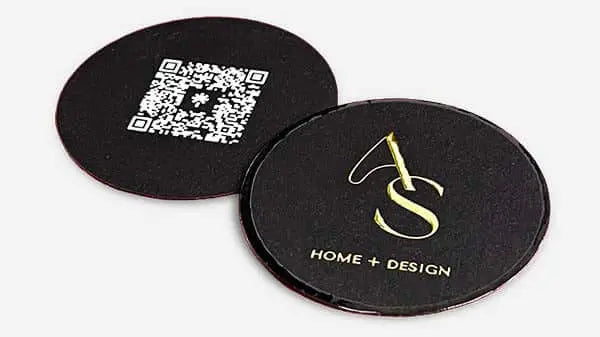


Why Business Cards Still Matter in 2025
TL;DR:
- Business cards continue to be a powerful branding tool in 2025 because they create memorable micro-moments and foster trust during in-person interactions. Combining tactile design with digital extensions like QR codes and NFC enhances their effectiveness by enabling easy, up-to-date follow-up. Success depends on rapid follow-up after exchanging cards, using both physical and digital formats appropriately to maximize relationship-building opportunities.
Business cards remain one of the most effective personal branding tools in professional networking because they create a physical, memorable moment that digital contact sharing cannot replicate. In a world where every interaction competes with screen notifications, a well-designed card commands attention. Research confirms that physical cards reduce follow-up friction by giving recipients everything they need without requiring them to search or type. Understanding why business cards still matter in 2025 means recognizing that the card itself is not the point. The follow-through it enables is.
Why business cards still matter in 2025 for in-person networking
Physical business cards create micro-moments. A micro-moment is a brief, high-attention exchange where your brand registers clearly in another person’s memory. Handing someone a card at the right time means they hold your name, title, and contact details in their hands. That physical act carries weight that a phone tap or QR scan alone does not.
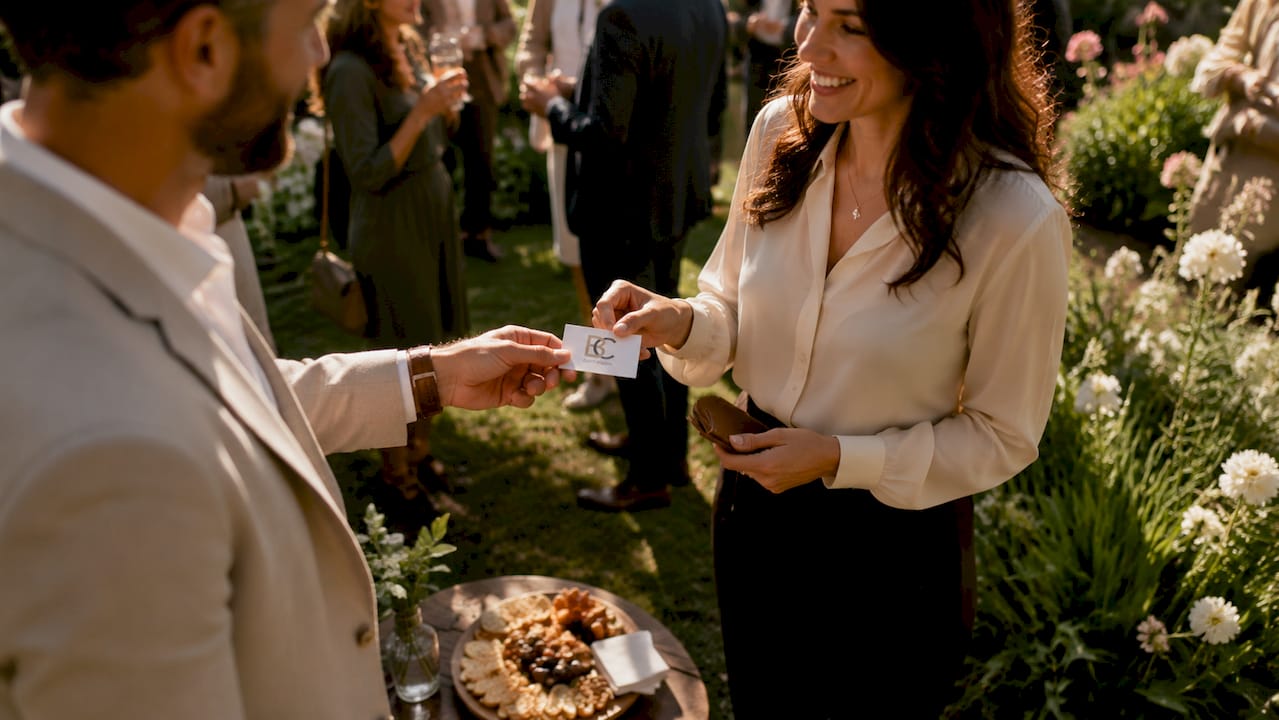
Printed cards keep attention on people, not phones. When you pull out a card instead of asking someone to open their camera app, you avoid the distraction spiral that comes with unlocking a device. The conversation stays intact. That focus is a competitive advantage in high-trust settings like investor meetings, trade shows, or client introductions.
The tactile dimension matters more than most professionals realize. Tactile design elements like embossing engage memory and emotional pathways that visual cues alone cannot reach. A card with a soft-touch coating or raised foil does not just look premium. It feels premium. That sensory signal shapes how the recipient perceives your brand before they read a single word.
Cards also signal respect. In many professional cultures, the act of presenting a card with both hands or pausing to read a received card before pocketing it communicates seriousness. Physical card etiquette affects credibility in international business contexts, particularly in Japan, South Korea, and parts of the Middle East, where the exchange ritual carries real social meaning.
Pro Tip: Write a brief note on the back of a card immediately after meeting someone. A single word like “fintech intro” or “referred by Marcus” gives you context weeks later when you follow up.
How QR codes and NFC make physical cards more useful
Digital integration does not replace the physical card. It extends it. A QR code printed on a card lets the recipient save your contact details, visit your portfolio, or connect on LinkedIn within seconds. Recipients can save contacts within seconds using QR or vCard technology, removing the friction of manual data entry entirely.
The real advantage of dynamic QR codes is flexibility. A static QR code locks in a URL at print time. A dynamic code points to a redirect that you control. Dynamic QR codes allow cards to remain current even after your phone number, email, or website changes. You update the destination without reprinting a single card. That matters for professionals who change roles or rebrand.
Here is what a well-integrated card setup looks like in practice:
- Front of card: Name, title, company, and a clean logo. No clutter.
- Back of card: A single QR code linking to a dynamic landing page with your current contact details, portfolio, or booking link.
- NFC chip (optional): Embedded in plastic or metal cards for tap-to-save functionality on modern smartphones.
- Landing page: Updated whenever your details change, so the printed card never becomes outdated.
This setup treats the card as a conversion surface pairing physical recall with immediate digital action. The physical card creates the memory. The digital layer captures the follow-up.
Pro Tip: Use a service like QR Tiger or Beaconstac to generate dynamic QR codes. Both allow you to track scan counts by location and date, which tells you which events actually drive engagement.
Does fast follow-up determine whether cards convert?
Speed is the variable most professionals underestimate. Following up within 5 minutes improves lead qualification chances by 21 times compared to waiting 30 minutes or more. That statistic applies to digital leads, but the principle holds for in-person networking. The longer you wait, the colder the connection becomes.
Here is a practical follow-up system that works:
- Same day, within 2 hours: Send a short email or LinkedIn message referencing the specific conversation. Mention one detail from your exchange to prove you were paying attention.
- Within 24 hours: Add the contact to your CRM or contact manager with tags for event name, date, role, and any next steps discussed.
- Within one week: Send a second touchpoint. Share an article, a resource, or a brief proposal if the conversation warranted it.
- Within 30 days: Schedule a call or meeting if the relationship has potential. Do not let a warm connection go cold.
Organizing contacts by event, role, and location improves retrieval and follow-up success significantly. Tagging cards with at least three contextual attributes means you can search your contacts six months later and still reconstruct the context of the meeting. Without that structure, cards become souvenirs rather than leads.
Micro-commitments during the meeting also increase follow-up urgency. If you agree to send a specific resource or make an introduction before you part ways, the card exchange becomes a commitment device. You are not just exchanging contact details. You are creating a reason to reconnect.
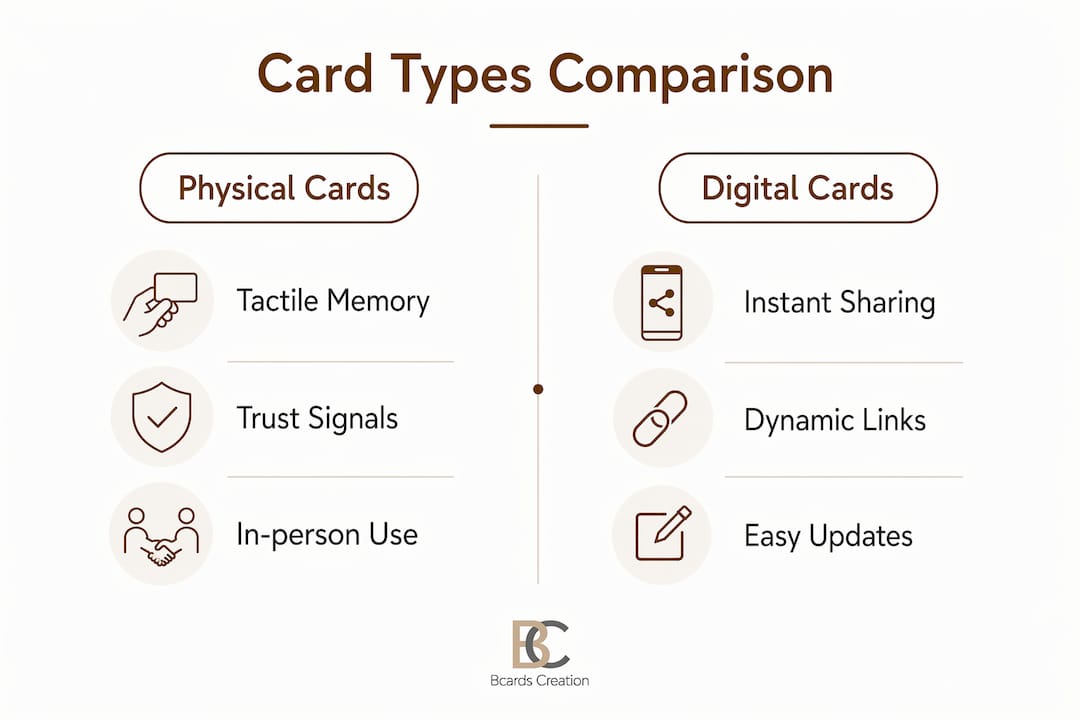
Physical vs. digital business cards: which one actually works?
The honest answer is that both work, and the best professionals use both. The question is not which format wins. The question is which format fits the moment.
| Scenario | Physical Card | Digital Card |
|---|---|---|
| High-trust, first-time meeting | Strong. Tactile signal builds credibility. | Weaker. Feels transactional. |
| Large conference or trade show | Strong. Fast exchange, no phone needed. | Moderate. Requires recipient to scan. |
| Remote or virtual networking | Not applicable. | Strong. Shareable via email or link. |
| International business meeting | Strong. Etiquette and ritual matter. | Risky. Cultural norms may not support it. |
| Follow-up and CRM integration | Requires manual entry or scanning. | Strong. Syncs directly with contact tools. |
Print demand declined more than 70% since COVID, yet approximately 100 billion paper cards are still produced annually. That number tells you the format is not dying. It is concentrating. The professionals still using physical cards are the ones who understand their value. Digital business cards improve networking efficiency by 50% with 30% higher follow-up rates, which makes them a strong complement for scalable outreach. The two formats are not competing. They are covering different parts of the same relationship-building process.
High-trust business interactions rely on physical presence signals that cards provide. A card gives clearer permission to follow up than a digital exchange alone. When someone hands you a card, they are explicitly inviting contact. That social contract is harder to establish through a QR scan or a LinkedIn request.
What makes a business card actually memorable?
Design is where most professionals underinvest. A card that looks like every other card does not create a micro-moment. It creates a pile. The cards that get kept, displayed, or photographed are the ones that communicate quality through material and finish before the recipient reads the text.
The tactile and texture choices that differentiate cards and boost professional perception include:
- Soft-touch coating: A matte, velvety surface that feels expensive and photographs well.
- Raised foil: Gold, silver, or colored foil applied in relief, adding dimension and catching light.
- Embossing and debossing: Pressed patterns or text that create physical depth on the card surface.
- Colored edges: Paint applied to the card’s sides, visible when the card is held at an angle.
- Specialty substrates: Thick cotton paper, translucent plastic, or layered materials that signal a deliberate material choice.
Consistency with your broader brand identity is non-negotiable. Your card’s colors, typeface, and logo treatment should match your website, your email signature, and your presentation decks. A card that looks disconnected from your other brand materials creates doubt, not confidence. For a deeper look at how tactile finishes shape perception, the relationship between material and memory is worth understanding before you commit to a print run.
The goal is not to be flashy. The goal is to be remembered accurately. A card that reflects your brand’s actual positioning tells the recipient exactly who you are before you say another word.
Key takeaways
Business cards remain effective in 2025 because physical exchange creates trust signals, tactile memory, and follow-up permission that digital contact sharing cannot fully replace on its own.
| Point | Details |
|---|---|
| Physical cards create memory | Tactile design engages sensory pathways that visual-only digital sharing does not reach. |
| QR codes extend card value | Dynamic QR codes keep card details current without reprinting, linking physical to digital. |
| Follow-up speed determines ROI | Contacting a new connection within hours, not days, dramatically increases conversion chances. |
| Both formats serve different moments | Physical cards win in high-trust settings; digital cards win for scalability and remote networking. |
| Design quality signals brand quality | Material choice and finish communicate professionalism before the recipient reads your name. |
The part most professionals get wrong
By Kostiantyn
After working with hundreds of professionals on their card projects, the pattern I see most often is this: someone invests in a well-designed card, hands it out at an event, and then does nothing for two weeks. The card did its job. The follow-up did not.
The card is a trigger, not a closer. Its job is to create a physical anchor in someone’s memory and give them a reason to expect your outreach. What happens in the 48 hours after the exchange is where the real work lives. I have seen beautifully crafted cards from founders who never followed up, and I have seen simple cards from consultants who closed clients because they sent a personalized email the same evening.
The other thing I push back on is the idea that digital cards are the future and physical cards are the past. That framing misses the point entirely. The professionals I respect most carry both. They hand over a physical card in the meeting because it creates a moment. They follow up digitally because it creates a record. Neither format is complete without the other.
If you are reconsidering whether cards are worth the investment, the question to ask is not “do people still use them?” The question is “do I follow up fast enough to make them work?” If the answer is yes, a well-made card is one of the most cost-effective branding tools you have. If the answer is no, even the most beautiful card will sit in a drawer.
— Kostiantyn
Custom cards that work as hard as you do
Bcardscreation designs and produces fully custom business cards for professionals who treat their card as a branding asset, not a formality. Every project is developed individually, with material consultation, finish selection, and design guidance built into the process. No templates. No automated editors.
If you want a card that creates the kind of micro-moment this article describes, explore custom business card design options built around your brand. For professionals who want maximum tactile impact, the raised foil and soft-touch range delivers the sensory quality that gets cards kept rather than discarded. Small-batch production means your order gets the attention it deserves.
FAQ
Do business cards still work in 2025?
Yes. Physical business cards remain effective for in-person, high-trust networking because they create a tangible exchange that supports memory retention and gives clear permission to follow up. They work best when paired with fast, personalized outreach after the meeting.
What is the difference between static and dynamic QR codes on cards?
A static QR code links to a fixed URL that cannot be changed after printing. A dynamic QR code links to a redirect you control, so you can update your contact details, portfolio, or booking page without reprinting your cards.
How soon should you follow up after exchanging business cards?
Follow up within 2 hours of the meeting for the strongest results. Research shows that contacting leads within 5 minutes improves qualification chances by 21 times, and the same urgency principle applies to in-person networking connections.
Are digital business cards better than physical ones?
Neither format is universally better. Physical cards outperform digital in face-to-face, high-trust settings. Digital cards offer better efficiency for remote networking and CRM integration. Most professionals benefit from using both depending on the context.
What design features make a business card memorable?
Tactile finishes like embossing, raised foil, soft-touch coating, and colored edges engage sensory memory beyond what a standard printed card achieves. Consistency with your broader brand identity, including colors, typeface, and logo, reinforces recognition and builds credibility.


