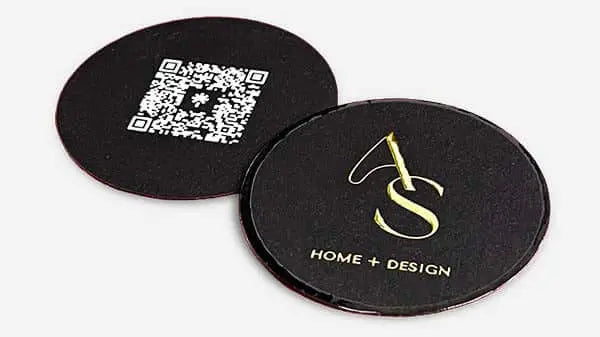


Why Branded Business Cards Matter for Designers
TL;DR:
- Branded business cards serve as a concentrated expression of a designer’s professional identity, enhancing recognition and trust through tactile and visual cues. They outperform digital connections in recall, demonstrate craftsmanship, and establish a coherent brand system that links in-person and online presence effectively. Strategically designed with intentional finishes, layout coherence, and a primary call to action, they remain a vital branding tool in 2026 for designers committed to authenticity and professionalism.
Branded business cards are the most concentrated expression of a designer’s professional identity, delivering brand recognition, trust signals, and follow-up pathways in a single physical object. Understanding why branded business cards matter for designers means recognizing that a card is not a contact sheet. It is a designed artifact that communicates your standards before you say a word. 61% of people recall someone’s details more easily after receiving a physical card, and 38% of Gen Z still prefer traditional cards over digital formats. That data, from a 2025 Adobe Express survey of 1,000 respondents, confirms that physical cards retain real strategic value for creatives who compete on perception.
Why branded business cards matter for designers
Physical cards outperform digital-only connections on one specific metric: recall. A LinkedIn connection request disappears into a feed. A well-designed card sits on a desk, gets passed to a colleague, or ends up pinned to a studio wall. Physical cards outperform digital connections for perceived professionalism and memory retention, making them strategic tools for creatives whose reputation is their primary asset.

For designers specifically, the card is also a proof of concept. It demonstrates your typographic judgment, your color discipline, and your material sensibility in a format small enough to hold in one hand. A poorly designed card from a designer signals exactly the wrong thing. A card that reflects genuine craft signals the right thing before the conversation even starts.
Consistency between physical cards and online brand identity builds recognition and credibility, functioning as a direct connection from the in-person meeting to your digital presence. That connection, from card to portfolio to client relationship, is the core value of branding through business cards done well.
How tactile finishes increase memorability and brand trust
Touch is a memory trigger. Tactile finishes like embossing and textured paper activate somatosensory processing, which strengthens emotional encoding and brand recall in ways that flat digital impressions cannot replicate. This is not a marketing claim. It is documented in neuromarketing research reviewed by Baesman using USPS data. The implication for designers is direct: the physical experience of your card is part of the brand message.
Specific finishes carry specific signals. Consider what each communicates:
- Raised foil on a logo or name signals precision and premium positioning. It catches light and creates a tactile ridge that recipients notice immediately.
- Soft-touch coating creates a matte, velvety surface that reads as restrained and sophisticated. It works well for brand identities built around minimalism or luxury.
- Embossing and debossing add dimension without color, making them effective for monochromatic or typographically driven designs.
- Textured paper stocks like cotton or linen communicate craft and authenticity. They feel different from standard card stock, and that difference registers.
- Rounded corners reduce the sharp, generic feel of standard cards and add a subtle design detail that recipients notice without being able to articulate why.
Branding impact occurs immediately on tactile interaction and at a glance via typographic hierarchy. These design elements cue professionalism before the recipient reads a single word. That means your material choice is doing active brand work from the moment the card changes hands.
Pro Tip: Choose your finish based on your brand’s primary emotional register, not personal preference. A brand built on warmth and approachability reads better on uncoated textured stock than on cold, high-gloss laminate. Match the material to the message.
For designers who want to go deeper on the neuroscience behind physical materials, the tactile design advantages for business cards are worth understanding as a strategic framework, not just a production decision.
What design principles make business cards feel trustworthy
Trust is a design output. A 2026 J-STAGE study analyzing 58 participants found a positive correlation between well-structured, coherent layouts and recipients’ trust and preference. The study specifically identified that recipients favor cards that demonstrate consideration for the reader over cards that prioritize individual expression. For designers, that is a useful constraint: your card needs to serve the recipient, not just showcase your style.
Layout orientation and color choices
| Format | Perception | Best use case |
|---|---|---|
| Horizontal layout | Higher readability, stronger credibility | Most professional contexts |
| Vertical layout | More distinctive, creative signal | Design, art, fashion industries |
| White, black, or navy | Perceived as more trustworthy | Client-facing, B2B contexts |
| Bold accent colors | Memorable, expressive | Creative studios, personal brands |
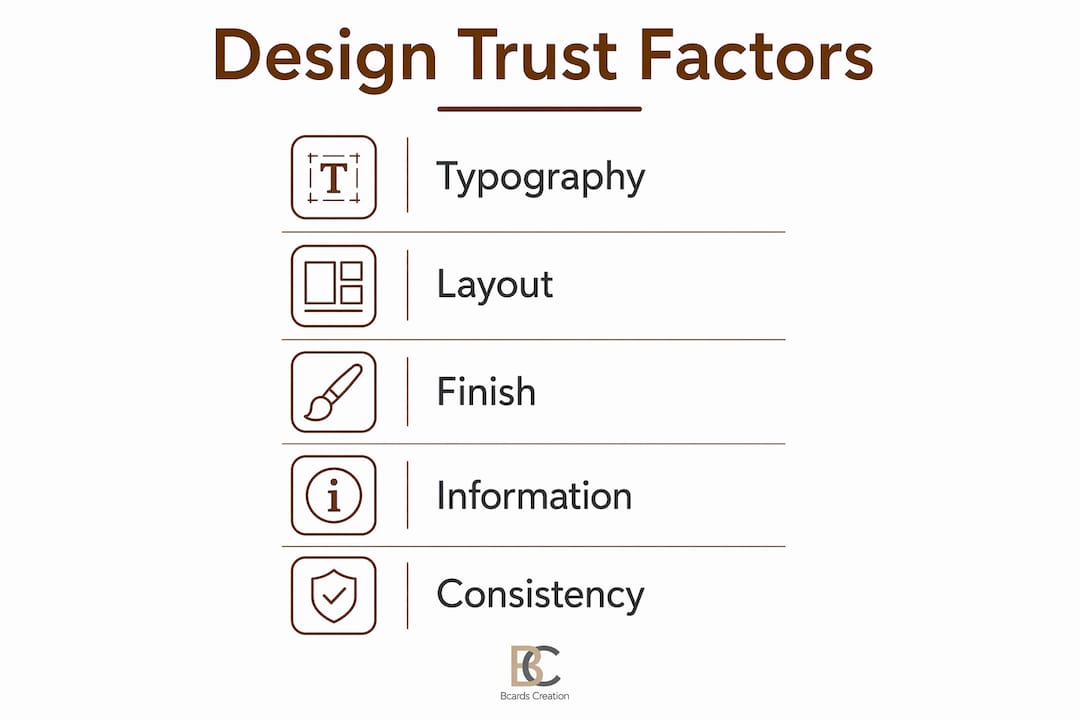
Horizontal layouts are preferred for readability and credibility according to the Adobe Express survey data. That does not mean vertical cards are wrong for designers. It means you should choose the orientation deliberately, knowing what signal it sends.
Typography hierarchy is the most overlooked trust signal on a business card. Your name, title, and primary contact point should be immediately scannable in under two seconds. If a recipient has to search for your website or email, the card has failed its primary function. Design coherence signals recipient consideration, and that consideration is what converts a card into a follow-up.
Pro Tip: Treat your business card as the strictest test of your brand system. If your typography hierarchy, spacing ratios, and color palette cannot survive at 3.5 by 2 inches, they are not disciplined enough for larger formats either.
Avoid putting too much information on the card. One primary call to action, whether that is your portfolio URL, a QR code, or your email, performs better than three competing options. Cards must balance identity and functionality by avoiding clutter and establishing a clear digital pathway to reduce scanning friction.
Are business cards still relevant in the digital era?
Physical cards remain relevant because they solve a problem that digital tools do not: they transfer information at the moment of connection without requiring a phone, an app, or a signal. The card exists independently of any platform. That independence is a feature, not a limitation.
The practical case for physical cards in 2026 includes several specific advantages:
- Offline-to-online conversion. QR codes on business cards increase contact likelihood by 69%, according to a 2026 Avery study. A QR code placed in the natural eye flow of the card reduces friction and gives recipients a direct path to your portfolio or website when they are ready to follow up.
- Timing advantage. Recipients engage with a card when they are calm and focused, not in the middle of a busy event. That delayed engagement often produces higher-quality follow-up than an immediate digital exchange.
- Reduced cognitive load. Physical cards reduce the mental effort required to process contact information compared to fleeting digital impressions. A card on a desk is a persistent reminder. A LinkedIn notification is noise.
- Cross-demographic reach. The Adobe Express data shows that Gen Z preference for physical cards is stronger than most designers assume. 38% of Gen Z respondents prefer traditional cards, which means physical formats are not aging out of relevance.
- Omnichannel positioning. A card that visually aligns with your website, your social profiles, and your portfolio creates a consistent brand experience across every touchpoint. That consistency is what brand identity systems are designed to produce.
The card does not replace digital networking. It completes it by providing a physical anchor for the relationship.
Practical strategies for custom branded business cards that work
Designing a card that actually performs requires treating it as a strategic document, not a design exercise. These steps produce better results than starting with a template or an automated editor.
-
Start with one primary action. Decide what you want the recipient to do: visit your portfolio, scan a QR code, or send an email. Build the entire layout around making that action obvious and frictionless. Everything else is secondary.
-
Design the card as the foundation of your brand system. Designing the brand system from the card outward enables consistent use of core spacing and typography ratios across all collateral. Your card sets the rules. Your website, proposals, and presentations follow them.
-
Choose materials that match your brand positioning. A studio that sells premium identity work should not hand out cards on standard 14pt card stock. The material is part of the message. Cotton stock, plastic cards, or specialty papers each communicate something specific about your standards.
-
Avoid AI-generated and template-first approaches. AI-generated or template-first cards may undermine perceived authenticity, according to research on creative perception in business card design. Designers are specifically recommended to curate details carefully for originality. For a creative professional, an obviously generic card is a credibility problem.
-
Use small details intentionally. Rounded corners, special paper stocks, and unique finishes enhance memorability when they are intentional rather than decorative. Each detail should connect to a brand decision, not just a preference.
-
Brief a specialist, not a generalist. Small-batch production with expert material consultation produces better results than ordering 500 cards from a mass-market printer. The step-by-step framework for professional card design covers how to approach that brief effectively.
Pro Tip: Place your QR code on the back of the card, aligned to the lower right corner. That position follows natural eye flow when someone flips the card over, and it keeps the front clean for your primary brand impression.
For designers who want practical benchmarks, the design tips for creatives at Bcardscreation cover the specific decisions that separate effective cards from forgettable ones.
Key takeaways
Branded business cards give designers a physical proof of their craft, a memory trigger, and a direct path from in-person meeting to online presence, all in a format that no digital tool replicates.
| Point | Details |
|---|---|
| Tactile finishes drive recall | Embossing, foil, and textured stock activate haptic memory, strengthening brand retention beyond digital impressions. |
| Layout coherence signals trust | Structured, readable layouts correlate with recipient trust and preference, according to the 2026 J-STAGE study. |
| QR codes extend card value | A well-placed QR code increases follow-up likelihood by 69%, converting physical cards into digital entry points. |
| Avoid templates for authenticity | AI-generated and template-first cards reduce perceived authenticity, which is a direct credibility risk for designers. |
| Card design anchors brand systems | Designing from the card outward sets typography and spacing standards that carry through all other brand collateral. |
The first two seconds are the whole argument
Most designers I work with underestimate how fast a card is judged. The recipient picks it up, feels the weight, registers the finish, scans the layout, and forms an opinion. That entire sequence takes under two seconds. Everything you spent hours deciding, the typeface, the color, the paper, either lands in that window or it does not.
What I find consistently true is that designers who treat their card as a brand investment produce cards that get kept. Designers who treat it as a formality produce cards that get recycled. The difference is not budget. It is intention. A single well-chosen finish on a modest card stock outperforms an expensive card with no clear design logic.
The other thing worth saying directly: your card is the one piece of brand collateral that someone else holds. Your website, your portfolio, your social presence, all of those exist on screens you control. The card exists in someone else’s space. That is a rare opportunity. A card that aligns with your digital presence creates a coherent experience that reinforces trust every time the recipient encounters either one.
Designers who view cards as commodities are leaving a high-impact branding tool unused. The physical format is not a legacy habit. It is a deliberate choice that signals you take your own brand seriously enough to invest in it.
— Kostiantyn
Custom cards built for designers who take branding seriously
Bcardscreation works with designers and creative professionals who need cards that reflect the same standards they hold for their clients’ work. Every project is developed individually, with material consultation, finish selection, and controlled small-batch production. No templates. No automated editors.
If you want a card that functions as a genuine brand asset, Bcardscreation offers custom business card design built around your specific positioning. For designers who want to explore tactile and visual impact at a higher level, the luxury foil and creative finishing options cover raised foil, soft-touch coating, and specialty stocks. Each option is selected based on your brand, not a default production run.
FAQ
Why do branded business cards matter more for designers than other professionals?
Designers are judged on visual judgment before anything else. A poorly designed or generic card directly contradicts the service being sold, making card quality a credibility signal unique to creative professionals.
What finish works best for a designer’s business card?
The right finish depends on your brand positioning. Raised foil and embossing signal premium precision, while soft-touch coating and textured stock communicate craft and restraint. Match the material to the message your brand is built around.
Do business cards still work in 2026?
Yes. Physical cards increase detail recall for 61% of recipients and remain preferred by 38% of Gen Z, according to the 2025 Adobe Express survey. QR codes extend their function by connecting physical cards directly to digital portfolios.
How many details should a designer include on a business card?
One primary call to action performs better than multiple competing options. Include your name, title, and one clear contact point, whether that is a portfolio URL, QR code, or email, and keep everything else secondary.
Should designers avoid templates when creating business cards?
Research on creative perception confirms that template-first cards reduce perceived authenticity, which is a direct risk for designers whose credibility depends on original thinking. Custom design, even simple custom design, outperforms generic templates in professional contexts.


