

Why design is crucial for your business cards' success
Most professionals treat business cards as simple contact tools, but in luxury and creative industries, your card design is a direct reflection of your brand identity and positioning. Every visual choice, from typography to material selection, shapes how clients perceive your expertise and value. This guide explores why design matters critically for business cards, how it influences client engagement, and practical steps to leverage design for maximum brand impact and differentiation in competitive markets.
Table of Contents
- Key takeaways
- The role of design in shaping your brand identity
- How design influences perception and client engagement
- Comparing common business card design approaches in luxury and creative sectors
- Practical steps to design business cards that elevate your brand identity
- Elevate your business cards with expert design and premium materials
- Why is design important on business cards? Frequently asked questions
Key Takeaways
| Point | Details |
|---|---|
| Brand identity via cards | Your business card acts as a miniature brand ambassador and communicates your brand personality and professional values. |
| Luxury requires custom design | In luxury and creative sectors, clients expect high quality custom card design using premium materials and finishing to signal positioning. |
| Visual hierarchy matters | Effective cards use clear hierarchy, generous margins, and high contrast to guide attention to key contact details. |
| Premium materials boost trust | High end materials and finishes create tactile and visual cues that enhance perceived value and trust. |
The role of design in shaping your brand identity
Your business card functions as a miniature brand ambassador, working long after initial meetings end. Business card design is a fundamental part of brand engineering and image projection for service providers. Every element, from logo placement to color palette, communicates your brand personality and professional values to potential clients.
Brand identity creates trust and distinguishes you from competitors in saturated markets. When clients receive your card, they instantly form judgments about your attention to detail, creative capabilities, and commitment to quality. Visual elements work together to create coherent brand narratives that support recognition and professional credibility over time.
Consistent design across all touchpoints reinforces your positioning. If your card displays sophisticated typography and premium materials, clients expect the same refinement in your services. Misalignment between card quality and actual offerings creates cognitive dissonance that undermines trust and damages conversion rates.
Core design elements that build brand identity:
- Logo positioning and scale communicate hierarchy and brand confidence
- Color choices trigger emotional responses and category associations
- Typography selection signals formality, creativity, or technical expertise
- White space usage demonstrates sophistication and visual restraint
“Your business card is often the only physical artifact clients keep from initial meetings. Design quality directly correlates with perceived service value and professional competence.”
Cards communicate values and expertise instantly to clients without requiring verbal explanation. A design business cards luxury brands approach emphasizes visual storytelling through material choices and finishing techniques. When executed properly, your card becomes a conversation starter that positions you as a premium provider worth higher fees.
How design influences perception and client engagement
Clients often judge professionalism instantly based on card design, making split-second decisions about whether to follow up or discard your information. Research shows that high-quality business cards with thoughtful design increase perceived trustworthiness and memorability significantly compared to generic alternatives. This perception gap directly impacts conversion rates and referral likelihood in luxury and creative sectors.

Effective design uses hierarchy, space, and contrast to guide attention toward your most important information. Strategic placement of contact details, combined with visual breathing room, makes cards easier to scan and remember. Cluttered layouts create cognitive overload, causing recipients to miss critical information or abandon engagement entirely.
High-end materials and finishes enhance both tactile and visual quality in ways that digital interactions cannot replicate. The physical weight of premium paper stock, the shimmer of foil stamping, or the transparency of clear plastic creates sensory experiences that reinforce luxury positioning. These tactile elements trigger positive associations that persist in client memory.
Design elements that maximize client engagement:
- Clear visual hierarchy that prioritizes name and primary contact method
- Generous margins and white space that prevent visual overwhelm
- High-contrast color combinations that ensure readability in various lighting
- Unique structural elements like rounded corners or non-standard dimensions
- Finishing techniques such as spot UV, embossing, or metallic foils
Pro Tip: Include a subtle design element that invites touch, like textured paper or raised lettering. This tactile engagement increases the time clients spend with your card and strengthens memory formation.
Well-designed cards encourage referrals and repeat impressions because they stand out in wallets and card holders. When clients need services in your category, distinctive design helps your card surface first during decision moments. A professional business card design framework ensures all visual elements work cohesively to support business development goals rather than simply displaying information.
Comparing common business card design approaches in luxury and creative sectors
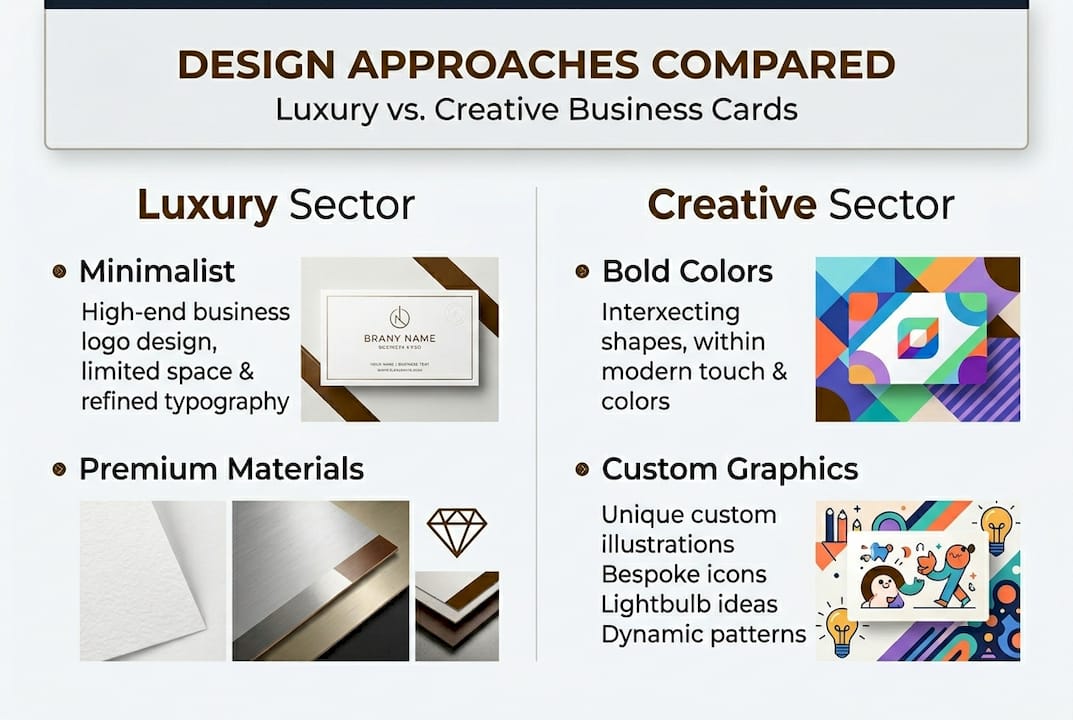
Different design strategies serve distinct positioning goals, and understanding their strengths helps you select approaches aligned with your brand identity. Minimalist designs emphasize sophistication through restraint, using generous white space and limited color palettes to communicate confidence and refinement. This approach works exceptionally well for architects, interior designers, and high-end consultants who want to project understated luxury.
Ornate designs showcase creativity and craftsmanship through detailed illustrations, complex patterns, or multiple finishing techniques. These cards suit photographers, event planners, and artists who need to demonstrate visual capabilities directly through their cards. The risk lies in crossing into excessive decoration that overwhelms rather than impresses.
Material choices and their positioning signals:
- Thick cotton paper stock: Traditional luxury, environmental consciousness
- Clear plastic cards: Innovation, modernity, creative boldness
- Metal cards: Permanence, premium positioning, industrial aesthetics
- Textured specialty papers: Artisanal quality, tactile engagement
| Design Approach | Best For | Key Advantage | Potential Drawback |
|---|---|---|---|
| Minimalist | Architects, consultants | Timeless sophistication | May lack memorability |
| Ornate | Photographers, artists | Showcases creative skills | Risk of visual clutter |
| Material-focused | Luxury brands | Strong tactile impact | Higher production costs |
| Typography-driven | Writers, publishers | Clear information hierarchy | Requires exceptional font choices |
Single-sided printing offers simplicity and forces prioritization of essential information, creating cleaner visual experiences. Double-sided printing provides more space for detailed information or creative storytelling but requires careful design to maintain cohesion. Clear and creative business cards with unique design elements stand out better in luxury markets when executed with professional guidance.
Customization levels directly impact exclusivity perception. Template-based cards signal commodity thinking and budget constraints, undermining premium positioning regardless of service quality. Fully custom designs communicate investment in brand details and willingness to differentiate, supporting higher fee structures and attracting quality-conscious clients. Exploring luxury business card ideas reveals how strategic design choices separate market leaders from followers.
Practical steps to design business cards that elevate your brand identity
Define your brand attributes and target client clearly before making any design decisions. Write down three adjectives that describe your ideal brand perception, then identify visual elements that communicate those qualities. If targeting corporate executives, sophistication and reliability might guide choices toward classic typography and premium paper. Creative entrepreneurs might prioritize innovation and personality through bold colors and unconventional materials.
Choose design elements that convey luxury and creativity appropriate to your specific sector. Following professional design frameworks enhances effectiveness and brand alignment in business cards by ensuring visual consistency and strategic information hierarchy. Consider how each element supports your positioning rather than simply looking attractive in isolation.
Actionable design development process:
- Research competitor cards to identify differentiation opportunities
- Select 2-3 material options that align with brand values and budget
- Develop mood boards showing desired aesthetic direction
- Create multiple layout variations testing different hierarchies
- Test readability and visual impact at actual card size
- Gather feedback from trusted clients or industry peers
Collaborate with skilled designers or use professional services rather than attempting DIY solutions with template tools. Understanding how to brief a designer for business cards ensures productive partnerships that yield results aligned with your vision. Professional designers bring expertise in typography, color theory, and production constraints that prevent costly mistakes.
Pro Tip: Order small test batches before committing to large quantities. Physical samples reveal issues invisible in digital proofs, from color accuracy to paper texture and finishing quality.
Review proofs meticulously and incorporate feedback from multiple perspectives. Check spelling, contact information accuracy, and visual balance across different lighting conditions. Small errors become magnified when printed hundreds of times, damaging credibility with every distribution.
| Design Decision | Impact on Brand | Production Consideration |
|---|---|---|
| Foil stamping | Premium positioning | Requires die creation |
| Rounded corners | Modern, approachable | Needs specialty cutting |
| Embossing | Tactile luxury | Adds production time |
| Clear plastic | Innovation signal | Limited color options |
Avoid common design mistakes that dilute your message and undermine professional perception. Understanding things not to put on a business card prevents including outdated elements like fax numbers, excessive social media icons, or generic taglines that waste valuable space. Focus ruthlessly on information that drives client action and supports your positioning.
Elevate your business cards with expert design and premium materials
Transforming your business cards from contact tools into brand assets requires professional expertise and access to premium production capabilities. BcardsCreation specializes in custom business card design tailored specifically for luxury and creative professionals who view cards as strategic positioning investments.
Explore creative business cards printing and foiling services that combine expert design guidance with advanced finishing techniques like real metallic foils and specialty papers. For professionals seeking maximum differentiation, clear business cards offer unique transparency effects that create memorable first impressions and showcase innovative thinking.
Why is design important on business cards? Frequently asked questions
Can a simple design work for luxury brands?
Absolutely. Minimalist design often communicates luxury more effectively than ornate approaches by emphasizing quality over quantity. The key lies in exceptional execution: perfect typography, premium materials, and refined finishing techniques that demonstrate attention to detail. Simplicity requires discipline and expertise to avoid appearing generic or cheap.
Which materials best communicate quality in business cards?
Thick cotton paper stock with weights above 300gsm signals traditional luxury and environmental consciousness. Clear plastic cards project innovation and creative boldness while ensuring durability. Metal cards communicate permanence and premium positioning but work best for specific industries like finance or luxury goods. Material selection should align with your brand personality and client expectations.
How often should I update my business card design?
Update cards when your contact information changes, your brand evolves significantly, or current cards appear dated compared to competitor offerings. Most professionals refresh designs every 2-3 years to maintain contemporary aesthetics. Avoid frequent changes that undermine brand consistency, but recognize when outdated design actively damages perception.
Does card design really impact client conversion rates?
Yes, significantly. Studies show that premium card design increases follow-up rates by creating stronger memory formation and positive brand associations. Clients perceive professionals with high-quality cards as more competent and trustworthy, directly influencing hiring decisions. The investment in superior design pays returns through higher conversion rates and premium fee acceptance.
Should I include my photo on business cards?
Photos work well for real estate agents, speakers, and personal brands where face recognition drives business. For most luxury and creative professionals, photos consume valuable space better used for design elements that communicate brand personality. If including a photo, ensure professional quality and strategic placement that supports rather than dominates the overall design.
Recommended
- How to Brief a Designer for Business Cards (Even If You’re Not a Desig – BcardsCreation
- Why invest in business card design for lasting impact – BcardsCreation
- Role of Design in Business Cards: Elevating Luxury Brands – BcardsCreation
- How to Design Business Cards That Elevate Your Brand Identity – BcardsCreation


