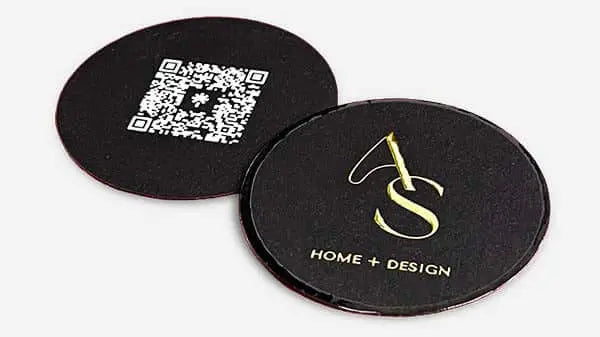


Business cards that grow your small business brand
TL;DR:
- Over half of small businesses still use business cards as an effective, tangible marketing tool for face-to-face networking. Premium cards with quality materials and thoughtful design significantly improve perception, retention, and measurable ROI. Strategic distribution to high-value contacts maximizes the impact of a well-crafted business card in building brand credibility.
More than half of small businesses still rely on business cards to win new clients. That number surprises a lot of people. 58% of small businesses use cards to drive new business, and 72% say exchanging cards positively shapes how prospects perceive their company. Physical cards are not a relic. They are a practical, affordable, and often underused marketing tool. This article breaks down why premium cards work, how to design them well, and how to track real results.
Table of Contents
- Why business cards matter in small business marketing
- Premium business card features that drive results
- Business cards and measurable ROI: Do the numbers add up?
- Essential design principles for high-impact business cards
- Physical vs. digital business cards: Finding the ideal balance
- Hard-earned lessons: What most small businesses miss about business cards
- Elevate your brand with premium business cards
- Frequently asked questions
Key Takeaways
| Point | Details |
|---|---|
| Physical cards still matter | Most small businesses see strong ROI and credibility boosts with premium business cards. |
| Quality beats quantity | Thick, premium cards are far more likely to be retained and remembered than basic designs. |
| Track card performance | Integrate QR codes and unique offers to track your cards’ impact on sales and leads. |
| Go hybrid for best results | Combining physical cards with digital tools maximizes both memorable impressions and measurable outcomes. |
Why business cards matter in small business marketing
Digital tools are everywhere. Yet the handshake moment, the one where you pass someone a card and they actually hold your brand, still carries weight that a LinkedIn connection simply cannot replicate. Business cards remain a tangible, cost-effective tool for face-to-face networking, brand credibility, and referral generation.
The numbers back this up. 57% of business owners view cards as essential for marketing success, and 68% find them the most effective tool for face-to-face connection. That is not a small group of holdouts. That is the majority of small business owners actively using cards and seeing results.
Why does a physical card still work so well? A few reasons:
- Instant credibility. Handing someone a well-made card signals that you take your business seriously. It sets a professional tone before you say another word.
- Referral power. Cards get passed along. A client who loves your work can hand your card to three people. That is word-of-mouth marketing with a physical vehicle.
- No barrier to entry. No app to download. No password to remember. Your contact information is immediately accessible, right in someone’s pocket.
- Budget friendly. For a small business watching every dollar, a batch of quality cards delivers one of the lowest cost-per-impression rates in marketing.
Good networking card strategies treat the card as a conversation starter, not just a contact dump. And when the design is thoughtful, it opens doors that a quick email never could. Learning more about designing for brand impact is a smart next move for any small business owner serious about making networking count.
“A business card is often the first branded object a prospect touches. Make it count.”
Premium business card features that drive results
Not all cards are created equal. A flimsy, thin card printed at the lowest cost gets discarded fast. In fact, thin cards lead to an 88% discard rate within a week. That is nearly nine out of ten cards ending up in the trash. Premium features like thick stock at 350 to 400gsm or higher, embossing, foil stamping, and spot UV coating change that equation entirely.

Here is a quick comparison of what separates premium cards from standard ones:
| Feature | Standard card | Premium card |
|---|---|---|
| Paper weight | 80 to 100gsm | 350 to 400gsm+ |
| Finish | Flat matte or gloss | Soft touch, foil, spot UV |
| Texture | Smooth, plain | Embossed, letterpress, textured |
| Discard rate | Up to 88% within a week | Significantly lower |
| Brand perception | Ordinary | Elevated, memorable |
| Retention | Low | High |
The difference is felt the moment someone picks up the card. A heavier stock communicates stability and confidence. A soft-touch laminate finish feels luxurious. Foil stamping catches the light and draws the eye. These are not just aesthetic choices. They are strategic signals about the quality of your business.
Key premium features worth knowing:
- Thick stock (350gsm+): Resists bending and signals durability.
- Foil stamping: Metallic gold, silver, or custom colors add visual pop.
- Embossing or debossing: Raised or recessed text adds a tactile dimension.
- Spot UV coating: Selective gloss over matte creates contrast and depth.
- Edge painting: Colored edges make your card stand out in a stack.
- Plastic or metal cards: Specialty materials for ultra-high-end positioning.
Pro Tip: Never order the cheapest paper option. If your card bends when someone picks it up, the first impression is gone. Go with at least 350gsm and add one specialty finish to create a memorable tactile experience.
Exploring premium card finishes in detail helps you match the right treatment to your brand. And understanding business card material choices gives you a foundation for making smart production decisions. If you want inspiration before committing to a direction, browsing creative business card ideas is a great starting point.
Business cards and measurable ROI: Do the numbers add up?
Here is a concrete figure that gets most small business owners to pay attention. For every 2,000 cards handed out, businesses can expect roughly a 2.5% increase in sales. At a low printing cost per card, that ROI outperforms many digital ad formats on a pure cost-per-conversion basis.
Let’s put that in practical terms. If you invest $200 in a premium batch of 500 cards and one client from that distribution spends $2,000 with you, the return is 10 times your investment. That math works. And premium cards improve retention rates, so your cards stay in wallets longer, generating more opportunities per batch.
| Metric | Estimate |
|---|---|
| Cards per batch | 500 |
| Approximate cost | $150 to $300 |
| Expected response rate | 2 to 3% |
| Potential new contacts | 10 to 15 |
| Revenue if one converts | Depends on your average sale |
| Estimated ROI | Often 5x to 10x or more |
“The cost of a business card is trivial. The cost of a weak first impression is not.”
How do you actually track whether your cards are working? Here are four practical methods:
- Add a QR code. Link it to a landing page with a unique URL. Every scan is trackable in Google Analytics or your preferred platform.
- Use a promo code. Print a discount code exclusive to your cards. When clients use it, you know exactly where they came from.
- Ask new clients directly. “How did you find us?” is a simple question with valuable answers. If cards come up, log it.
- Track referral chains. Note which cards came back to you as leads. This shows which networking moments produced the best results.
Measuring brand card impact through these methods turns a passive marketing tool into an active, data-informed asset.
Essential design principles for high-impact business cards
A great card is not just premium materials. The design has to work too. Design best practices point to minimalism, clear hierarchy, whitespace, one to two fonts at or above 8pt, and print-ready CMYK files with proper bleed and trim margins. These are not optional preferences. They are what separates a card that communicates clearly from one that confuses people.
What your card must include:
- Your name, set as the largest element for easy reading.
- Your role or specialty, directly under your name.
- One primary phone number and one email address. Not three of each.
- Your website or social handle, depending on where you want traffic.
- A QR code, linking to your portfolio, booking page, or a targeted landing page.
What to avoid:
- Cluttered layouts that try to say everything at once.
- Low contrast text that is hard to read under any lighting.
- Too many fonts, colors, or graphic elements competing for attention.
- Tiny text that clients need reading glasses to decipher.
Edge case design strategies like adding a loyalty punch or discount offer on the back of the card increase both retention and conversion. A card that gives someone a reason to hold onto it is a card that keeps working for you. NFC chips embedded in cards take this further, allowing a tap to open your website or digital portfolio instantly on any smartphone.
Pro Tip: Whitespace is not wasted space. It is what makes your name and contact information readable at a glance. When in doubt, remove one more element rather than adding one.
Reviewing the full business card design process helps you understand how expert designers make these decisions. And if you want your card to truly stand out in a competitive market, reading up on unique business card tips gives you ideas beyond the standard rectangle format.
Physical vs. digital business cards: Finding the ideal balance
Both formats have a place. The question is not which one to choose. It is when to use each one.
Physical cards offer tactile trust and professionalism that digital options simply cannot match. When you hand someone a well-made card, it creates a moment. It signals preparation and confidence. Digital cards, on the other hand, are easy to update, never run out, can include analytics, and reduce paper waste.
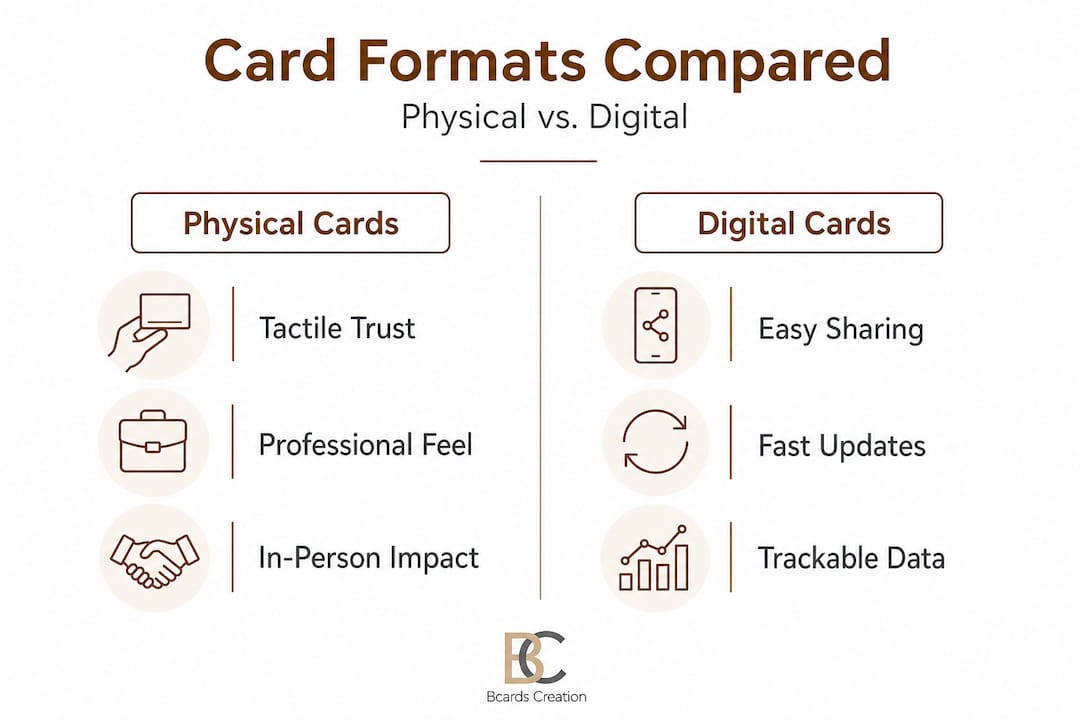
| Factor | Physical card | Digital card |
|---|---|---|
| First impression | Strong tactile impact | Convenient, modern feel |
| Update flexibility | Requires reprint | Instant updates |
| Analytics | Limited (QR code helps) | Built-in tracking |
| Environmental impact | Paper and ink use | Minimal waste |
| Network event suitability | High | Moderate |
| Client perception | Premium, professional | Tech-savvy |
| Longevity in wallet | High if premium | Depends on app/platform |
For most small businesses, a hybrid approach works best. Here is how to make it practical:
- Carry premium physical cards to every in-person event, meeting, and trade show.
- Include a QR code on your physical card that links to your digital card or contact page.
- Follow up digitally within 24 hours of exchanging physical cards to reinforce the connection.
- Use digital cards for online networking, virtual meetings, or when you run out of physical cards unexpectedly.
- Match both formats visually so your branding is consistent across every touchpoint.
Understanding a strong hybrid card workflow lets you move between formats without losing brand consistency or momentum.
Hard-earned lessons: What most small businesses miss about business cards
Here is the truth most articles skip. The problem is not that small businesses do not use business cards. The problem is that they use them wrong. They print cheap cards in bulk and hand them out to everyone. Then they wonder why nothing comes of it.
Mass distribution of low-quality cards is close to invisible marketing. Success depends on quality over quantity. Investing in premium stock and finishes is what beats the 88% trash rate and actually builds perceived value in the mind of the person holding your card.
Think about the last time you received a card that made you stop and look at it twice. You probably remember the company. You might even still have the card. That is the outcome premium design creates. It is not about spending more for the sake of it. It is about spending smarter.
The other thing most businesses miss is intentional distribution. Handing your card to someone you just met for 45 seconds at a crowded event is rarely effective. Handing your card to a prospect after a genuine conversation, at the right moment, when they have expressed real interest in what you do? That is a moment worth designing for.
Strategic, thoughtful sharing beats volume every time. A batch of 200 premium cards handed to the right 200 people will outperform 2,000 cheap cards scattered at random. The card is not the close. It is the bridge. Make it a bridge worth crossing. Revisiting premium card strategies with this lens changes how you think about the entire investment.
Elevate your brand with premium business cards
Your card should match the quality of your work. If your business delivers premium results, your card needs to show that from the moment someone picks it up.
At BcardsCreation, every card is designed individually without templates or automated editors. You get expert design guidance, material consultation, and controlled production from start to finish. Whether you need a bold custom business card design or something more distinctive from the full range of luxury card options including foiling and specialty finishes, the process is built around your brand. Not a generic file. Your brand.
Small batches. High standards. Real results.
Frequently asked questions
Are business cards still effective in 2026 for small business marketing?
Yes. 58% of small businesses still rely on cards to generate new business, and 72% report that exchanging cards improves how clients perceive their company. Physical cards remain one of the most direct and personal marketing tools available.
What features make a business card stand out for clients?
Thick premium stock, specialty finishes like foil and embossing, and clean professional design all increase retention. Thin cards have an 88% discard rate within a week, so investing in quality directly impacts whether your card survives past the first meeting.
Can business cards be tracked for marketing ROI?
Yes. Adding a QR code linked to a unique landing page or including incentives for retention like referral discounts and loyalty punches makes it easy to measure responses and calculate return on investment.
How many cards should I hand out at a networking event?
Focus on quality over volume. Success depends on thoughtful distribution to high-value contacts rather than handing cards to every person in the room. A genuine conversation followed by a premium card creates far more value than mass distribution.


