

Why business card size matters: boost your brand impact
TL;DR:
- Over 90% of US business cards follow the standard 3.5 x 2 inch size for compatibility and practicality.
- Size influences first impressions, signaling reliability in formal sectors and creativity in others.
- Choosing between standard and custom sizes depends on industry norms, audience storage, and brand strategy.
Over 90% of US business cards follow a single precise standard: 3.5 x 2 inches. That is not a coincidence. It is the result of decades of practical refinement, driven by wallets, card holders, and professional expectations. Many business owners assume that going unique automatically means going better. But size is not just a design choice. It shapes how people store your card, how they perceive your brand, and whether they keep it at all. This article covers what the standard size is, why it dominates, and how to make a smart sizing decision that fits your brand goals.
Table of Contents
- What is the standard business card size and why does it exist?
- How card size influences first impressions and brand identity
- Standard vs. custom: Pros, cons, and strategic considerations
- Common pitfalls: What happens when size goes wrong
- Choosing the right size for your brand strategy
- A fresh perspective: When the rules of card size are meant to be broken
- Create business cards that stand out and fit your brand
- Frequently asked questions
Key Takeaways
| Point | Details |
|---|---|
| Standard size prevails | Most US business cards use the 3.5 x 2 inch size because it fits wallets and recipients’ expectations. |
| First impressions count | The size of your card shapes how professional, reliable, and memorable your brand appears. |
| Custom with caution | Non-standard cards can stand out but may be impractical if they do not fit standard holders. |
| Strategic sizing | Choose card dimensions that align with your industry norms and your brand’s desired message. |
What is the standard business card size and why does it exist?
The standard business card size in the USA is 3.5 x 2 inches, or 88.9 x 50.8 mm. This matches the dimensions of a standard credit card almost exactly. That alignment is intentional. It means your card fits neatly into wallets, cardholders, and organizers that people already use every day.
This size did not emerge overnight. It evolved over time as printing technology, wallet design, and professional norms converged. Businesses needed a format that was easy to carry, easy to file, and easy to hand over. The 3.5 x 2 inch card became the answer.
“A card that fits where people already store things is a card that gets kept.”
Here is a quick look at standard card sizes across key markets:
| Region | Standard size (inches) | Standard size (mm) |
|---|---|---|
| USA | 3.5 x 2 | 88.9 x 50.8 |
| Europe | 3.35 x 2.17 | 85 x 55 |
| Japan | 3.58 x 2.17 | 91 x 55 |
| UK | 3.35 x 2.17 | 85 x 55 |
The US standard is slightly more compact than its European or Japanese counterparts. That compact format reinforces a clean, professional look. It also means US-printed cards may look slightly different when exchanged at international events. Worth knowing if you work across borders.
Over 90% of cards printed in the US follow this format. That level of consistency is not about lack of creativity. It reflects a practical reality: cards that do not fit standard holders get set aside, lost, or thrown away. Compatibility is a form of respect for the recipient’s time and space.
How card size influences first impressions and brand identity
Size is one of the first things someone notices when you hand over a card. Before they read your name or see your logo, they feel the card in their hand. They register its weight, its dimensions, and whether it feels familiar.
A standard-sized card signals reliability. In industries like finance, law, consulting, or real estate, that familiarity is an asset. It says you operate within professional norms. It builds immediate trust. Your professional card design choices work best when the format itself does not create friction.
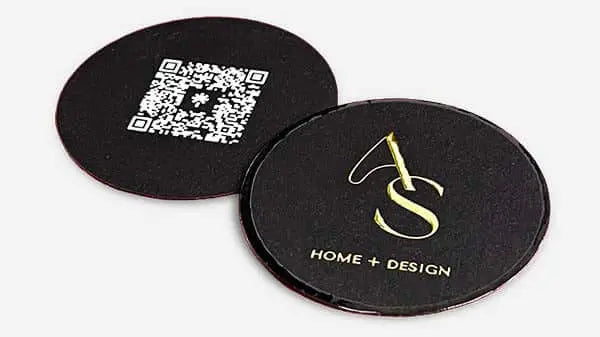
Creative industries tell a different story. Designers, photographers, and brand agencies sometimes choose custom sizes to communicate originality. A square card, a mini card, or an oversized format can say “we think differently” before a single word is read. But there is a tradeoff. A card that does not fit a wallet is a card that gets left on a table.
Here are the key ways size shapes perception:
- Familiarity builds trust. Standard size feels professional and expected in formal sectors.
- Novelty creates attention. Unusual sizes get noticed, but also get misplaced.
- Physical feel matters. Thicker or larger cards feel more premium, even at standard dimensions.
- Storage drives retention. Cards that fit holders get kept. Cards that do not often get lost.
The impactful card features that drive retention are not just about visuals. They include how the card behaves in the real world after the handoff.
Pro Tip: If you are in a traditional industry, use standard size and invest your differentiation budget in finish, material, or typography. That is where premium perception is built without sacrificing practicality. The must-have card elements that make a card memorable rarely depend on unusual dimensions.
Standard vs. custom: Pros, cons, and strategic considerations
Choosing between standard and custom card sizes is a strategic decision, not just a design preference. Both approaches have real advantages and real risks. Here is a side-by-side comparison:
| Factor | Standard (3.5 x 2 in) | Custom size |
|---|---|---|
| Wallet fit | Yes | Often no |
| Printing cost | Lower | Higher |
| Professionalism signal | Strong | Depends on execution |
| Memorability | Moderate | High (if done well) |
| Risk of being discarded | Low | Higher |
| Industry fit | Finance, law, consulting | Creative, design, hospitality |
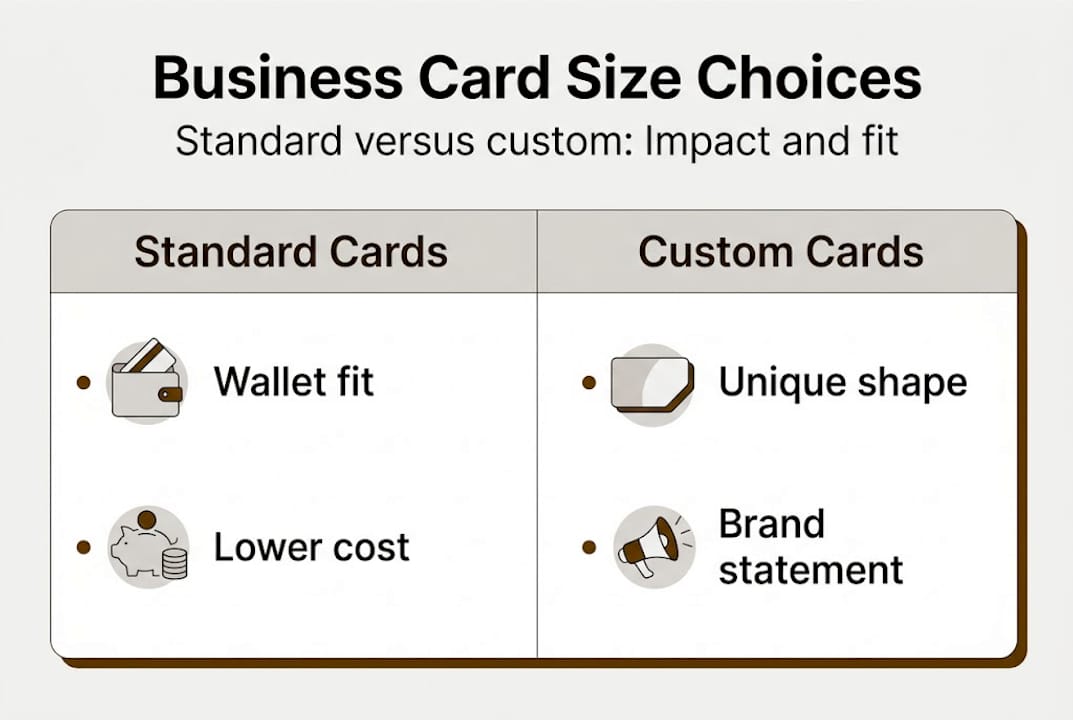
As noted, standard cards signal professionalism while custom formats can feel innovative but risk friction with recipients.
Standard cards work best when:
- Your audience expects professional norms
- Cards will be exchanged at formal events or meetings
- You want lower print costs with reliable compatibility
- Your brand story is told through design, not format
Custom sizes work best when:
- Your brand is built around creativity or disruption
- The unusual format reinforces your core message
- You are prepared for higher production costs
- Your audience will appreciate the novelty, not be annoyed by it
Some business card formats used by luxury brands lean into oversized or square formats to signal exclusivity. Clear card options are another example where material and format combine to create a strong impression without necessarily changing dimensions. If you want to design a unique card that stands apart, the format is one tool, but not the only one.

Common pitfalls: What happens when size goes wrong
A poorly sized card is not just a missed opportunity. It can actively hurt your brand. Here is what goes wrong when size decisions are made without strategy.
Oversized cards feel awkward to hold and impossible to store. Recipients do not know what to do with them. They end up on desks, in bags, or in the trash. Undersized cards feel flimsy and easy to lose. Neither extreme communicates confidence.
Non-standard cards also create friction at the moment of exchange. If someone has to pause and figure out where to put your card, that pause breaks the flow of a conversation. That is the opposite of what a business card should do.
Here is a checklist to avoid common sizing errors:
- Confirm dimensions before printing. Always verify your file is set to 3.5 x 2 inches with proper bleed (typically 0.125 inches on each side).
- Test physical fit. Print a prototype and put it in a real wallet or card holder before ordering a full run.
- Check your industry norms. Research what your competitors and peers use. Deviation should be intentional.
- Consider the event context. Cards handed out at trade shows face different storage conditions than cards exchanged in one-on-one meetings.
- Review your design at actual size. On screen, cards look larger. Print a test sheet and review at true scale.
Pro Tip: Know what not to put on a card before you finalize your layout. Overcrowding a standard-sized card with too much information is just as damaging as choosing the wrong size.
Over 90% of US cards use the credit card-sized 3.5 x 2 inch standard for a reason. Compatibility is not a limitation. It is a feature. When you invest in card design, the format should support the design, not compete with it. Review professional card design steps to make sure every element works together.
Choosing the right size for your brand strategy
Now that you understand the risks and rewards, here is a practical framework for picking the right card size.
Start with your industry. Finance, legal, medical, and corporate sectors expect standard sizing. Showing up with an unusual card in these environments can signal carelessness rather than creativity. In contrast, design studios, event companies, and lifestyle brands have more flexibility.
Next, think about your audience. Will they be storing your card in a wallet, a binder, or a card holder? If the answer is yes to any of those, standard size is your safest bet. If your audience is likely to pin your card to a board or keep it as a keepsake, custom formats have more room to shine.
Consider these factors when making your decision:
- Industry expectations. What does your sector consider normal?
- Audience behavior. How will recipients store or use your card?
- Brand personality. Does your brand lean traditional or disruptive?
- Budget. Custom sizes cost more to produce and may require specialty finishing.
- Event context. Formal meetings vs. creative networking events call for different approaches.
As a rule, choosing a card size should balance stand-out style with practical compatibility for your industry. A card that sets your brand apart does not need to be a different size. It needs to be better designed, better finished, and more intentional than the competition.
A fresh perspective: When the rules of card size are meant to be broken
Here is something most articles will not tell you. Breaking the standard size rule can work brilliantly, but only when the format serves a clear purpose. Doing it just to be different is not a strategy. It is a gamble.
We have seen brands use square cards, oversized cards, and even folded formats to great effect. In every successful case, the format reinforced something specific about the brand. A square card for a brand built around symmetry and balance. An oversized card for a luxury product where the extra space conveyed generosity. The format was not the idea. It supported the idea.
The brands that get this wrong choose unusual sizes because they think it will make them memorable. Sometimes it does. But more often, the card ends up in a pile of “interesting” cards that never get followed up on. Memorable is not the same as useful.
Our honest take: lead with strategy, not novelty. If you can articulate exactly why your card needs to be a different size, and that reason connects to your brand message, go for it. If the answer is “because it looks cool,” reconsider. Unique card approaches work when they are grounded in purpose, not impulse.
Create business cards that stand out and fit your brand
You now have a clear picture of how card size affects perception, practicality, and brand strategy. The next step is putting that knowledge to work.
At BcardsCreation, every card is designed individually, with no templates and no automated editors. We work with you to match format, material, and finish to your brand goals. Whether you want a custom business card design that stays within standard dimensions or you are ready to explore luxury creative card options with specialty finishes, we handle the strategy and production from start to finish. Browse all card options and find the format that fits your brand.
Frequently asked questions
Why does business card size make such a difference?
Standard cards fit wallets and are kept more often, which directly affects how many connections you actually maintain after a networking event. Size shapes perceived professionalism and determines whether your card survives the first 24 hours.
What is the standard business card size in the USA?
The standard US size for business cards is 3.5 x 2 inches, which matches credit card dimensions and fits standard wallets and cardholders.
Are custom-shaped or sized business cards a good idea?
Custom cards are innovative but risk friction because they often do not fit standard holders, making them easier to misplace or discard. They work best when the format directly supports a clear brand message.
How do I choose the best card size for my business?
Match your industry’s expectations, think about how recipients will store your card, and balance sector norms with your brand personality to make a practical and strategic choice.


